
Feb 27, 2026
Getting planning permission wrong is a seriously expensive mistake. You will need it for most big changes to your home, but many smaller projects can be built without asking the council first under rules called Permitted Development.
Knowing the difference before you start is the best way to avoid wasting thousands of pounds and months of your time.
Avoid the Costly Mistake of Guessing on Planning Rules
Figuring out when you need planning permission can be confusing. The rules are full of jargon. But ignoring them can lead to painful and expensive problems. A simple error, like miscalculating your extension size by a few centimetres, could be enough for the council to refuse your plans.
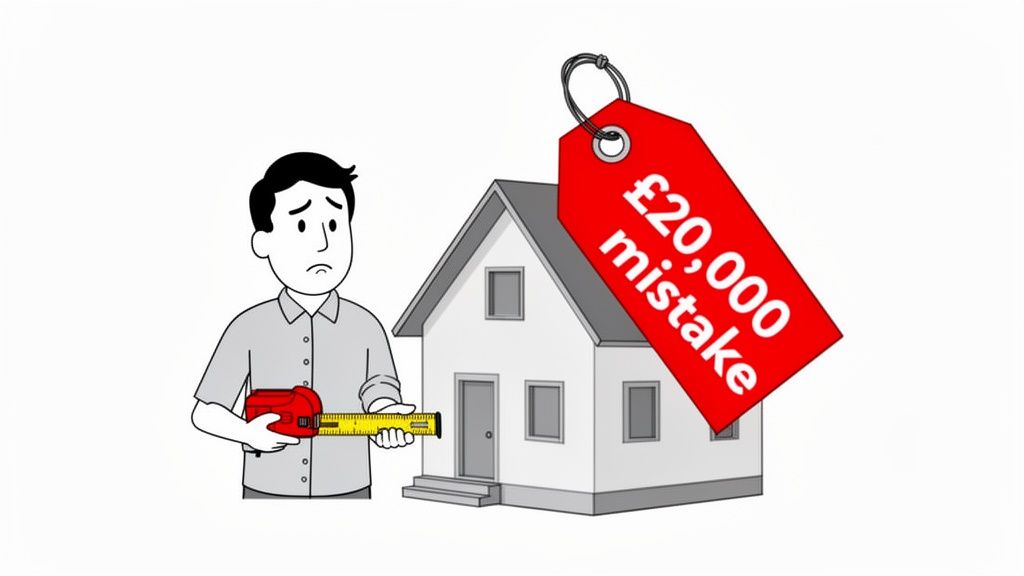
This is not a minor setback. It means you have wasted money on architect fees. You have thrown away a non refundable application fee, which is often over £200. You have also lost months to delays. In the worst case, the council can serve an enforcement notice. This forces you to tear down your new work at your own expense.
The total cost for getting it wrong can easily pass £20,000.
Understand Your Starting Point
To avoid this outcome, you need to understand the two main paths for any home improvement project in the UK. Your project will fall into one of these two categories.
Permitted Development: These are pre approved building rights from the government. You can make certain changes to your home, like a small rear extension or a loft conversion, without needing to ask the council for permission. But these rights come with very strict size and design limits. See our planning application process FAQs for how the application itself works.
Full Planning Permission: You must submit a formal application to your local council if your project is too big or does not meet the tight criteria for Permitted Development. This is a more involved process. Planners will review your project’s impact on your neighbours and the local area.
Getting this first decision right is crucial. It affects your budget, your timeline, and your chances of success.
Why Guessing Is So Risky
Many homeowners assume their project will be fine. They only find out it is not when it is too late. The planning system is not just a set of national rules. Local policies and your property's history can completely change what is allowed.
The stakes are high for every application. Guessing whether your plans will be approved is a gamble you cannot afford, especially when a refusal means losing both time and money.
Thousands of homeowners face this reality every year. In 2023, 688,151 planning applications were submitted across the UK. The national approval rate is around 81%. This means over 130,000 projects were rejected by councils. You can learn more about UK planning application approval rates from recent data.
Understanding the system from the start protects your savings. It gives your project the best possible chance of being a success, not another costly statistic.
Your Right to Build Without Asking for Permission
You can carry out many popular home improvements without a full planning application. This is thanks to Permitted Development Rights. These are a pre approved list of projects the government allows homeowners to build without first asking the local council. Understanding these rights can save you months of waiting and hundreds of pounds in fees.
Think of Permitted Development as a pass for building. But this pass has very strict conditions. If your project fits perfectly within these national rules, you can often start without a formal application. This is why knowing the specific limits for your property is so important. It gives you the confidence to plan a project that avoids the time consuming planning process.
What Can You Build Under Permitted Development?
The rules cover a range of common projects. The allowed size and scale depend on your type of house and where it is. A terraced house, for example, has a much smaller allowance for a loft conversion than a detached one.
Here are a few typical projects that often fall under these rights:
Single Storey Rear Extensions: The classic way to create a larger kitchen diner or living space.
Loft Conversions: A great way to add a new bedroom or home office in your roof space.
Garden Rooms and Outbuildings: Building a home office, gym, or workshop in the garden.
Porches: Adding a small, practical porch to the front of your property.
These rights were designed to let homeowners improve their properties without overwhelming local councils with applications for minor works. But the details are critical. If you get them wrong, you could face an enforcement notice ordering you to tear your work down.
Know the Specific Limits for Your Project
The most common mistake is misunderstanding the precise size limits. A few centimetres can be the difference between a legal build and an expensive error.
For instance, the size of a loft conversion you can build under Permitted Development is measured in volume. For a terraced house, you are generally allowed to add up to 40 cubic metres of new roof space. For a semi detached or detached house, this increases to 50 cubic metres. You must include any previous roof extensions in that calculation.
It is the same for extensions. A single storey rear extension on a detached house can typically extend up to four metres from the original rear wall. For a terraced or semi detached house, this is usually limited to three metres. These limits are hard rules, not suggestions. Our guide to permitted development rules for extensions covers these specific measurements in more detail.
Even when you do not need formal permission, getting proof that your project is lawful is a smart move. It protects you from future disputes and provides peace of mind when you sell your home.
Here is a brief overview of some common projects to help you get a quick sense of the rules.
Common Permitted Development Limits at a Glance
A quick reference guide showing the size and placement rules for popular home improvements. Always check these before you start planning.
Project Type | Key Limit for a Terraced House | Key Limit for a Detached House | Main Restriction to Watch For |
|---|---|---|---|
Single-Storey Rear Extension | Up to 3 metres deep | Up to 4 metres deep | Can't cover more than 50% of the original garden area. |
Loft Conversion | Up to 40 cubic metres volume | Up to 50 cubic metres volume | The extension cannot be higher than the highest part of the roof. |
Garden Room/Outbuilding | Max height 2.5 metres near boundary | Max height 2.5 metres near boundary | Cannot be built in the front garden. |
Porch | Up to 3 square metres area | Up to 3 square metres area | Must be at least 2 metres from any boundary with a highway. |
Remember, this table is just a starting point. The official guidance is detailed. Local restrictions like conservation areas can change everything.
Get Official Proof with a Lawful Development Certificate
So how do you prove your project is legal, even if it fits all the Permitted Development rules? This is where a Lawful Development Certificate (LDC) is useful. It is not the same as planning permission. It is official confirmation from your council that your project was lawful and did not need permission.
Applying for an LDC is a simpler and cheaper process than a full planning application. It typically costs about half the price. You submit your plans to the council. They then issue a formal legal document confirming your project is compliant. This certificate is very valuable if a neighbour complains or when you sell your property. It removes any doubt about the legality of the work. It is the best way to get concrete proof that your home improvement is fully compliant.
When You Must Get Full Planning Permission
Your plans for a bigger home might be larger than the rules of Permitted Development allow. That is fine, but it means you must now apply for full planning permission.
Understanding what requires a full application is crucial. It stops you from wasting time and money on a project that has no chance of being approved. Knowing these rules helps you shape your plans for a smoother process. This can save you the headache of a council refusal later.
This flowchart shows the basic decision process.
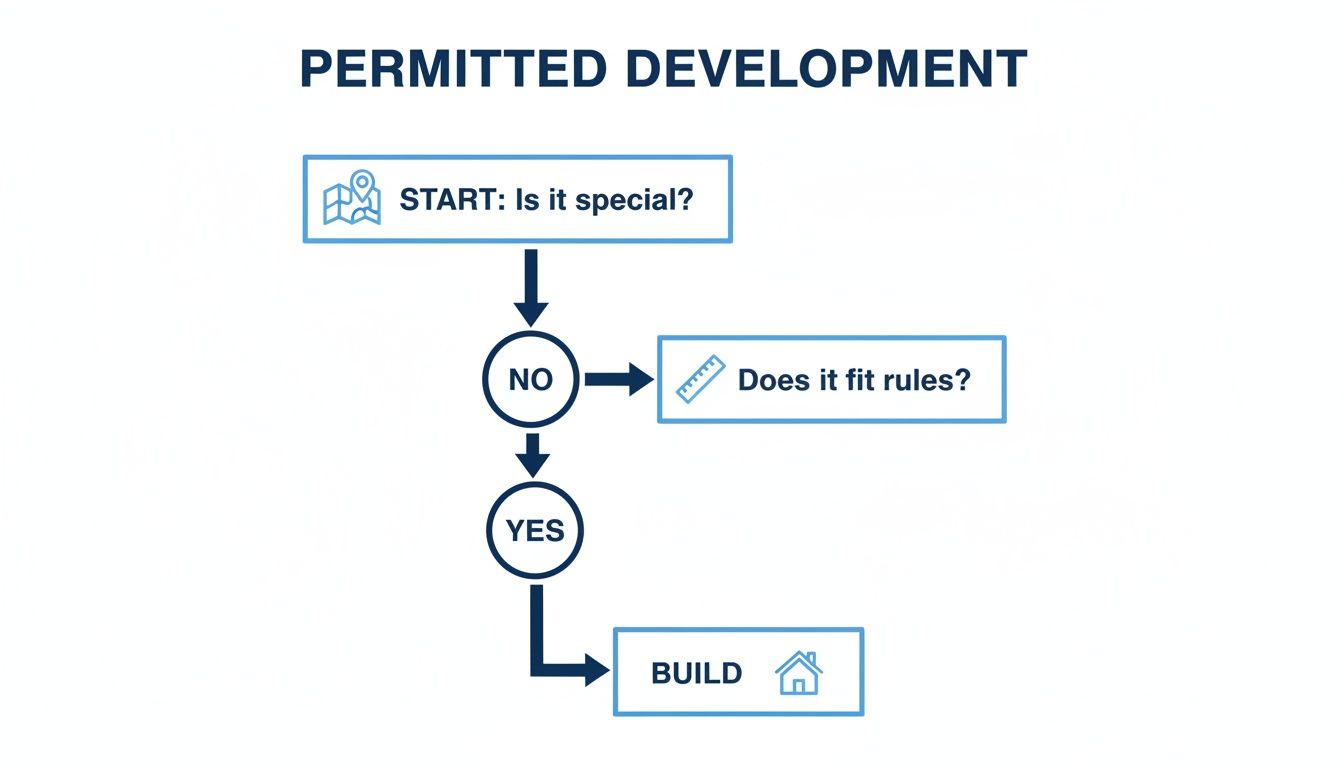
The main point is simple. Permitted Development is your first check. If your project does not meet all its requirements, you automatically need full planning permission.
Key Triggers for a Full Planning Application
Some projects are almost guaranteed to need full planning permission. They are too big or have too much impact to be covered by the government's pre approved list. If your plans involve any of the following, you must submit a formal application.
These are the most common project types that fall outside Permitted Development:
Two Storey Side Extensions: Adding a second floor to a side extension always needs planning permission.
Front Facing Extensions: Anything built forward of the main front wall of your house requires permission. This rule protects the character of the street.
Wrapping Around Your House: An extension that goes beyond both the side and the rear of your home is not allowed under Permitted Development.
Exceeding Height Limits: Building anything higher than your existing roofline requires a full application.
Covering Too Much Land: You will need permission if your planned extension, combined with any sheds or outbuildings, would cover more than 50% of your garden.
These are hard limits, not just guidelines. Pushing past them without approval will likely lead to an enforcement notice from your local council.
What the Council Considers
When you submit a full planning application, the council's focus changes. They are no longer just checking measurements. They will now take a more subjective look at your project's overall impact.
Their job is to balance your dream of improving your home against the interests of your neighbours and the wider community. A planning officer will check your plans against several key criteria. Knowing these criteria gives you a huge advantage. You can fix potential issues in your design before you apply.
They will primarily look at:
Impact on Neighbours: This is often the most important factor. They will consider if your extension will block sunlight from a neighbour's window. They will check if it creates an overbearing sense of enclosure or lets you look into their private garden.
Design and Appearance: Your project needs to look right. It should fit with the style of your house and the character of the local area. The materials you choose, the shape of the roof, and the style of the windows will all be reviewed.
Local Planning Policies: Every council has its own rulebook, known as the Local Plan. These documents set out specific rules on everything from parking spaces to protecting trees. Your application must follow these local rules.
Thinking about these factors from day one is the smartest way to design a project the council is more likely to approve. This can save you the £258 fee for reapplying after a refusal.
Navigate Special Rules for Your Property
Another layer of rules can appear just when you think you understand Permitted Development. If your property has a special designation, many of the standard rules no longer apply. Getting this wrong can lead to serious legal and financial problems. Checking your property’s status before you plan anything is critical.
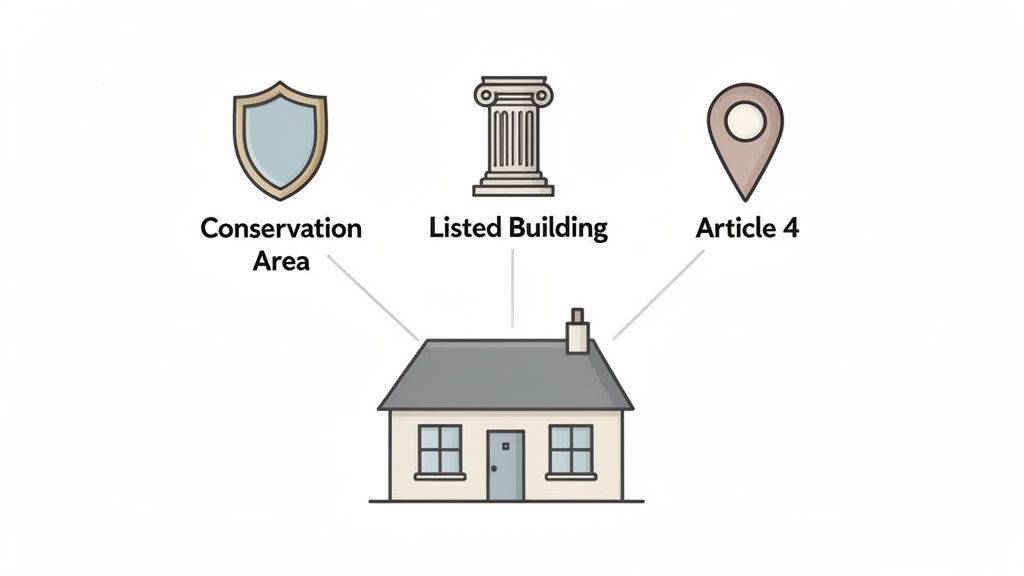
These designations limit your normal building rights. They exist to protect areas or buildings with special architectural or historic interest. This means even small changes might need formal consent. Finding out if your home is affected is the most important step to avoiding a costly mistake.
Conservation Areas and Your Project
If your home is in a Conservation Area, your Permitted Development Rights are significantly reduced. These areas are protected because of their special character. The council’s job is to preserve that unique look and feel.
This means projects that are usually fine elsewhere will almost certainly need planning permission here. For example:
Replacing Windows: You will often need permission to change windows, especially if the new ones are not a like for like match in material and style. UPVC is frequently refused.
Cladding: Adding render or cladding to the outside of your house is very unlikely to be allowed without permission.
Side Extensions: Most side extensions of any size will require a full planning application.
Roof Alterations: Even minor changes to your roof, like adding a rooflight, can require permission.
The aim is to stop small changes that, over time, would damage the character of the neighbourhood.
The Strictest Rules for Listed Buildings
Living in a Listed Building puts your property in the highest tier of protection. These buildings are on a national register because of their exceptional importance. The rules for altering them are incredibly strict.
You will need to apply for Listed Building Consent for any work that could affect the building's historic character, inside or out. This is a separate and often more demanding process than standard planning permission. It covers the interior of the property too.
Trying to replace an internal door, altering historic plasterwork, or repainting a significant feature without consent is a criminal offence. The penalties are severe, including unlimited fines and even imprisonment.
It is a myth that getting consent for a listed building is nearly impossible. The process is more detailed, but data shows that sensitive applications have a very high chance of success.
The process is more successful than many people think. Historic England reported that around 25,600 Listed Building Consent decisions were made in 2023/24. A remarkable 92% of these were granted. This is a higher approval rate than for general planning permission. You can learn more about these planning findings on the Historic England website.
What Is an Article 4 Direction?
The final special rule to know is an Article 4 Direction. This is a tool a local council can use to remove specific Permitted Development Rights in a certain area. They are often used to control changes that could damage the local character.
An Article 4 Direction might, for example, remove your right to:
Convert a house into a small House in Multiple Occupation (HMO).
Change windows or doors on the front of your house.
Build a porch without permission.
Paint the exterior of your house a different colour.
These directions are very specific. They do not remove all your rights, only the ones named in the direction. They are most common in Conservation Areas but can be applied anywhere the council feels is necessary. It is essential you check your council’s website to see if one applies to your home.
Check Your Chances Before Spending Money
Do not gamble your savings on guesswork. You can take practical steps to see if your project is likely to be approved before you commit thousands of pounds to an architect. These early checks can save you from a costly refusal and give you the confidence to move forward.
The government's official Planning Portal is a useful starting point for most homeowners. It helps you understand the national rules and has general guidance.
This screenshot shows the homepage of the UK's Planning Portal, a resource for homeowners.
But the Planning Portal only tells you the general rules. It cannot tell you what gets approved or refused on your specific street.
Look Beyond the National Rulebook
To understand your chances, you need to see what your local council is approving in your neighbourhood. This is where the real insight is. National rules are the foundation. But local decisions will determine if your project succeeds.
Every council has a public register of planning applications on its website. This is a searchable database of every application submitted. By looking at projects similar to yours on nearby streets, you can see clear patterns.
This is not about becoming a planning expert. It is about gathering real world evidence to shape your plans.
Learn from Your Neighbours' Successes and Failures
Imagine you want a loft conversion. A search on your council's planning register might show that three neighbours have had loft conversions approved in the last two years. That is a strong positive signal.
But then you see one that was refused. You open the decision notice. The reason given was that the dormer was "excessively bulky and out of character". This is very valuable information. It tells you exactly what to avoid in your own design.
Finding just one similar refusal in your area is more useful than reading ten pages of generic government guidance. It provides a clear, evidence based warning of what your council is likely to reject.
This local research helps you build a strong case for your project. You can move forward knowing your design is based on what has already been successful, not just what you hope will be acceptable.
A Practical Checklist for Your Initial Research
Work through these steps before you spend any money on drawings. This process takes some time but could save you thousands.
Visit the Planning Portal: Use their interactive guides to get a basic idea if your project falls under Permitted Development.
Find Your Local Council's Website: Search online for "[Your Council Name] planning search" to find their public register.
Search Your Street and Postcode: Look at the planning history for your house and your immediate neighbours.
Broaden Your Search: Look for similar projects like "single storey rear extension" or "loft conversion" within a quarter mile radius over the last three to five years.
Analyse the Results: Note the addresses of successful projects. More importantly, read the "Decision Notice" for any refusals to understand why the council said no.
This process gives you a clearer picture of your local planning landscape. A tool like our planning permission checker can speed this up by analysing local data to give you an initial confidence score. This evidence allows you to have a more productive conversation with your designer and proceed with your eyes open.
What Is the Next Step for Your Project?
You now understand the core rules and what can go wrong. You are in a position to make a smart, evidence based decision instead of just hoping for the best.
This is your game plan. Your project will likely fall into one of three paths. Figuring out which path is yours is the key to avoiding wasted time, money, and the stress of a refusal.
Route 1: Proceed with Permitted Development
If your checks confirm your project fits within Permitted Development rights and your property has no special restrictions, you can move forward. Your main priority now is to document it.
Action: Apply for a Lawful Development Certificate (LDC). This is not planning permission. It is official confirmation from the council that your project is legal. It will protect you from future disputes and makes things simpler when you sell your home.
Route 2: Tweak Your Design for a Full Application
It turns out you need full planning permission. Do not worry. The research you have done is now your most valuable asset. The evidence from nearby successes and failures gives you a powerful advantage.
Action: Look at the reasons for local refusals and use them to improve your own design. If nearby extensions were rejected for being "overbearing," consider a smaller footprint or a lower roofline. This approach lets you design out problems before the council sees your plans. You can learn more in our guide to pre planning application advice.
Route 3: Re-evaluate Your Project's Scope
Sometimes the evidence points to a difficult process. It is better to know now if similar projects are consistently refused or if your property's special designation makes approval a long shot.
Acknowledging that your grand plan might not be approved is not a failure. It is a smart financial move that saves you from a near certain refusal and lets you pivot to a project that can actually happen.
Action: Step back and re-evaluate your goals. Could a smaller extension under Permitted Development still meet your needs? Is there an alternative design that avoids the issues you have seen in local refusals? This early rethink stops you from throwing good money after bad on a project destined to fail.
Got a Few Questions?
We get asked about planning permission all the time. Here are some quick, straightforward answers to the most common questions.
How Long Does Planning Permission Take?
Most straightforward applications should be decided within eight weeks. But many local councils have backlogs, so delays are common. This is why it pays to submit a solid application that is likely to be approved the first time. You do not want to get stuck in a long queue.
What Happens if I Just Build it Anyway?
This is a risk you do not want to take. If you build something that needs permission without getting it, the council can serve you with an enforcement notice. In a worst case scenario, this legally requires you to tear the whole thing down at your own expense. It will also cause major problems when you try to sell your property.
An enforcement notice from the council is not a small penalty. It is a legally binding order that can turn your dream project into a demolition site, leaving you thousands of pounds out of pocket.
Can I Ask the Council Before I Apply?
Yes, you can. Most councils offer a paid service called 'pre application advice'. It can be a good way to get an informal opinion on your plans before you commit to a full application. The downside is this service can cost a few hundred pounds and it often takes weeks to get a response. Knowing your local planning history first helps you make the most of this expensive conversation.
Does Planning Permission Expire?
Yes, it does. If your application is approved, you are normally given three years from the date of approval to start the building work. If you do not start within that timeframe, the permission expires. You will have to submit a brand new application. This rule ensures projects are built under current local policies, not old ones.
Before you commit thousands to architects and application fees, get the evidence you need to move forward with confidence. SurePlan provides a Planning Confidence Report that analyses recent, local planning decisions to show you what gets approved in your specific area. Avoid costly mistakes and make smarter decisions from day one. Learn more about making confident planning decisions.