
Feb 13, 2026
Building an extension without getting planning permission first can save you thousands of pounds and months of waiting. A government scheme called Permitted Development Rights gives you a way to do this legally. This guide explains the rules so you know what you can build and how to avoid a £258 refusal fee or a demolition order from the council.
Build an Extension Without Full Planning Permission
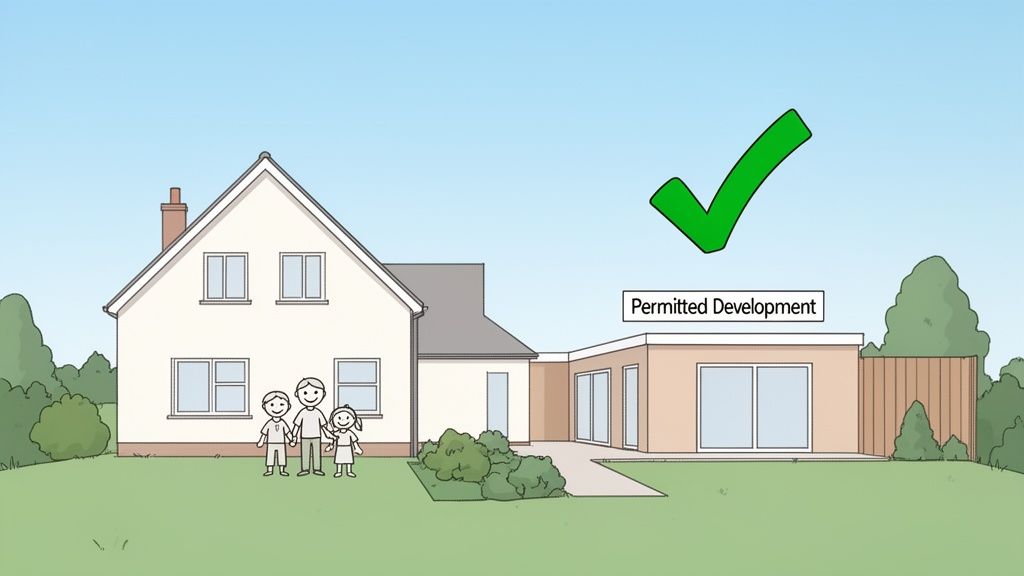
Applying for planning permission is a gamble. You can spend thousands on architect's drawings and application fees. Then you wait for months for a council decision that might be a 'no'. A refusal stops your project. It can also cost you the non refundable application fee, often over £258 in England.
Permitted Development Rights remove this uncertainty. The government created these rules to make it easier, faster, and cheaper for you to improve your home. Your plans just need to stay within specific limits.
Why These Rules Matter to You
Understanding the permitted development rules for extensions is the first step to avoiding expensive mistakes. If you get it wrong, the council could force you to tear down your new extension at your own expense.
Knowing these rules gives you clarity and control from the start. It helps you:
Save Money: Avoid the fees for a full planning application.
Save Time: Skip the typical 8 to 12 week wait for a planning decision.
Reduce Risk: Know your project is compliant before you commit to building costs.
These rights help you add value and space to your property with less hassle. But the system has strict conditions to protect your neighbours and the local area.
Who Can Use Permitted Development
These rights usually apply to houses but not to flats or maisonettes. The rules are also stricter in 'designated areas' like Conservation Areas. Sometimes a council uses an 'Article 4 Direction' to remove these rights on a specific street.
For a deeper dive into the differences, you can learn more about permitted development vs planning permission and how they compare.
It is critical to confirm that your property has these rights before you plan any work. This guide explains the key rules you need to know. It will help you understand what you can build and how to do it safely.
The Critical Measurements You Must Know
Designing an extension that breaks the measurement rules is an easy way to get a rejection from the council. These rules are not guidelines. They are strict limits.
Getting them right from the start means you can plan with confidence. You avoid wasting money on designs that will fail.
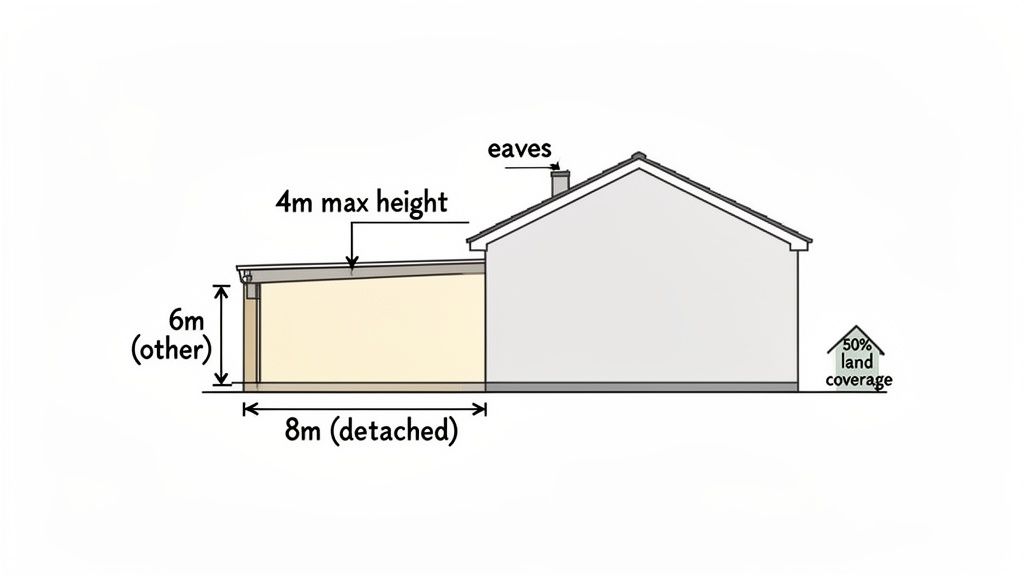
The rules focus on three key areas: how far your extension projects, its maximum height, and how much of your garden it covers. Let's break down these numbers so you know what is possible for your home.
How Far Can a Rear Extension Project?
This is often the first question homeowners ask. The answer depends on your house type. For a single storey rear extension, the limits are measured from the rear wall of the original house.
For detached houses, you can build out by up to 4 metres. You can extend up to 8 metres under permitted development, but this requires a process called Prior Approval.
For all other houses (like semi detached or terraced), the limit is 3 metres. If you want to go up to 6 metres, you will also need to use the Prior Approval route.
This system fast tracks smaller projects. It gives larger ones a simple review. The rules for larger extensions were made permanent in 2020. This gives homeowners a clear path to add significant space without a full planning application.
Here is a simple breakdown for a quick reference.
Single-Storey Rear Extension Limits At A Glance
House Type | Maximum Extension Depth | Maximum Height |
|---|---|---|
Detached House | 4 metres (or up to 8 metres with Prior Approval) | 4 metres |
Semi-Detached House | 3 metres (or up to 6 metres with Prior Approval) | 4 metres |
Terraced House | 3 metres (or up to 6 metres with Prior Approval) | 4 metres |
These figures give you a solid starting point for your project.
Height Restrictions You Cannot Ignore
Height is another factor councils check closely. If your extension is too tall, it will automatically need a full planning application.
The maximum height for a single storey rear extension is 4 metres. But a crucial detail often causes problems. The height of the eaves (where the wall meets the roof) cannot be more than 3 metres if any part of your extension is within 2 metres of a boundary. This rule protects your neighbours' access to light. It stops your build from feeling too imposing.
Imagine a pitched roof on your extension. The peak can reach 4 metres. But the sides must be below 3 metres if you build close to a fence.
Getting the eaves height wrong is a common mistake. It is a frequent reason for enforcement action from a council. This small detail can have expensive consequences if you are forced to alter your completed build.
The 50 Percent Garden Rule
This simple rule catches many people out. Your extension, along with any sheds or other buildings, cannot cover more than 50% of the land around your original house.
The "original house" means the house as it was first built, or as it stood on 1 July 1948 if it is older. Any extensions built by previous owners count towards your 50% limit. This rule stops gardens from being completely built over. It preserves green space and prevents overdevelopment.
To check this, you need two figures:
The total area of your garden and any other land around the house.
The total footprint of all existing and proposed buildings (but not the original house itself).
If the second number is more than half of the first, your project will not qualify under permitted development. You can use our simple extension size checker to help you run these initial calculations. Understanding these three measurements is the foundation of a successful project.
How The Prior Approval Process Works
If you want a bigger extension, you may need to use a process called **Prior Approval**. This sounds like more bureaucracy. But it is a much simpler and faster route than a full planning application. It is a streamlined check, not a full review of your plans.
Prior Approval is a light touch review by your local council. They do not judge your design or choice of bricks. Their focus is on the impact your larger extension will have on your immediate neighbours.
You need to go through this process if your single storey rear extension is larger than the standard limits. This means it projects more than 4 metres from a detached house or more than 3 metres from any other house type.
What The Council Actually Checks
When you notify the council for Prior Approval, they use a short checklist. They only assess whether the "amenity" of your adjoining neighbours will be negatively affected.
In plain English, this usually means two main worries:
Loss of Light: Will your extension cast a large shadow over a neighbour’s window for a key room like a kitchen?
Overbearing Impact: Will the size of the extension feel overwhelmingly large from next door?
The council writes to your immediate neighbours. They have 21 days to raise objections on these specific grounds. If no one raises a valid concern, your project will likely get the green light.
The Prior Approval Timeline
The process is designed to be quick. Once you submit your notification, the council has a fixed 42 day period to make a decision. If you do not hear from them in that time, you can legally start building.
This speed is a major advantage over the full planning system. Statistics show it is a highly successful route for homeowners. In one three month period in 2023, there were 6,200 prior approval applications for larger home extensions. A huge 78% of them were approved. This shows how effective these rules can be.
A Prior Approval refusal is not the end of the road. It often happens because a neighbour raised a genuine concern about loss of light. This feedback is useful. It allows you to adjust your design, perhaps by reducing the length, and then try again.
Providing the right information from day one is the secret to a smooth process. You must provide basic drawings, a site plan, and your neighbours' addresses. Simple mistakes can cause delays or a refusal. For a complete walkthrough, you can learn more about the Prior Approval process for larger extensions in our dedicated article.
Rules for Side Extensions, Lofts, And Outbuildings
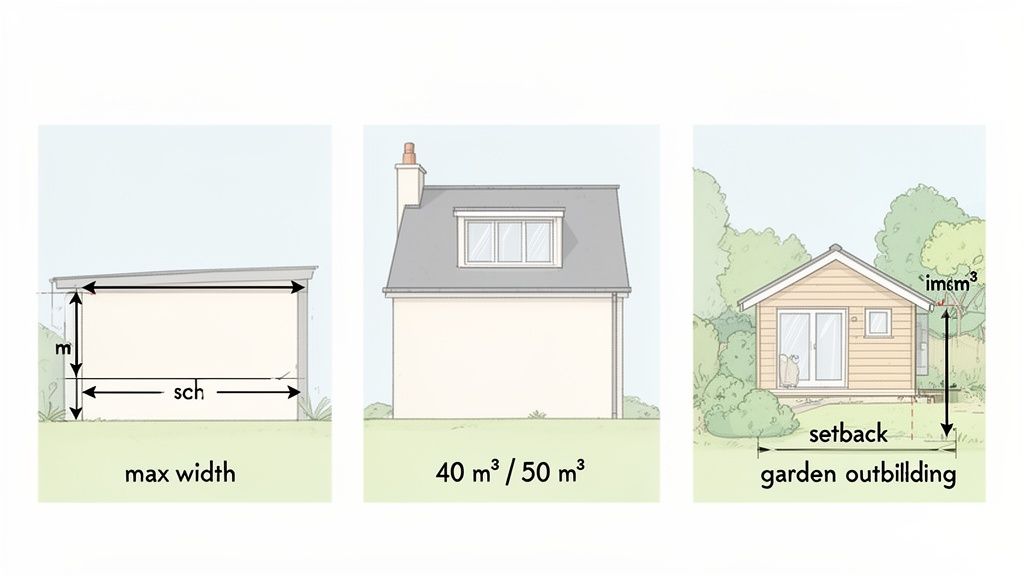
Permitted development also covers building out to the side, converting your loft, and adding outbuildings like a home office. Understanding these specific rules can unlock the full potential of your property.
Get these rules wrong and you could face expensive consequences. A mistake in measuring the width of a side extension can invalidate your project and lead to council enforcement action. Let's break down what you need to know.
Building a Side Extension
A side extension can create a wider kitchen or an open plan living area. Under permitted development, a single storey side extension has its own set of strict rules you must follow.
The most important rule relates to its width. Your side extension cannot be more than half the width of the original house. If your house is eight metres wide, your side extension can be a maximum of four metres wide.
Height is also critical. A side extension has a maximum height of four metres. The eaves height cannot exceed three metres if the extension is within two metres of a boundary.
Permitted Development Rules for Loft Conversions
Converting your loft is a cost effective way to add an extra bedroom. To do this under permitted development, your plans must stay within strict volume limits. Get this wrong and you will need to apply for full planning permission.
The key numbers to remember are the volume limits for any additions you make to the roof space.
For terraced houses, you can add up to 40 cubic metres of new volume.
For detached and semi detached houses, this limit increases to 50 cubic metres.
This volume includes any previous roof additions. If a former owner already added a small dormer, its volume counts towards your total allowance.
A common mistake is to only measure the new room's floor space. The council measures the total external volume of the addition. This includes the walls and roof structure, so the final figure is always larger than the internal room size.
Additionally, there are strict design rules. Any extension must not go higher than the highest part of your existing roof. Materials used on the exterior must look similar to the existing house. Side facing windows must be obscure glazed and non opening unless they are 1.7 metres above the floor.
What About Garages and Garden Rooms?
Permitted development rights also cover outbuildings like garden offices, gyms, and garages. These can be useful, but they have their own regulations to prevent them from affecting neighbours.
The rules change depending on where you place the building. If your outbuilding is within two metres of any boundary, it cannot be any taller than 2.5 metres. This single rule often decides the design and placement of a garden room.
If the building is more than two metres away from all boundaries, you have more flexibility. In this case, the maximum eaves height can be 2.5 metres, and the overall height can go up to:
4 metres for a dual pitched roof.
3 metres for any other type of roof, such as a flat roof.
Finally, outbuildings are also included in the 50 percent garden rule. All your sheds, garages, and extensions combined cannot cover more than half of the land around your original house.
Hidden Rules That Can Invalidate Your Project
Believing you have permitted development rights when you do not is one of the most expensive mistakes a homeowner can make. Certain "hidden" rules can remove these rights, putting you at risk of enforcement action from the council. In a worst case scenario, this means a demolition order forcing you to tear down your new extension.
Checking for these red flags before you spend money on drawings is critical. It gives you the clarity to choose the right path from day one. This saves you from wasted time, stress, and huge costs.
Why Your Property Might Not Qualify
Not every home automatically has these rights. Permitted development is designed for houses. The rules do not apply to flats, maisonettes, or apartments. If you live in one of these, you will always need full planning permission for external changes.
Even if you own a house, your local council can restrict or remove your rights. This usually happens for specific reasons to protect the character of an area. The problem is these restrictions are not always obvious. Checking your property's status is a crucial first step.
A costly mistake is assuming your house has permitted development rights just because your neighbour’s did. Local rules can change from one street to the next. You must verify the rules for your specific address.
This is the kind of local risk a SurePlan report is designed to spot. We check your council's data for any restrictions tied to your property. This gives you the evidence you need to proceed safely.
Designated Areas and Their Impact
Some parts of the country are considered special, so permitted development rights are automatically restricted. If your home is in a designated area, the standard rules often do not apply.
These areas include:
Conservation Areas: Historic areas where councils want to preserve a special character.
National Parks: Places like the Lake District, protected for their natural beauty.
Areas of Outstanding Natural Beauty (AONBs): Landscapes protected for what makes them special.
World Heritage Sites: Locations of outstanding international importance.
In these places, permitted development rights are severely reduced. For example, you cannot build any side extensions at all. Cladding your house is also not allowed. Rear extensions are still possible, but they have much stricter size and design rules.
The Power of an Article 4 Direction
Sometimes a council wants to control development in a specific place that is not a full conservation area. To do this, they can issue an Article 4 Direction. This is a legal tool that lets them remove specific permitted development rights for a street, a group of houses, or even a single property.
Councils often use Article 4 Directions in areas with a unique architectural style. For instance, if a whole street has original Victorian windows, the council might use an Article 4 to stop homeowners from swapping them for modern ones.
They can also use them to control extensions, porches, or even painting your house. The problem for homeowners is that these directions are not always well publicised. You might not know one applies to your home until an enforcement letter from the council arrives.
Finding out if your property is affected by an Article 4 Direction or is in a designated area requires a proper check of your local council's records. It is vital due diligence. Skipping it can invalidate your project before it starts, turning your dream extension into a planning nightmare.
Your Action Plan for a Successful Extension
You have a grasp of the rules. But putting theory into practice is different. To avoid expensive missteps, you need a clear action plan. This simple roadmap shows you what to check and when. It will make sure your project is built on solid ground from day one.
This flowchart gives you a quick visual rundown of the main things that can instantly remove your permitted development rights.
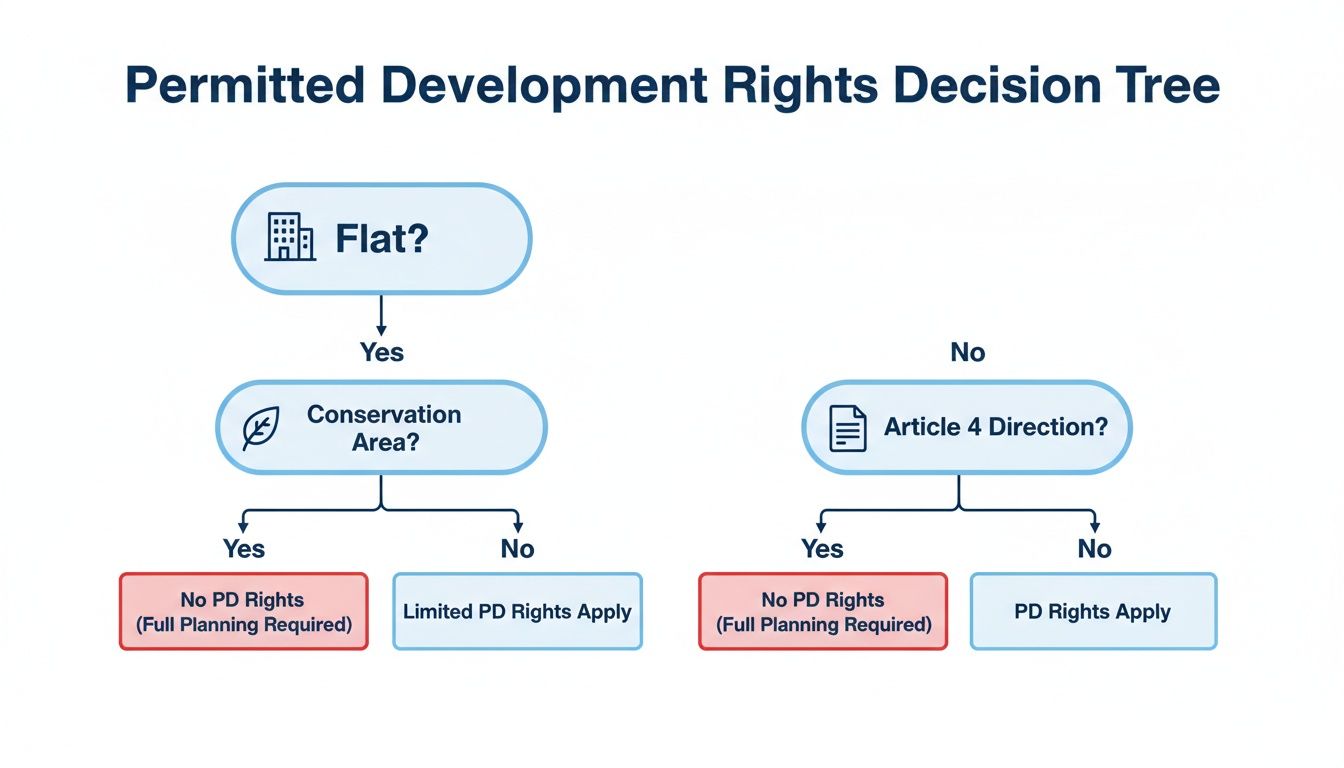
As you can see, your rights can disappear if you live in a flat, a conservation area, or a property with an Article 4 Direction.
First, Confirm Your Property's Status
Before you measure a single wall, you must confirm if your property has permitted development rights. Assuming you do is a massive gamble. If you get it wrong, you could face a planning refusal or a demolition order from the council.
You need to know for certain if you are in a designated area or if a hidden Article 4 Direction applies.
A SurePlan report removes the guesswork. We check your local council's data and give you hard evidence on any restrictions tied directly to your address. Knowing this upfront is vital before you start spending money on an architect.
Grab a Tape Measure
Once you confirm your property qualifies, it is time for basic measurements. This is a quick reality check to see if your ideas fit within the key limits.
Rear Extension Depth: How far can you build out? Is it 3 metres for a terraced home or 4 metres for a detached one?
Side Extension Width: Would the side extension be less than half the width of your original house?
The 50% Rule: Will your new extension, plus any existing sheds or garages, cover less than half of your garden?
These simple checks will quickly tell you if your project is feasible.
Decide on Your Next Move
With this information, you can decide on the best way forward.
If your plans are within the limits and you want absolute certainty, applying for a Lawful Development Certificate (LDC) is a smart move. It is an official document from the council confirming your project is legal. This is very valuable when you sell your home.
But if your project is more complex, or you feel unsure, now is the time to bring in a professional. Armed with your knowledge of permitted development rules, you can hire an architect and ask the right questions. This saves time and makes sure the design is compliant from the start.
Frequently Asked Questions
Even with a good grasp of the main rules, specific questions often arise. Here are straight answers to the queries we hear most from homeowners. Getting these details right can be the difference between a smooth project and a costly problem.
Do I Still Need Building Regulations Approval?
Yes, absolutely. This is a critical point. Permitted development rights and Building Regulations are two separate sets of rules.
Permitted development just means you do not have to ask for planning permission. It does not remove your duty to make sure the extension is built safely. Your project must still meet national standards for structural integrity, fire safety, and insulation. You must make a Building Regulations application to your local council or an approved private inspector before you start work.
Can My Neighbours Object to My Extension?
It depends on the size of your extension. If your plans fall within the smaller, standard permitted development limits, your neighbours do not have a formal right to object.
However, if you are planning a larger extension under the Prior Approval scheme, the council must consult your immediate neighbours. They get 21 days to raise any valid planning concerns, such as a serious loss of light. If their worries are legitimate, the council can refuse your application. It is always a good idea to have a friendly chat with your neighbours about your plans early on.
What Happens If I Build Without Permission?
Building an extension that does not comply with planning rules is a serious gamble. If your project breaks the permitted development rules, the local council can issue an enforcement notice.
This could force you to make expensive changes. In a worst case scenario, you could be ordered to demolish the entire extension at your own expense. This is why it is so important to confirm your rights and follow the rules exactly before you start building.
A Lawful Development Certificate (LDC) is your best defence against future enforcement action. It’s official proof from the council that your project was legal when it was built. It is invaluable for your peace of mind and essential when you eventually sell your house.
What Is a Lawful Development Certificate?
A Lawful Development Certificate (LDC) is an official document from your local council. It confirms that your proposed extension is lawful and does not need planning permission. It is not mandatory to get one, but it is highly recommended.
Think of it as an insurance policy for your build. It provides legal proof that you followed all the permitted development rules correctly. This certificate is very useful for answering questions from a buyer’s solicitor when you sell your property. It can prevent frustrating delays and problems later on.
Unsure if an Article 4 Direction or a conservation area affects your plans? The SurePlan report checks your local council's data for you, giving you the evidence you need to move forward safely. Get clarity on your project at https://www.getsureplan.co.uk.