
Jan 17, 2026
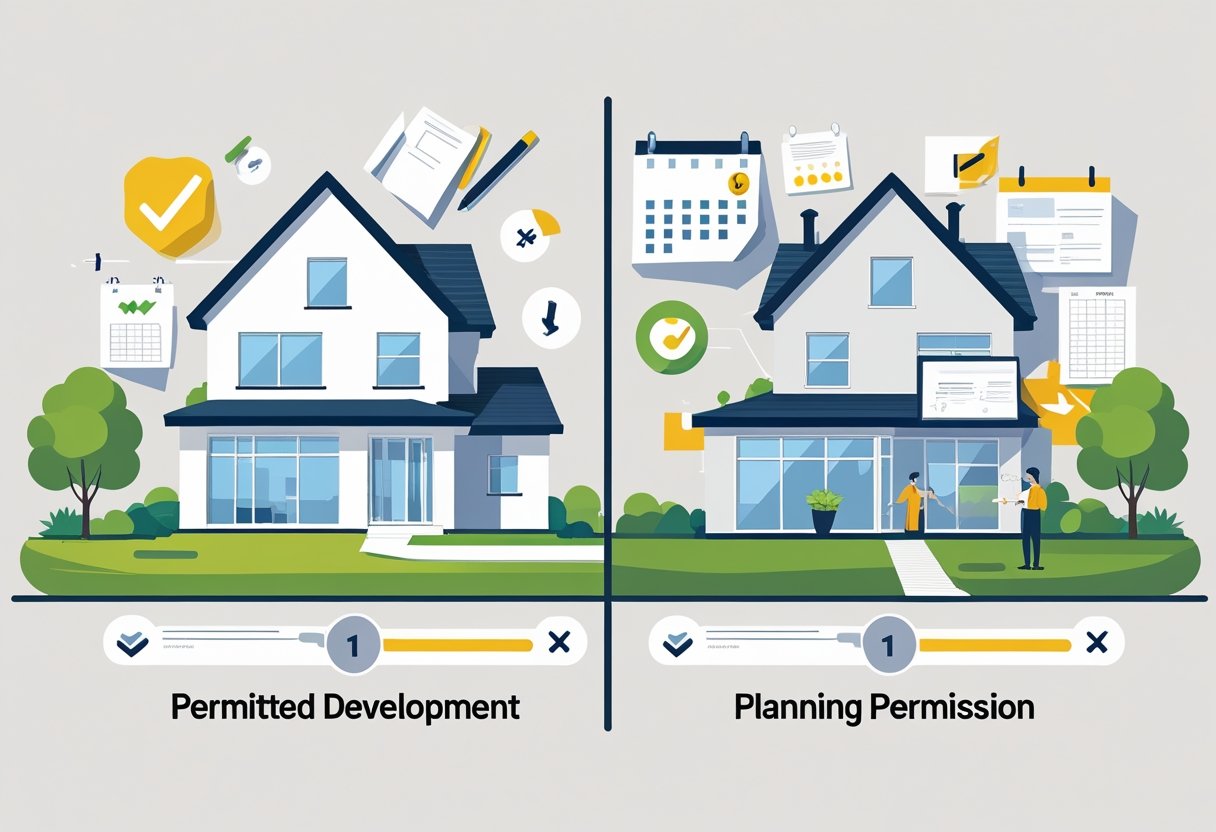
When planning a home extension, one of your first decisions is choosing between permitted development rights and a full planning permission application. Permitted development allows you to extend your home without applying for planning permission, provided your plans meet specific size limits and conditions set by government regulations. Planning permission, on the other hand, requires submitting an application to your local authority for approval and offers more flexibility for larger or complex projects.
The route you choose affects your timeline, costs, and what you can build. Permitted development is typically faster and less expensive because you avoid application fees and lengthy approval processes. However, it comes with strict rules about extension size, height, and location. Planning permission takes longer and costs more, but it lets you propose larger extensions or designs that fall outside permitted development limits.
Understanding which route applies to your project saves time and prevents costly mistakes. Making the wrong choice could mean delays, rejected applications, or even demolition orders. This guide explains the key differences between both routes and helps you determine which one suits your extension plans.
Key Takeaways
Permitted development allows certain home extensions without planning permission if you meet specific size and location rules
Planning permission is required for larger extensions or when permitted development rights don't apply or have been removed
Both routes require compliance with building regulations and may need legal documentation to prove your extension is lawful
Understanding Permitted Development and Planning Permission
These two routes represent fundamentally different approaches to authorising home extensions. Permitted development rights allow you to build without formal approval, whilst planning permission requires your local authority to assess and approve your plans.
Key Definitions and Concepts
Permitted development rights are pre-approved allowances that let you build certain extensions without applying for planning permission. If you own a house, you likely already have these rights attached to your property. The General Permitted Development Order sets out the specific rules and limitations for what you can build.
Planning permission is formal approval from your local planning authority. You submit detailed plans, and they assess whether your extension complies with their planning policies. This route involves more scrutiny but offers greater flexibility for larger or more complex projects.
Not all properties have permitted development rights. Flats and maisonettes don't qualify. Properties in conservation areas, national parks, or areas of outstanding natural beauty face restrictions. Your rights may also be removed through an Article 4 Direction or conditions on previous planning approvals.
How Each Route Regulates Extensions
Permitted development operates on strict, black-and-white criteria. Your extension either meets the legal requirements or it doesn't. There's no room for negotiation or interpretation. You typically don't need to submit an application, though you may need to notify the council for larger projects.
Planning permission involves subjective assessment. Your local authority reviews your application against their planning policies, which can be interpreted differently depending on your specific circumstances. They consider factors like impact on neighbours, design quality, and the character of the surrounding area.
The key difference lies in control. With permitted development, you're informing rather than asking. With planning permission, you're requesting approval and accepting the possibility of refusal.
Permitted Development: Scope and Rules
Permitted development rights allow you to extend and improve your home without full planning permission, provided you stay within specific limits for size, height and location. These national rules cover common projects like single-storey rear extensions, loft conversions and outbuildings, but strict measurements and conditions apply to each type of work.
What Home Extensions Qualify
Single-storey rear extensions represent the most common type of permitted development work. You can extend up to 6 metres for detached houses and 8 metres under the larger home extension scheme, though the standard limit is 3 metres for terraced or semi-detached properties.
Side extensions also qualify under PD rights, but they must not exceed half the width of the original house. The extension cannot project beyond the front of your property (the principal elevation).
Loft conversions with dormer windows fall under Class B, allowing you to add up to 40 cubic metres of space for terraced houses or 50 cubic metres for detached and semi-detached properties. Wraparound extensions that combine rear and side elements may qualify if each component meets the relevant criteria separately.
Garage conversions typically benefit from PD rights since you're working within your existing structure. However, you'll still need to check other restrictions apply.
Limits on Size, Height and Location
Your extension cannot exceed the height of the highest part of your existing roof. The eaves height must also match or stay below the existing eaves line.
The 50% rule governs all building work within your curtilage. This means all buildings combined, including your extension, outbuildings and any structures except the original house, cannot cover more than 50% of your garden area.
Single-storey rear extensions must not extend beyond three metres from the rear wall for attached houses or four metres for detached houses without triggering the neighbour consultation scheme. Under the larger rear extension scheme, you can extend up to 6 metres (detached) or 8 metres (terraced/semi-detached), but your neighbours have the right to object.
Side extensions cannot come within seven metres of any boundary facing a road. No part of your extension can project beyond the principal elevation facing a highway.
Typical Projects Eligible
Conservatories and garden rooms commonly fall under PD rights when built as single-storey structures at the rear of your property. These must stay within the standard depth limits and height restrictions.
Garden offices and outbuildings qualify under Class E, provided they don't exceed 2.5 metres in height if within two metres of a boundary. You can build up to 4 metres high for dual-pitched roofs or 3 metres for other roof types when positioned further from boundaries.
Rear extensions remain the most straightforward project under permitted development. Most homeowners choose single-storey rear extensions because they offer significant additional space whilst staying within the clear parameters set by PD rights.
Loft conversions with dormer windows work well under permitted development, though you cannot install dormers on the principal elevation or side elevations facing a highway. The dormer must not extend higher than the existing ridge line.
Planning Permission: When and Why It's Needed
Some projects exceed the limits of permitted development and require formal approval from your local council. Planning permission ensures your extension meets local policies, respects neighbouring properties, and complies with environmental standards.
Types of Extensions Requiring Permission
A two-storey rear extension typically needs planning permission because it exceeds the height and size limits for permitted development. Single-storey rear extensions that go beyond 4 metres for detached houses or 3 metres for terraced and semi-detached properties also require approval.
Two-storey extensions on the side of your house almost always need planning permission. Front extensions that extend more than 3 metres from the original wall or exceed 3 metres in height require a householder planning application.
You'll need to submit architectural drawings, a site plan, and supporting documents to your local council. The planning portal provides detailed guidance on what documentation your specific project requires. Processing times typically range from 8 to 12 weeks.
Larger or More Complex Developments
Major structural changes to your house extension require a full planning application. This includes projects that significantly alter the appearance of your property or affect the surrounding area.
Extensions that impact your neighbours through overshadowing, loss of privacy, or blocking views need planning permission. If your project involves building on restricted land such as green belt areas or conservation zones, you must apply for approval.
Listed buildings have additional restrictions. Even minor changes to a listed property require both planning permission and listed building consent.
Change of Use and Special Circumstances
Change of use applications are necessary when you convert a building from one purpose to another. Converting a commercial property into residential flats requires planning permission regardless of the size of the work involved.
Converting a garage into a living space might need permission if it alters the external structure significantly or removes essential parking. Converting an outbuilding into a separate dwelling always requires approval because permitted development rights don't allow creating new residential units.
Properties in conservation areas, Areas of Outstanding Natural Beauty, or National Parks face additional restrictions. Flats, maisonettes, and already-converted buildings often have limited or no permitted development rights, making planning permission necessary for most extensions.
Deciding Between Permitted Development and Planning Permission
The choice between permitted development and planning permission depends on your project's size, design ambitions, and how much control you want over the outcome. Budget, timeline, and the specific requirements of your home extension will all play a role in determining which route works best.
Assessing Your Project's Needs
Start by measuring what you want to build against permitted development rules. A standard single-storey rear extension of 3 metres on a terraced house fits within permitted development limits, whilst a 5-metre extension requires planning permission.
Your property type matters significantly. Flats and maisonettes cannot use permitted development rights for extensions. If you live in a conservation area, many permitted development rights don't apply.
Consider whether your design meets the strict criteria. Permitted development demands that materials match your existing house and limits how close you can build to boundaries. Planning permission offers more flexibility for creative designs that don't fit these rules.
Check if any Article 4 Directions apply to your area. These restrictions remove permitted development rights in specific locations, forcing you to apply for planning permission even for small projects.
Flexibility Versus Speed
Permitted development works faster when your project fits the rules exactly. You can often start work immediately or after a quick prior approval process taking about 6-8 weeks.
Planning permission takes 8-12 weeks minimum but lets you propose designs that break permitted development limits. A wrap-around extension combining side and rear additions typically needs householder planning permission because it exceeds permitted development width restrictions.
The planning process allows negotiation with your council. If they initially refuse your application, you can modify your design and resubmit. Permitted development offers no such flexibility - your extension either meets the criteria or it doesn't.
Application costs differ too. A Certificate of Lawful Development costs around £100, whilst planning permission fees start at approximately £230. However, planning permission might save money overall if it prevents having to reduce your extension size later.
Long-Term Considerations
Think about future property sales. A Certificate of Lawful Development provides clear legal proof that your extension was built correctly under permitted development rules. Without this documentation, buyers' solicitors may raise concerns.
Planning permission creates a permanent record with your local authority. This documented approval can actually add value by showing buyers that your home extensions received proper scrutiny and approval.
Consider whether you might want to extend again later. Using permitted development rights now reduces what you can do in the future, as the rules limit total coverage to 50% of your original property's land area. Planning permission doesn't carry the same cumulative restrictions.
Some designs simply achieve more space through one route than the other. Loft extensions typically gain more usable space under permitted development, allowing up to 50 cubic metres for detached houses. Most planning policies restrict rear dormers to half the roof width, creating smaller rooms.
Permitted Development Restrictions and Exclusions
Permitted development rights aren't universal across England. Local authorities can withdraw these rights in specific areas, and certain protected locations come with automatic restrictions that require you to submit a full planning application instead.
Article 4 Directions and Withdrawn Rights
Your local planning authority can remove permitted development rights by issuing an Article 4 Direction. This legal tool allows councils to require planning permission for work that would normally fall under permitted development.
Article 4 Directions typically apply to specific streets, estates, or neighbourhoods where the council wants to maintain architectural character. You'll often find them in areas with uniform housing styles or distinctive features that the council considers worth protecting.
Common locations for Article 4 Directions include:
Victorian and Edwardian terraces
Post-war housing estates
Areas with specific architectural heritage
Streets with consistent building lines
Your local authority must maintain a public register of Article 4 Directions. You need to check with your council's planning department before starting any work, as these restrictions won't appear on standard property searches. Some Article 4 Directions cover entire boroughs, whilst others apply to individual properties.
Conservation Areas and Listed Buildings
Conservation areas completely remove most permitted development rights. If your property sits within a designated conservation area, you'll need planning permission for extensions, alterations, and many external changes.
Listed buildings receive even stricter controls. You cannot rely on permitted development rights for any work that affects the building's character, whether internal or external. You'll need both planning permission and listed building consent for most alterations.
Restrictions in conservation areas include:
No permitted development for rear extensions on terraced houses
Planning permission required for most roof alterations
Strict controls on satellite dishes and solar panels
Protection of boundary walls and gates
Areas of Outstanding Natural Beauty
Areas of Outstanding Natural Beauty (AONBs) face enhanced restrictions on permitted development rights. These designated landscapes receive protection similar to National Parks.
Single-storey rear extensions in AONBs cannot extend beyond three metres from the original house (compared to four metres for terraced houses elsewhere). You cannot build side extensions under permitted development rights in these areas.
Two-storey extensions face particularly tight controls. The volume limits are significantly reduced, and many extensions that would qualify as permitted development elsewhere require full planning application in AONBs. The Broads and World Heritage Sites follow identical restrictions to AONBs under the planning system.
Key Steps for Each Route
The path you take determines the paperwork you'll submit and how long you'll wait for approval. Permitted development requires a certificate of lawful development or prior approval, whilst planning permission involves a full householder application reviewed by a planning officer.
Permitted Development Process
You'll need to apply for a certificate of lawful development to prove your extension meets permitted development criteria. This application goes to your local planning authority with drawings showing your existing property and proposed changes.
For larger extensions (6m deep for terraced or semi-detached houses, 8m for detached), you must submit a prior approval application. The prior approval process includes mandatory neighbour consultation. Your local authority will notify adjoining properties, giving them 21 days to comment.
If neighbours raise objections during this period, the planning officer must consider them before making a decision. The authority typically takes 8 weeks to issue a decision on prior approval applications.
You won't face neighbour consultation for standard permitted development work like loft conversions or smaller extensions. However, it's worth seeking pre-application advice from a planning consultant or architect to confirm your plans meet all the technical requirements in the General Permitted Development Order.
Planning Permission Application Steps
Your architect or planning consultant will prepare detailed drawings and submit a householder planning application to your local planning authority. The application fee varies by council but typically costs between £206 and £462 for most house extensions.
The planning process begins when the council validates your application within 2-3 weeks. They'll publish your plans online and notify neighbours, who get 21 days to submit comments or objections.
A planning officer reviews your application against local planning policies. Neighbour objections don't automatically mean refusal, but the officer must consider them alongside other planning factors.
Pre-application advice costs extra but can improve your chances of approval. Most councils charge £50-£150 for this service, where an officer reviews your proposals before formal submission.
The standard decision time is 8 weeks, though complex cases may take longer. The council will either approve, refuse, or request amendments to your plans.
Legal Documentation and Certificates
Both routes require different types of documentation to prove your extension is legal. A Lawful Development Certificate provides written proof for permitted development, while planning approval gives you formal council consent.
Lawful Development Certificate
You don't legally need a Lawful Development Certificate (LDC) for permitted development work. However, getting one gives you written proof that your extension is lawful for planning purposes.
An LDC protects you during future property sales. Solicitors, mortgage lenders, and buyers often request proof that extensions were built legally. Without a certificate, you may face delays or complications during conveyancing.
You apply for an LDC through your local council's planning portal. The application requires sufficient information about your proposed work, including drawings and measurements. You'll pay a fee, and the council has eight weeks to make a decision.
If your application is refused or not determined within eight weeks, you can appeal to the Planning Inspectorate. The process can be complex, so you might benefit from professional advice or guidance from your council's planning officers.
Planning Approval Documents
Planning permission is formal approval from your local authority to carry out construction work. The process requires detailed documentation, including accurate existing and proposed drawings of your property.
Once granted, your planning approval document serves as legal proof that the council has approved your extension. You must keep this documentation safe for future reference.
Planning permission typically includes conditions you must follow during construction. These might specify materials, working hours, or additional drawings you need to submit before starting work. Your approval documents will clearly list all conditions and requirements you must meet.
Required Drawings and Technical Information
The drawings you need depend on which approval route you take. Permitted development requires basic plans to demonstrate compliance, whilst planning permission demands comprehensive architectural documentation and supporting statements.
Planning Drawings and Site Plans
Your application must include a location plan at 1:1250 or 1:2500 scale showing the property's position within the surrounding area. This helps the local planning authority identify your site and understand its context within the neighbourhood.
You'll also need a site plan (also called a block plan) at 1:200 or 1:500 scale. This drawing shows your property boundaries, the proposed extension's position, distances to boundaries, and any trees or features that might be affected. The site plan must clearly mark the direction of north and include measurements.
For permitted development, you typically need simplified versions of these drawings. They should demonstrate that your extension meets the size limits and boundary distance requirements set out in permitted development rights.
Architectural, Building Regulation, and Floor Plans
Planning applications require detailed architectural drawings showing existing and proposed floor plans, elevations, and sections. These must be drawn to scale (usually 1:50 or 1:100) and clearly indicate what currently exists versus what you're proposing to build.
Your architectural drawings should include:
Existing and proposed floor plans for all affected levels
All four elevations (front, rear, and both sides)
Cross-sections through the building showing floor and ceiling heights
Material specifications and window details
Building regulation drawings contain more technical detail than planning drawings. They show construction methods, insulation specifications, structural calculations, and compliance with building standards. You'll need these for both permitted development and planning permission routes, though they're submitted separately to building control.
Design and Access Statement
Planning applications often require a design and access statement explaining your proposal's rationale. This document describes how your extension responds to the site's context, local character, and planning policies.
Your statement should cover design principles, materials choices, and how the extension relates to neighbouring properties. For householder applications, this can be brief—typically one to three pages. Some local planning authorities don't require statements for minor extensions, so check your council's specific requirements.
Permitted development doesn't require a design and access statement. You only need to submit a prior approval application with basic drawings demonstrating compliance with the technical limits.
Understanding Costs, Timelines and Professional Advice
The financial and time commitments for permitted development and planning permission differ significantly. Application fees range from £100 to several hundred pounds, whilst professional support can add substantially to your budget depending on the complexity of your project.
Application Fees and Associated Expenses
For permitted development, you'll typically pay £130 for a Lawful Development Certificate (LDC) to your local planning authority. This certificate isn't mandatory, but it provides legal proof that your work complies with permitted development rights. Without it, you may struggle to prove legality when selling your property.
Full planning permission costs £258 for most household applications submitted to your council. The local authority sets these fees, and they're non-refundable even if your application is rejected. Beyond the application fee, you'll need to budget for professional drawings and documentation.
Additional costs to consider:
Architect or designer fees: £300-£800 for permitted development checks, £1,500-£3,000+ for full planning applications
Structural engineer reports: £400-£800 if required
Planning consultant fees: £500-£2,000 for complex applications
Resubmission fees if your application is refused
Timescales for Each Route
Permitted development allows you to start work immediately if you're certain your project meets all criteria. However, if you apply for an LDC, your local planning authority has eight weeks to issue a decision. This waiting period provides legal certainty before you begin construction.
Planning permission takes 8-13 weeks minimum from submission to decision. Your LPA validates your application first, then makes it publicly available for neighbour comments. The planning officer conducts a site visit and assesses your proposal against local planning policies. Extensions to this timeframe occur frequently if the council requests additional information or if your project raises complex issues.
The Role of Architects and Consultants
Professional support becomes essential when navigating either route. Architects measure your property accurately, check compliance with permitted development criteria, and prepare drawings that meet council requirements. They understand local planning policies and can design extensions that maximise your allowances.
For permitted development, a consultant verifies that your project stays within the specific limits for height, depth, and site coverage. They identify potential issues before construction begins. With planning permission, professionals manage the entire application process, including pre-application discussions with the local authority, neighbour consultation, and responding to planning officer queries.
Compliance with Building Regulations
Both permitted development and planning permission routes require full compliance with building regulations. Building control approval is separate from planning consent and covers structural safety, fire protection, ventilation, and energy efficiency standards.
Building Control and Inspections
You must notify your local authority building control or use an approved inspector before starting work on your extension. Building control officers will inspect your project at key stages to verify compliance with current regulations.
The inspection process typically includes foundation depths, damp-proof courses, structural elements, drainage connections, and final sign-off. You'll receive a completion certificate once all inspections pass. This certificate is essential when you sell your property, as solicitors will request proof that building work was properly approved.
Without building control approval, you may face enforcement action requiring remedial work. Lenders can also refuse mortgages on properties with unapproved extensions.
Cladding, Eaves Height and Construction Standards
Cladding materials must meet fire safety standards, particularly for buildings over 18 metres or multiple dwellings. Your cladding choice affects thermal performance requirements under Part L of the building regulations.
Eaves height calculations are critical for permitted development limits but also influence structural requirements. Higher eaves create different wind loading and drainage specifications that building control will assess.
Construction standards cover:
Structural integrity - foundations, walls, and roof structures must support expected loads
Thermal performance - insulation values must meet current U-value requirements
Weatherproofing - damp-proof membranes and cavity trays prevent moisture penetration
Drainage - proper connection to existing systems without overloading capacity
Building control fees apply regardless of whether you follow permitted development or planning permission routes.
Frequently Asked Questions
Property owners often have specific questions about the legal requirements and practical implications of extending their homes. Understanding permitted development rights versus planning permission can save you time, money, and potential legal issues.
What are the key differences between permitted development rights and planning permission for property extensions?
Permitted development rights give you automatic permission to carry out certain types of building work without submitting an application to your local planning authority. Planning permission requires you to submit a formal application that your council will assess against local planning policies.
The main difference is flexibility versus simplicity. Permitted development operates under strict national rules set out in the General Permitted Development Order. Your extension either meets these requirements or it doesn't.
Planning permission offers more flexibility for larger or more complex projects. Your local authority assesses each application individually based on factors like impact on neighbours, design quality, and local planning policies.
Speed and cost also differ significantly. Permitted development can let you start building much faster because you skip the full application process. Planning permission typically takes eight weeks for a decision and involves more detailed drawings and documentation.
How do you determine if an extension qualifies for permitted development rights?
You need to check several factors before assuming your extension qualifies as permitted development. First, verify that you live in a house rather than a flat or maisonette, as flats do not benefit from these rights.
Check whether your property sits in a restricted area. Conservation areas, national parks, areas of outstanding natural beauty, world heritage sites, and the Norfolk or Suffolk Broads all have reduced permitted development rights.
Review your property's planning history. New houses sometimes have permitted development rights removed through conditions attached to the original planning approval. Your local authority may have also introduced an Article 4 Direction that removes specific rights in your area.
Measure your proposed extension against the permitted development limits. Single-storey rear extensions can be 3 metres deep for terraced houses, 3 metres for semi-detached houses, and 4 metres for detached houses under standard permitted development rules.
You can apply for a Certificate of Lawful Development from your local authority. This confirms whether your proposed work qualifies as permitted development and provides legal proof for future property sales.
What are the limitations and conditions that might affect permitted development eligibility for an extension?
Size restrictions form the primary limitation for permitted development extensions. Loft conversions can add up to 50 cubic metres of space. Side extensions must not exceed half the width of your original house and should stay within the existing front and rear building lines.
Two-storey rear extensions cannot extend beyond 3 metres from the original rear wall and must be at least 2 metres from any boundary. Garden buildings cannot cover more than 50% of your garden area.
Height limits apply to most extension types. Side extensions generally cannot exceed 3 metres in height. Additional storeys added under new permitted development rules cannot exceed 3.5 metres per storey, with a total house height limit of 18 metres.
Materials used must match the appearance of your existing house. Windows cannot be placed in side elevations of additional storeys. These rules ensure extensions maintain visual consistency with the original property.
Previous extensions count against your allowances. If your house already has extensions built under permitted development, these reduce the amount of additional space you can add without planning permission.
What is the process for applying for planning permission for a home extension?
You begin by hiring an architect or planning consultant who will survey your property and prepare existing plans. They work with you to design your extension and create proposed plans showing how your property will look after the work.
Your architect submits a householder planning application to your local planning authority. The application includes detailed drawings, a site plan, and often a design and access statement explaining your proposals.
The council validates your application and publishes the details online for public viewing. Neighbours typically receive notification letters about your application. The consultation period allows nearby residents to submit comments or objections.
Your local planning authority assesses the application against their planning policies. They consider factors including impact on neighbouring properties, design quality, parking provision, and whether the extension suits the character of the area.
The council issues a decision within eight weeks in most cases. They may approve the application, approve it with conditions, or refuse it. If refused, you can make changes and resubmit or appeal the decision.
Can permitted development rights be removed or restricted, and how does this impact potential extensions?
Your local planning authority can remove permitted development rights through Article 4 Directions. These remove specific rights in defined areas where the council believes normal permitted development would harm the area's character.
Article 4 Directions are common in conservation areas, areas with unique architectural character, or neighbourhoods where the council wants tighter control over alterations. You can check whether an Article 4 Direction affects your property by contacting your local planning department.
Planning conditions attached to previous approvals can also withdraw rights. New housing developments often have conditions removing permitted development rights to maintain uniformity in the estate's appearance.
When your rights are removed, you must apply for planning permission for work that would normally qualify as permitted development. This adds time and cost to your project but doesn't necessarily mean your extension will be refused.
You can challenge an Article 4 Direction during the consultation period before it comes into force. Once in place, these directions remain until the council decides to remove them.
What are the possible consequences of carrying out an extension without the necessary planning permission?
Building without required planning permission creates an enforcement issue with your local planning authority. The council can serve an enforcement notice requiring you to remove the unauthorised extension or alter it to comply with planning rules.
You may face prosecution and unlimited fines if you fail to comply with an enforcement notice. The council can also obtain a court injunction to stop the work immediately if the breach causes serious harm.
Unauthorised extensions create serious problems when selling your property. Your solicitor must declare the lack of planning permission to potential buyers. Most buyers either withdraw their offer or demand significant price reductions.
Mortgage lenders often refuse to lend on properties with planning breaches. This limits your pool of potential buyers to cash purchasers only, significantly reducing your property's market value.
You can apply for retrospective planning permission if you've already built without approval. The council assesses retrospective applications using the same criteria as normal applications. However, submitting a retrospective application doesn't guarantee approval and won't stop enforcement action if your extension is refused.
Building regulations compliance remains separate from planning permission. Even if your extension qualifies as permitted development, you still need to comply with building regulations covering structural safety, fire safety, and energy efficiency.