
Feb 26, 2026
Permitted development rights can save you thousands of pounds and months of waiting. Use them correctly, and you can build an extension or convert your loft without needing a full planning application. But a simple mistake could force you to tear your project down.
These rights are a type of automatic planning permission from the government. They let you get on with common home improvements. You just have to follow a strict set of rules. This guide explains what you need to know before you commit to any costs.
Why Permitted Development Should Matter to You
The main reason to care is avoiding the planning permission system. A standard planning application takes 8 to 12 weeks to get a decision. That is after you have paid council fees just to submit it.
If your application is refused, you are out of pocket. A householder application refusal means you lose the £258 council fee. You also lose what you spent on drawings.
Permitted development offers a faster route. If your project fits the government's rules on size, height, and location, you may not need to ask the council for permission at all.
A Faster Route for Homeowners
Homeowners across the UK use this route. Government figures show that between January and March 2025, councils in England handled 5,600 applications under these rules. An impressive 80% got the green light.
Large householder extensions made up more than half of these cases. Even better, 2,900 of these projects did not need any formal approval. This means the homeowners could start building straight away. You can see the numbers yourself in the government's planning application statistics for early 2025.
The system exists to stop local planning departments getting swamped. It frees them up to focus on more complex projects.
The idea is simple. If your project is small and unlikely to bother your neighbours, the government grants automatic permission. But you must follow the rules exactly.
Is Your Project Permitted Development
How do you know which path your project will take? It depends on the type and scale of your plans. Some projects almost always fall under permitted development. Others will definitely need a full planning application.
The table below gives you a quick idea of where common projects land. It is designed to help you set realistic expectations from the start. This can prevent you from spending money on designs that will likely fail.
Permitted Development vs Full Planning Application at a Glance
Project Type | Likely Route | Key Consideration |
|---|---|---|
Small Rear Extension | Permitted Development | Stays within strict depth and height limits like 3 to 4m deep. |
Loft Conversion (with dormer) | Permitted Development | Volume stays under 40 or 50 cubic metres and dormer is at the rear. |
Garden Office or Shed | Permitted Development | Single storey, under a specific height, and not in the front garden. |
New Two Storey Side Extension | Full Planning Application | Almost always too impactful for permitted development. |
Building a New House | Full Planning Application | New dwellings always require full, detailed planning permission. |
Work on a Flat or Maisonette | Full Planning Application | Permitted development rights do not apply to flats. |
Projects in a Conservation Area | Full Planning Application | Rights are heavily restricted so most external changes need permission. |
This table is just a starting point. The details matter. Your property's location or its history can change everything.
Common Projects Covered by Permitted Development
The idea of permitted development rights can feel abstract. It becomes real when you think about your own project. Knowing the specific numbers and limits stops you from wasting money on plans that will be refused.
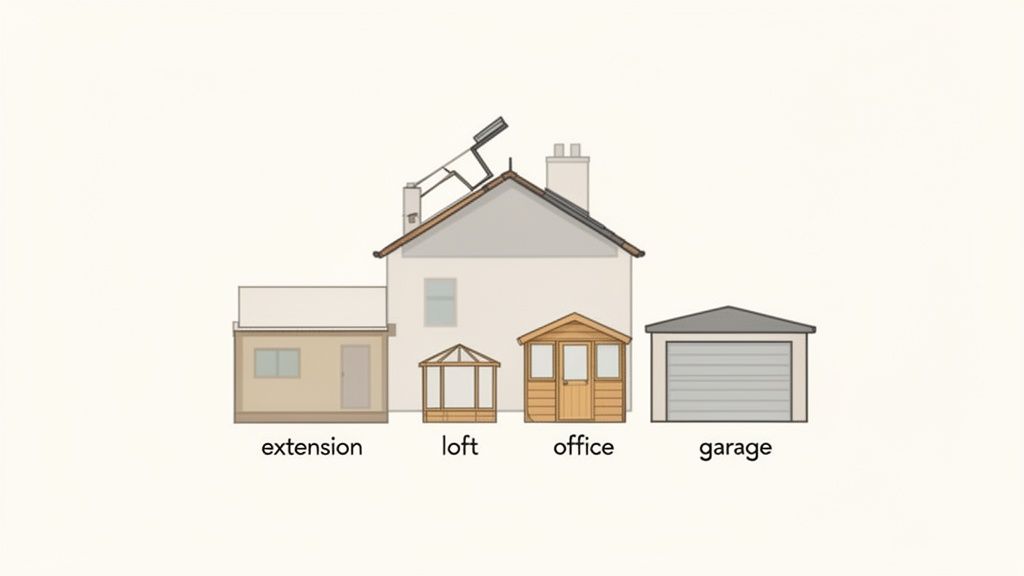
Let's turn the complex official rules into a practical checklist. These are the details you need to check your ideas against. This shows what is possible without a full planning application.
Single Storey Rear Extensions
This is one of the most common projects. Knowing the exact rules here can save you from a costly planning refusal.
The key limit is how far your extension sticks out from the rear wall of the original house. This means the house as it was first built, not from any later additions.
For detached houses: You can typically extend up to four metres.
For all other houses (semi-detached, terraced): The limit is smaller, at three metres.
These dimensions are for projects that do not need special approval from your council. For a larger extension, you might still use permitted development. But it triggers a more complex process involving your neighbours. We will cover that later.
The rules also say the extension cannot be higher than four metres. It also must not cover more than 50% of the land around your original house.
Loft Conversions
A loft conversion is a great way to add a bedroom or office. But the rules are very strict. The most important factor is the extra volume you add to your roof space.
Your goal is to stay under the volume allowance. If you exceed it, even by a small amount, you will automatically need a full planning application.
The limits are different depending on your property type.
For terraced houses, the additional roof volume must not exceed 40 cubic metres.
For detached and semi detached houses, you have more room with a limit of 50 cubic metres.
Any new dormer windows must not stick out beyond the existing roof slope on the front of the house. Side facing windows must have frosted glass. They also must not open unless the opening parts are more than 1.7 metres above the floor. This rule protects your neighbours’ privacy and is not negotiable.
Garden Buildings and Offices
Home working has made garden offices very popular. Under permitted development, you can build sheds and other outbuildings without planning permission. You just have to meet certain conditions.
The main rules for outbuildings are:
Height limits: The building must be single storey. If it is within two metres of a boundary, the maximum height is 2.5 metres.
Location: You cannot build it in your front garden. It must be behind the front wall of your house.
Total coverage: The total area of all sheds and extensions must not cover more than 50% of your total garden area.
Sleeping accommodation is not allowed. If you want it to be a self contained living space, you will need full planning permission.
Garage Conversions
Converting an attached garage into a living space is often covered by permitted development. This is because the work is usually internal. It does not involve enlarging the building.
But you need to be careful. If you add a window where the garage door was, it must look similar to the materials of the existing house.
Some new build estates have planning conditions that remove your right to convert a garage. This is often to ensure enough off street parking. If you break this rule, the council could force you to change it back.
The large number of these smaller projects shows how vital these rights are. In the first three months of 2025 alone, 36,200 householder applications were decided across the UK. This made up 51% of all planning decisions. Permitted development helps manage this flow. You can find out more from the official data on the government's planning statistics factsheet.
When Your Permitted Development Rights Are Removed
It is a costly mistake to assume you automatically have permitted development rights. These rights are not universal. Local councils can switch them off to protect a neighbourhood’s character.
Believing you have these rights when you do not can stop your project. Worse, if you build based on a wrong assumption, the council can order you to tear it down. You could be left with a huge bill and nothing to show for it. This is why checking your property's specific status is the most critical first step.
Conservation Areas and Their Impact
One of the most common restrictions is a Conservation Area. These are neighbourhoods with special architectural or historic interest. If your home is in one, your permitted development rights are significantly reduced.
Even simple projects like adding a porch or changing windows might need a full planning application. The goal is to ensure any changes respect the area's unique character. A modern extension that is fine elsewhere could be refused here if it is visible from the street.
Article 4 Directions: The Local Override
The other major restriction is an Article 4 Direction. This is a legal tool a council uses to remove certain permitted development rights in a specific area.
An Article 4 Direction acts like a local veto. The council is saying the national rules do not work for this street, so we are taking back control.
Councils use this tool to control changes in Conservation Areas. They also use them to stop family homes being converted into shared houses or to prevent front gardens becoming car parks. You can learn more in our guide to understanding Article 4 Directions.
Finding out if your property is affected by one of these directions is difficult. They are often buried deep within council websites. This is a major source of confusion for homeowners.
Other Important Restrictions to Know
Several other factors can remove your rights. It is crucial to be aware of them before you spend money on design work.
Listed Buildings: If your home is a listed building, assume you have almost no permitted development rights. Nearly any work will require special consent.
Flats and Maisonettes: Permitted development rights do not apply to flats or maisonettes. All external changes need a full planning application.
Designated Land: Homes in special areas like National Parks have more restrictive rules. Rights for extensions and outbuildings are often much smaller.
Previous Planning Conditions: When a house was originally built, the council may have attached a condition removing future permitted development rights. This is common on new build estates.
The clear warning here is that your property's location and history matter most. Proceeding without checking these details is a significant financial risk. An enforcement notice from the council could force you to undo thousands of pounds worth of work.
Navigating Prior Approval and Your Neighbours
Just because your project is classed as permitted development, it does not always mean you can start building tomorrow. For larger extensions, you often need to go through a process called Prior Approval. This is a crucial step that can make or break your plans.
Think of it as a light version of a full planning application. You formally notify your local council about your plans before any work begins. This gives them a chance to check your project and ask your neighbours what they think.
What Is Prior Approval?
Prior Approval is for larger extensions that still count as permitted development. For example, a single storey rear extension on a detached house can go up to eight metres deep. But anything over four metres automatically triggers this process. For a terraced or semi detached house, the trigger point is three metres.
The main goal is to assess the impact of your extension on your immediate neighbours. The council cannot object based on your design choices. Their focus is limited to how it affects your neighbours' enjoyment of their own home.
This flowchart shows the basic checks to see if your property might have permitted development rights. This journey can lead to processes like Prior Approval.
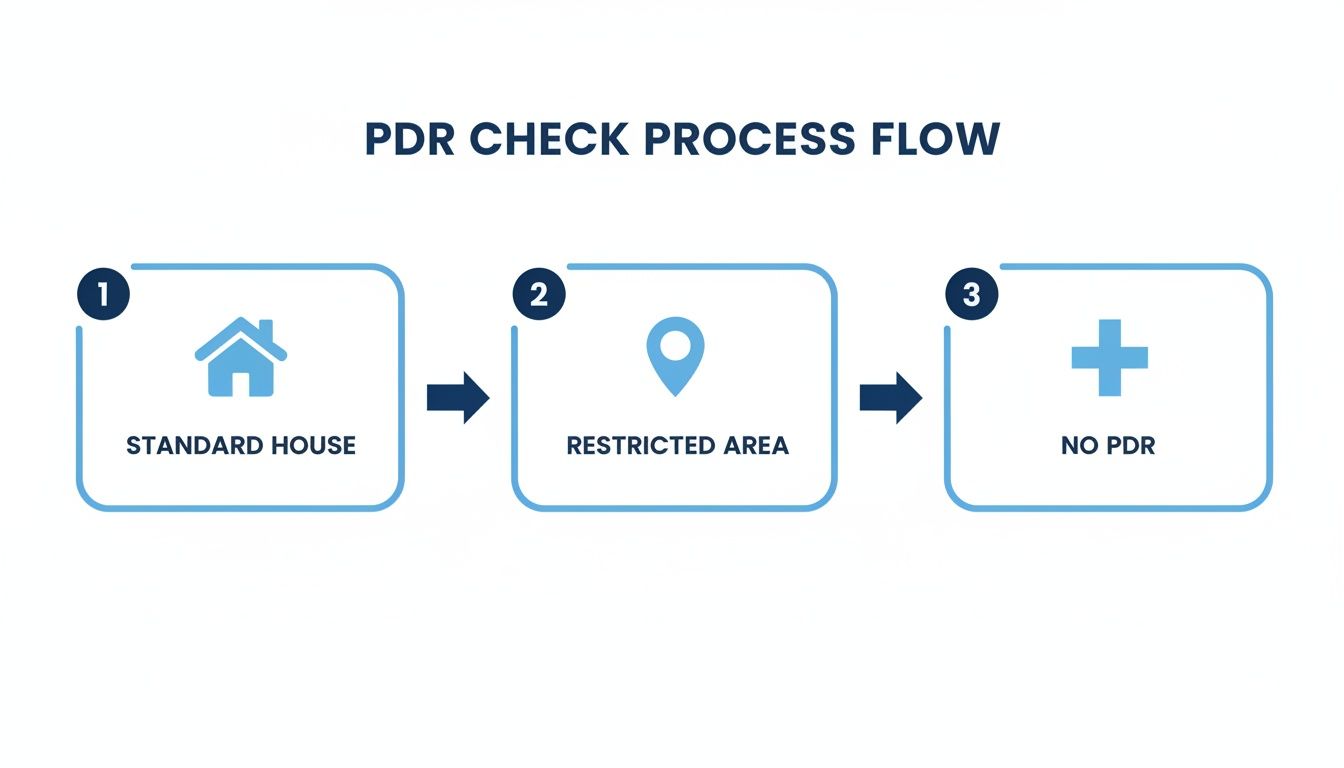
The key takeaway is that your property's status determines if you can even consider permitted development.
A common mistake is assuming that because an extension falls within the size limits, you can just build it. If it requires Prior Approval and you fail to apply, the council can force you to tear it down.
The Neighbour Consultation Scheme
Once you submit your Prior Approval notification, the council contacts the owners of any adjoining properties. This is officially known as the Neighbour Consultation Scheme.
Your neighbours then have 21 days to raise any objections. These objections must be based on valid planning grounds that relate directly to the impact on their property.
Valid Objections: A neighbour could object if your extension would cause a significant loss of light to their main rooms.
Invalid Objections: Complaints about loss of a view or disruption during construction are not considered valid planning reasons.
It is always a good idea to speak with your neighbours first. Showing them your drawings and explaining the project can prevent formal objections later.
If you want more detail, you can learn how Prior Approval for larger rear extensions works in our detailed guide.
The Council’s Decision and Timescale
The council has a strict 42 day period to make a decision. That is exactly six weeks from the day they receive your notification.
The table below breaks down the typical steps.
Key Steps in the Prior Approval Process
Step | What Happens | Typical Timescale |
|---|---|---|
1. Submission | You submit your Prior Approval notification to the council with plans. | Day 1 |
2. Validation | The council checks your application is complete and registers it. | Within 5 working days |
3. Consultation | The council writes to your neighbours, starting the 21 day consultation. | Starts within 1 week |
4. Assessment | The planning officer assesses your plans and any objections. | Weeks 4-5 |
5. Decision | The council issues their decision or the 42 day period expires. | By Day 42 |
There are three possible outcomes:
Approval is Granted: If the council has no concerns or no neighbours object, you get a notice stating Prior Approval is granted.
Approval is Refused: If the council agrees with a neighbour’s objection, they can refuse approval. You would then need to change your plans.
No Decision is Made: If you do not hear back from the council within the 42 day period, permission is automatically granted.
Understanding this process removes uncertainty. It gives you a clear timeline and helps you tick all the legal boxes without surprises.
How to Check Your Rights and Avoid Costly Mistakes
How do you find out what is actually allowed for your specific property? Council planning websites are often frustrating and leave you more confused. A wrong guess can lead to a wasted £258 on a refused application or enforcement action.
You need clarity before you commit thousands to architect drawings. An affordable check now is the best way to avoid costly mistakes later.
Look Before You Leap with Data
A SurePlan Planning Confidence Report gives you this clarity. For just £49, our report checks the real world planning decisions made by your local council. It is an affordable tool that gives you data driven insight so you can proceed with confidence.
Instead of you trying to interpret dense policy documents, our report tells you the most likely path forward. It answers two critical questions:
Does my project idea line up with what the council typically approves in my neighbourhood?
Are there any hidden local restrictions, like an Article 4 Direction, that have removed my rights?
Get a Clear Confidence Score
The report compares your idea against similar nearby projects. It boils this down to a straightforward confidence score. It flags specific restrictions tied to your address and explains what they mean for your plans. This insight helps you decide whether to use permitted development or prepare for a full planning application.
Permitted Development Rights have made countless extensions possible. But success is not guaranteed, especially in areas with local restrictions. Understanding these local patterns is vital to stop you spending money on unworkable designs. You can learn more about how PDR has shaped housing from the Town and Country Planning Association.
The goal is to make an informed choice early. Our evidence based report shows you what the council has approved and refused nearby. This gives you a realistic preview of your own chances.
This approach gives you a huge advantage. You can talk to an architect armed with real evidence about what is likely to succeed. It also helps you manage your budget by avoiding designs that are destined for refusal.
Our report provides the evidence you need to move forward with your eyes open. You can get more practical tips in our guide on how to check for planning permission. It is all about replacing guesswork with data so you can invest in your home improvement project with more certainty.
Frequently Asked Questions About Permitted Development
Homeowners often have questions about permitted development. This final section gives clear answers to the most common queries we hear.
Do I Still Need Building Regulations Approval?
Yes. This is a crucial point that catches many people out. Permitted development rights only remove the need for planning permission.
Building Regulations are a completely separate set of rules. They make sure your new extension is structurally sound, safe, and energy efficient. You will almost certainly need to make a Building Regulations application to your council or an approved inspector. Skipping this can cause huge problems when you try to sell your home.
Can I Combine Different Permitted Development Rights?
Sometimes, but the rules get very complex. For instance, you might be able to build a loft conversion and a rear extension under your permitted development rights.
However, the allowances are not simply added together. The volume of your loft conversion would count towards the total enlargement volume allowed for your property. This is a classic tripwire. It is vital to get professional advice before you assume you can build multiple extensions without a full planning application.
One of the most costly mistakes is miscalculating volumes when combining projects. If you go over the total limit, even by a tiny amount, the council could take enforcement action.
What Happens If I Build Without Permission?
If you build something that is not covered by permitted development and you do not have planning permission, the council can take enforcement action. This is a serious legal process.
They might invite you to apply for retrospective planning permission. But these applications are often refused. In the worst case, the council can issue an enforcement notice. This legal document could force you to alter or demolish the entire structure at your own expense. It is a stressful and financially damaging risk.
How Do I Find Out If My Home Is in a Conservation Area?
You can usually find this on your local council's website. The trouble is, these maps can be hard to find and difficult to use with any confidence.
A simpler way is to use a service designed for homeowners. A dedicated report checks for these restrictions automatically. This gives you a clear summary of what a Conservation Area designation means for your project ideas. It saves you time and prevents a costly wrong turn.
Before you commit to architects or builders, get the evidence you need. A SurePlan Planning Confidence Report gives you data-driven insight into your project's chances, highlighting the specific risks for your property.