
Feb 2, 2026
Thinking about an extension or a loft conversion? Before you hire an architect, a quick check can show if your project is likely to succeed. This guide shows you how to find out, potentially saving you thousands in wasted fees.
This check involves looking at your local council's online planning records. You can see your property's history and any special rules that apply. It tells you what the council has approved nearby and flags restrictions that could stop your project cold.
Why this check saves you thousands
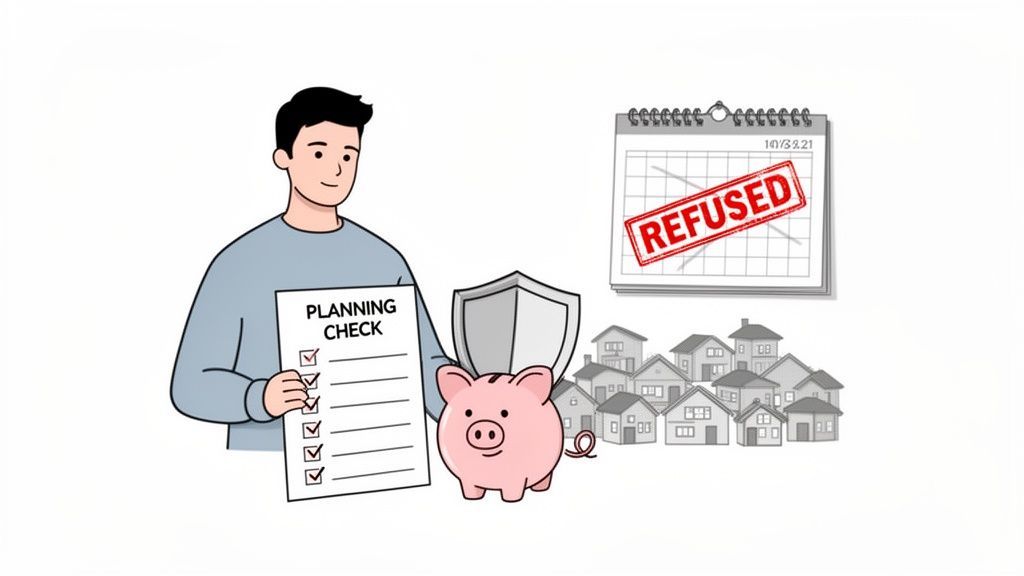
Skipping this homework is a gamble. It often leads to a refused application, wasting months of your time and thousands of pounds. Checking first is the single most important step you can take.
Imagine spending £2,000 on architectural plans. You then discover your home is in a conservation area where changes are difficult. A simple check would have revealed this upfront. You could have adjusted your plans or realised the project was never going to work. This is about protecting your savings.
Avoid costly and stressful mistakes
A common mistake is assuming you can build what a neighbour has. Planning policies change often. What was approved five years ago might be refused today. Knowing your council's recent decisions gives you a real advantage.
Councils seem to be more cautious right now. In the year ending June 2025, local authorities in England processed just 329,700 applications. This is the lowest 12 month total this decade. It is also an 11% drop from the previous quarter. Unworkable applications are often dismissed quickly. You can see these trends for yourself at PlanningResource.co.uk.
Think of this check as a small investment to avoid a much larger problem. You can make an informed choice and start a project that has a real chance of success.
Gain confidence and clarity early
This research gives you the clarity to make smart decisions. You can move forward based on evidence, not just hope.
This initial work helps you to:
Spot deal breakers like an Article 4 Direction, which removes your automatic development rights.
Understand what is realistic based on what gets approved in your neighbourhood.
Have more productive chats with architects and builders because you will be armed with facts.
Learning how to check planning permission yourself gives you confidence. You can push ahead with your plans, tweak them to improve your chances, or wisely stop before you spend money on a doomed project.
Finding your local council planning portal
Your first stop is your local council’s online planning portal. It is a public library for every planning application in your area. Getting this right saves you from digging through the wrong website.
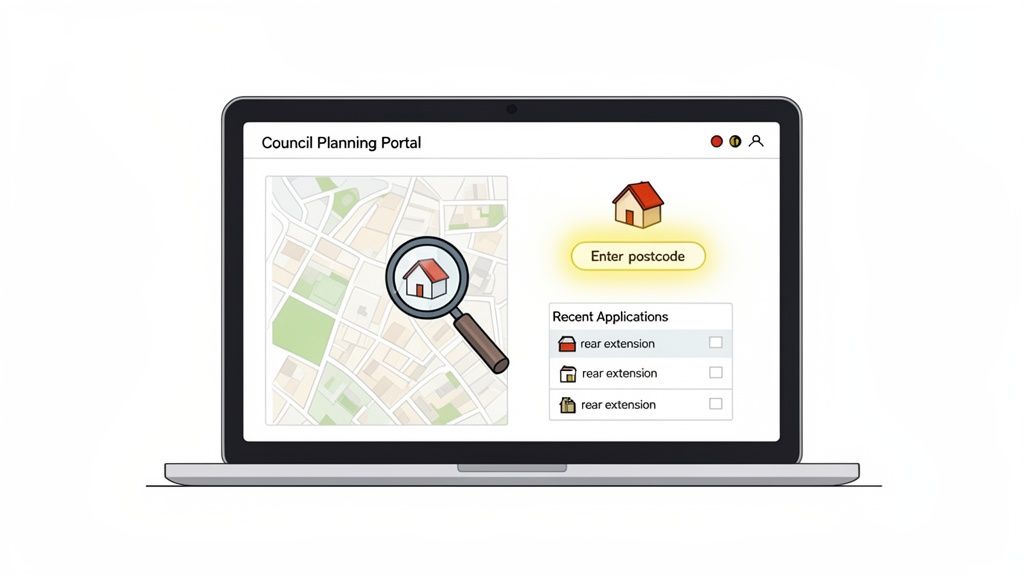
A simple search for "[your town/borough] council planning" is the quickest way in. If you live in a city, you may need a specific borough council. Once you find the right page, bookmark it.
How to search the portal like a pro
Many of these websites look dated. They can be clunky but share the same search functions. Do not let the design put you off. You can usually ignore most of the clutter.
Start by searching for your own property using your postcode. This will show the entire planning history for your home. You might find old applications for changes you never knew about.
Next, look at your immediate street or neighbourhood. Most portals have a map search tool that is perfect for this. It lets you click on neighbouring properties to see what they have applied for. You can also see what was approved or refused. This step turns a confusing database into a powerful research tool.
Use the right keywords to find similar projects
The best information comes from finding projects like yours. To do that, you need to use the right keywords in the portal's search bar.
Here are some effective search terms:
‘Single storey rear extension’
‘Dormer loft conversion’
‘Outbuilding’
‘Dropped kerb’
Looking at these real examples gives you a realistic picture of your council's attitude.
Pay attention to the decision dates. An approval from 2015 is interesting. A refusal from last month on a similar project is far more relevant.
Finding two or three similar projects on your street provides a great starting point. You can see the drawings, read comments from neighbours, and find the council's final decision notice. This is the solid evidence you need before spending money on your own plans.
Navigating your council's planning portal
Understanding the documents in the portal is key. They can seem complex, but knowing what to look for helps. This table breaks down the most important files.
Information to Find | What It Tells You | Why It Matters to You |
|---|---|---|
Application Form | The applicant's details and a summary of the work. | Confirms the basics of the proposal. |
Design & Access Statement | The thinking behind the design and how it fits the area. | Shows the arguments used to justify the project. |
Site & Location Plans | Maps showing the property and where the work will be. | Helps you visualise the proposal in its surroundings. |
Proposed Drawings | The architect's drawings of the new structure. | See exactly what got approved or refused. |
Decision Notice | The council's final verdict: approved, refused, or approved with conditions. | The single most important document. It states the outcome and why. |
Officer's Report | The planning officer's detailed assessment. | Gives you great insight into the council's thought process. |
By reviewing these documents for nearby properties, you stop guessing. You can build a strategy based on what has actually worked in your neighbourhood.
Understanding your Permitted Development Rights
What if you could skip the planning application process? For many home improvements, you can. This is thanks to Permitted Development Rights. These are national rules that grant automatic planning permission for certain projects.
Following these rules can save you months of waiting and hundreds of pounds in council fees.
Think of it as a pre-approved checklist from the government. If your project fits the rules on size, height, and location, you can often just build it. It is a big advantage for homeowners, but a mistake can be very expensive.
What projects are typically covered?
Permitted development is for common, lower impact home improvements. The rules are detailed, but many popular projects are covered if they meet the criteria.
Here are a few examples:
Small rear extensions: A single storey extension can often be built up to six metres for a semi-detached house without a full application.
Loft conversions: Adding a dormer to the rear of your roof is often allowed, as long as it does not exceed a certain volume.
Garden outbuildings: A home office or gym is usually possible, provided it is not too big or too close to your boundary.
These rights are a great way to improve your home with less bureaucracy. You can learn more in our guide to Permitted Development Rights explained. But you must be certain these rights apply to your property before you start work.
Why your rights might not apply
This is a critical point that many homeowners miss. Permitted development rights are a national grant of permission. But your local council can take them away. A simple misunderstanding could lead to the council ordering you to tear down your new extension.
The most important thing to remember is this: local restrictions can override national rules. Just because your project meets the size rules does not mean you have the right to build it.
Two common situations can remove your rights:
Conservation Areas: If your home is in a designated conservation area, your rights are much more limited. Simple jobs like replacing windows might need full planning permission.
Article 4 Directions: This is a legal tool a council can use to remove permitted development rights in an area. They might do this to protect a neighbourhood's character, for example, by stopping homeowners from paving over front gardens.
You must check if these local restrictions apply to you before starting work under permitted development. Assuming you have these rights without checking is a huge financial gamble. A quick search of your council's online planning maps will show you where these restrictions are.
How to spot hidden planning constraints
Hidden rules, or constraints, can kill your planning application. Many properties have them and they can limit what you can build. These invisible tripwires often turn a simple project into an expensive non-starter.
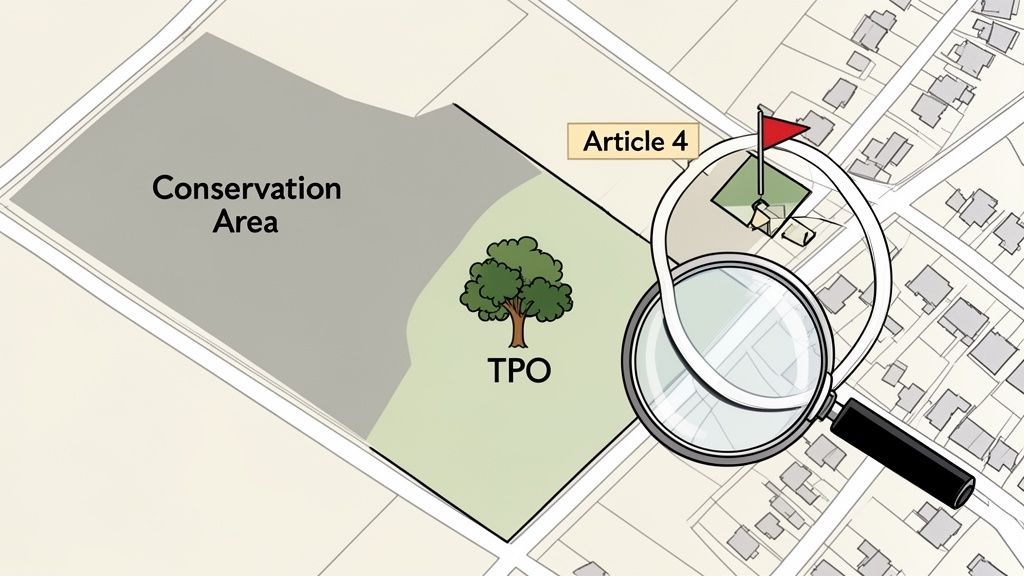
Ignoring these constraints is a common reason for planning refusal. For example, replacing timber windows with uPVC ones in a Conservation Area will almost certainly fail. Building an extension too close to a protected tree can also lead to rejection. You need to uncover these deal breakers before you spend money on architects.
Find constraints on your council's map
You do not need to be a planning expert to find these red flags. The most powerful tool is your council's interactive online map. You can usually find it on their planning portal. It might be called a 'Local Plan Map' or a 'Constraints Map'.
This digital map overlays restriction zones onto a map of your area. Find your property and see if it falls within any of these zones. A quick check here can save you thousands in wasted fees.
The big three to look for are:
Conservation Areas: These are areas where development is strictly controlled to preserve local character.
Article 4 Directions: These are special rules that remove specific permitted development rights, like converting a house into a small HMO.
Tree Preservation Orders (TPOs): These legally protect specific trees. You cannot cut down, prune, or build near them without council consent.
Finding a constraint does not mean your project is impossible. It means the council will look at it more closely. You will need to prove your design respects the special rule in place.
Why this check is so important
Failing to spot these constraints leads to wasted application fees and disappointment. The national grant rate is 87%. But UK planning stats show over 9,000 applications were still refused in one quarter of 2025. For homeowners in restricted zones, the refusal risks are much higher. You can see the full data in the latest planning application data.
Even projects you think are 'permitted' can get tripped up. Refusals for these projects rose by 3% to 1,300 in the same period. This often happened because a local constraint was overlooked. For more detail, see our guide on planning constraints that increase scrutiny.
This research helps you understand the situation before you commit. Knowing the constraints on your property lets you design a project that works with them. This will dramatically improve your chances of success.
Learn from your neighbours' applications
Do you want to know what your council is likely to approve? Look at what they have already approved on your street. Checking the planning history of nearby properties gives you a huge advantage. It turns vague hopes into a strategy built on hard evidence.
This is not just about looking at what people have built. It is about understanding why applications were approved and why others were refused. This local knowledge is more powerful than national guidance. It shows you how your council interprets the rules right now.
Find and review the key documents
Go to your council's planning portal. Search for applications similar to your project from the last few years on your street. When you find one, look for two crucial documents.
These two files tell the real story:
The Decision Notice: This is the official outcome. It will state "Approved" or "Refused". For an approval, check the conditions. Details like requiring matching bricks are clues about what the council values.
The Officer's Report: This is the goldmine. It is the detailed assessment written by the council's planning officer. It explains their reasoning and which policies the project followed or broke.
Reading a few of these reports is like getting a free masterclass in your local planning department. You will quickly see patterns you can apply to your own plans.
Decode the reasons for success and failure
The Officer's Report contains the important details. A common reason for refusal is a negative impact on a neighbour. This could mean a new extension blocking their light or a window overlooking their garden.
You might see a two storey rear extension was refused because its windows looked into a neighbour's bedroom. The Officer's Report will state this clearly. This is a warning not to make the same mistake.
An approval for a similar project might show how the design used screens or frosted glass to prevent overlooking. These are practical solutions you can borrow. By understanding what past planning decisions reveal about your chances of approval, you can get ahead of potential problems.
This analysis helps you build a strong case for your own project. You can shape your design to align with recent successes. This evidence based approach is the smartest way to reduce your risk before you commit thousands to fees.
Deciding your next steps
You have done your initial research. You have moved past guesswork and have solid information from your local council. This is the point where you decide how to move forward with confidence.
Your research will point you down one of two paths. Either your project falls under permitted development, or you need a full planning application. Each route has a specific next step.
If your project looks like permitted development
Even if you are 99% sure your project meets permitted development rules, do not start building yet.
The smart move is to apply for a Lawful Development Certificate (LDC). This is not a planning application. It is official proof from your council that your project is lawful and does not need planning permission. It costs around £103, much less than a full application fee, and gives you complete peace of mind.
Without an LDC, the council could challenge your build years later. It also helps avoid problems when you sell your home.
This decision tree shows how to analyse a neighbour's application. The process helps you understand the evidence needed for your own project.
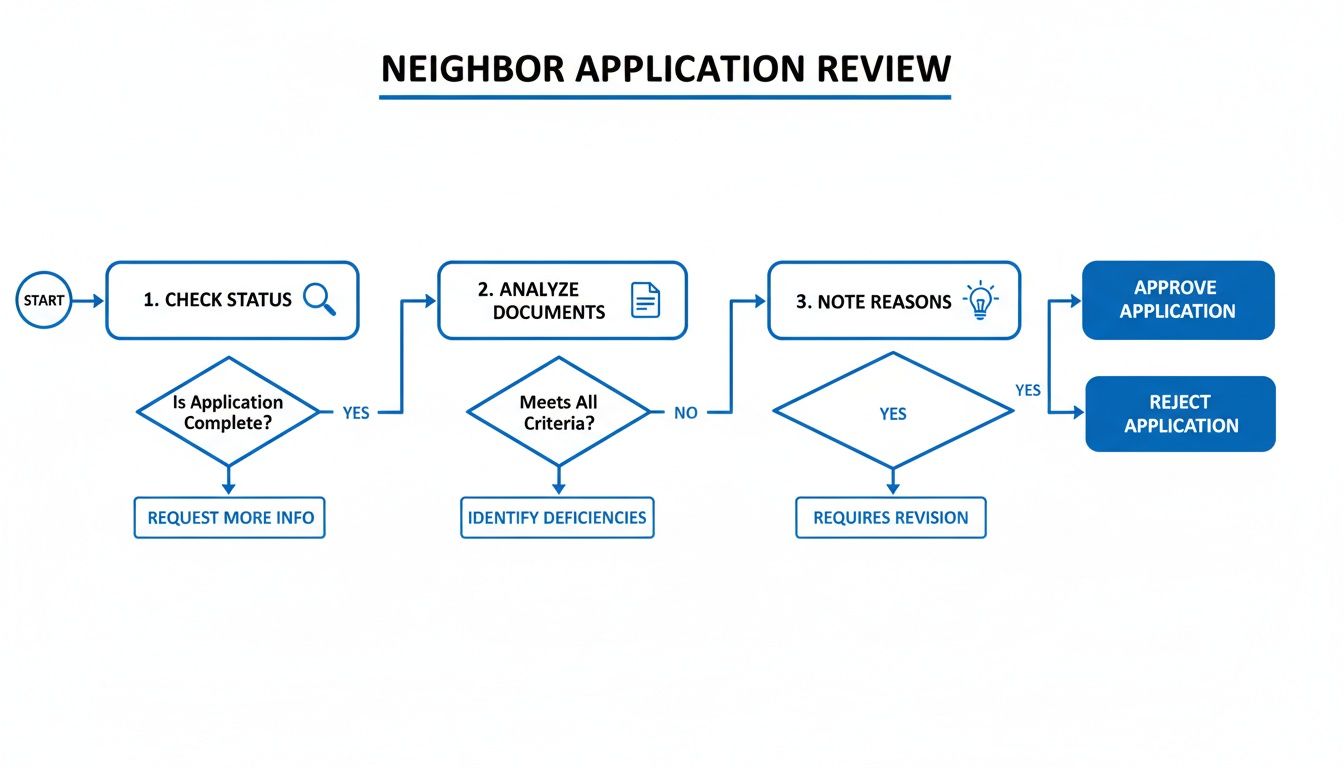
This systematic approach of checking status and analysing documents is how you build a strong case for your own certificate or application.
If you need a full planning application
If your research shows you need full planning permission, talk to a professional. This could be an architect or a planning consultant. Now is the perfect time to bring them in because you are not coming empty handed.
Instead of paying them to do this initial groundwork, you can present your findings:
Key constraints: "My house is in a conservation area, and a TPO protects the oak tree in the garden."
Local precedents: "Number 42 had a similar extension approved last year, but Number 38's was refused for overlooking."
Specific concerns: "The officer's report for the refusal at Number 38 mentioned privacy, so our design needs to address that."
Sharing this evidence makes your first meeting very productive. It helps a designer create plans that address the council's known concerns from day one. This increases your chances of success and helps you avoid a wasted £548 refusal fee.
This preparation helps professionals give you better advice and more accurate quotes. It frames the project around evidence, not assumptions. That is the best way to reduce your risk before you commit to the cost of drawings and a full application.
Your questions answered
Diving into planning permission can feel overwhelming. It is natural to have questions. Here are straight answers to common questions from homeowners.
How long does a planning check take?
You can get a good feel for the basics in a few hours. A quick search on your council's planning portal will show your property's history. It will also flag major roadblocks, like being in a conservation area. It is a great first step.
Do not confuse this with a full planning application. That is different. Once you submit official drawings, the council usually takes 8 to 12 weeks to make a decision. That is why doing your homework first is so important. It can save you from a long wait that ends in a "no".
What's the difference between planning permission and building regulations?
This is a big one. They are two separate hurdles you must clear.
Planning Permission is about whether you are allowed to build your project. It looks at the bigger picture: the size, appearance, and impact on your neighbours and the street.
Building Regulations are purely technical. They are standards to ensure your build is safe, structurally sound, and energy efficient. This includes foundations, insulation, fire safety, and drainage.
Even if your project is under permitted development, it still has to meet Building Regulations. There is no escaping them.
Can I talk to the council before I apply?
Yes. Most councils offer pre-application advice. For a fee, a planning officer will review your initial ideas. They will give written feedback on whether they are likely to be approved.
This can be very helpful for bigger or unusual projects. However, the service is not cheap and can take a few weeks. For a standard extension, doing your own research first is often a smarter and more cost effective way to check your chances.
Feeling unsure about your project's chances? A SurePlan report gives you an evidence based view in just 24 hours. We analyse local decisions so you can avoid costly mistakes before you spend on drawings. Find out more at https://getsureplan.co.uk.