
Feb 24, 2026
Wondering what a house extension will actually cost you is the biggest hurdle for most homeowners. Get the budget wrong, and you risk running out of money halfway through, leaving your home in chaos and your plans in tatters.
You often see build costs quoted from £1,800 to £3,000 per square metre. But this figure is misleading. It ignores thousands of pounds in essential fees for architects, planning applications, and structural engineers that you must pay before building even starts. This guide gives you the real numbers so you can avoid costly surprises.
Your Guide to Understanding UK Extension Costs
Starting an extension project brings up many financial questions. The most expensive mistake is underestimating the total cost from the beginning. It forces you to halt work, compromise on finishes, or take on stressful debt.
This guide provides an honest breakdown of the actual figures. Our goal is to give you clarity so you can plan with confidence and protect your money. Understanding the full picture helps you avoid major financial headaches before you commit thousands to designers and builders.
We will show you what drives the final price, including:
The typical build costs for different extension types.
The professional fees many people forget to budget for.
How to avoid expensive surprises down the line.
Planning a project without a realistic budget is like starting a long drive with an almost empty fuel tank. You will get stuck. Knowing the real costs gives you a clear and actionable plan.
By the end of this article, you will have a realistic idea of what your project is likely to cost. You will be able to ask builders the right questions, evaluate their quotes properly, and make smart decisions to prevent your budget from spiralling. Let's get you the numbers you need to plan your extension with confidence.
How Much Does a House Extension Actually Cost?
The final bill for your extension depends on three things: its type, its size, and where you live in the UK. Vague estimates are unhelpful. Let's look at real world numbers to give you a solid starting point for your budget.
Knowing these figures is your best defence against overpaying. It gives you the confidence to review a builder's quote and know if it is fair for your specific project and your local area.
Average Build Costs Per Square Metre
The most common way to estimate extension costs is by using a price per square metre (£/m²). This gives you a baseline for the main construction work. Remember, these prices almost always exclude VAT, architect fees, and the final fit out, such as kitchen units or bathroom suites.
Think of the £/m² rate as the cost to build the basic shell. It covers the foundations, walls, roof, and simple plumbing and electrics.
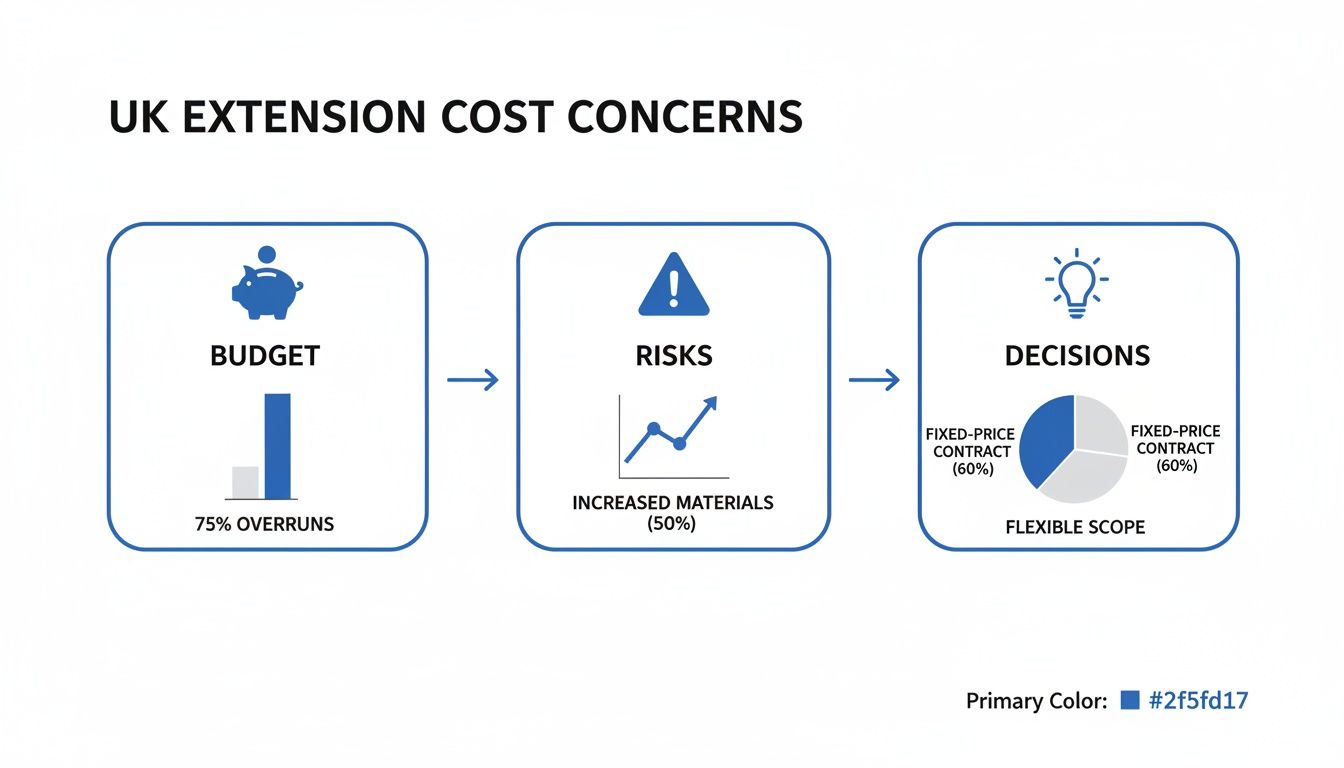
A successful project means balancing your initial budget with an awareness of potential financial risks. This clarity helps you make better decisions from day one.
Price Ranges for Common UK Extensions
Different extension types have different levels of complexity, which directly impacts the price. A simple single storey rear extension is usually the most straightforward. A two storey or wrap around project involves more complex structural work and costs more per square metre.
Here are some typical build only cost ranges for common projects across the UK.
Extension Type | Average Cost per m² | Typical Total Cost Range |
|---|---|---|
Single-Storey Rear | £1,900 – £2,500 | £47,500 – £62,500 (for 25m²) |
Side-Return | £2,300 – £2,800 | Varies (often smaller, complex) |
Wrap-Around | £2,400 – £3,000+ | £96,000 – £120,000+ (for 40m²) |
Two-Storey | £1,800 – £3,000+ | Highly variable by design |
These figures are a crucial baseline. A project with high end bifold doors, large panels of structural glass, and premium finishes will be at the top end of these ranges or higher.
For a more tailored estimate, our free extension cost calculator can provide a clearer picture based on your project details.
How Your Postcode Affects the Price
Your location is a major driver of the final bill. Labour and material costs vary significantly across the country. London and the South East are the most expensive places to build.
A project in the North of England could cost 15 to 20% less than the national average. Building the same extension in Central London could cost 30 to 50% more.
Let's look at a standard 25m² single storey extension, using a mid range build cost of £2,200 per m².
In Manchester (North West): The cost might be adjusted down by 15%, for a total build cost around £46,750.
In Bristol (South West): The price would likely be close to the national average, resulting in a £55,000 build cost.
In London (Greater London): You could easily see a 40% uplift, pushing the same project's cost to £77,000.
This regional variation is why you must get several quotes from local builders. It ensures the price you pay reflects the rate for your specific postcode, not a generic UK average. Without this local insight, you risk overpaying by thousands.
The Hidden Fees That Can Blow Your Budget
The large number on your builder’s quote is rarely the final figure you will pay. Many homeowners are shocked to realise the build cost is just one part of the total bill. A long list of professional and council fees can add thousands to your final costs, turning a comfortable budget into a stressful shortfall.
It is an expensive mistake to treat these as minor extras. They are essential costs needed to get your project designed, approved, and built safely. Knowing about them upfront transforms them from painful surprises into planned expenses.
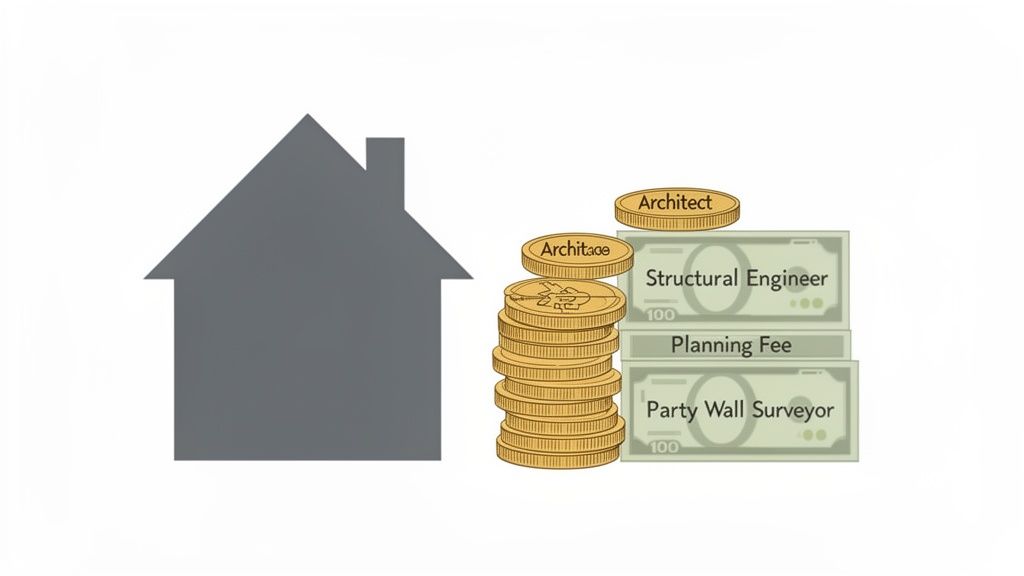
Let’s break down the main professional services you must budget for.
Architect and Structural Engineer Fees
An architect or architectural designer is your first professional hire. They turn your ideas into detailed drawings that builders can price and planners can assess. Their fees are usually a percentage of the total build cost, typically between 5% and 15%. For a £60,000 extension, that could add £3,000 to £9,000 to your bill.
Once you have a design, you will need a structural engineer. Their job is critical. They make sure the building is safe and stable. They produce calculations and drawings for key elements like steel beams, foundations, and the roof. Expect to pay a fixed fee for this, usually between £500 and £1,500, depending on your project's complexity.
These two roles are non negotiable. Without them, you cannot get planning permission, you will not meet building regulations, and a builder cannot even start work.
Planning and Application Costs
Before building begins, you usually need permission from your local council. This means submitting a planning application, and the fees for this are rising. Homeowners now face a significant increase in what they must pay just to have their plans reviewed.
This is not a small change. The fee for a typical householder application for an extension in England is now £258. This figure has risen sharply and is expected to increase again. Councils are raising fees to cover funding shortfalls in their planning departments.
A rejected application means you lose the fee. You also lose the money spent on drawings and the months you waited for a decision. A £258 refusal fee is a costly mistake.
Other costs can also appear. If you live in a terraced or semi detached house and your extension is close to a neighbour's property, you will probably need a Party Wall Agreement. This requires a specialist surveyor, and their fees can range from £700 to £1,500 per neighbour.
You might also need other surveys, depending on your property. These could include:
Tree Survey: If protected trees are near your proposed extension.
Drainage Survey: To check the location and condition of underground pipes.
Asbestos Survey: Essential for older properties before any demolition.
Each of these adds a few hundred pounds to the pre construction bill. Forgetting these items is why initial budgets often fail. To learn more, see our detailed guide on planning permission costs in the UK.
How Early Checks Can Save You Thousands
The most expensive mistake you can make is spending thousands on architect’s drawings only to have them rejected by your local council. A refusal costs you time, money, and momentum.
You lose the non refundable application fee. You lose the money you paid your architect for now useless plans. And you lose months of time, pushing your project back, often into a more expensive building season. It is a common and costly trap, but one you can avoid.
A small upfront investment in a planning feasibility check protects you from this financial hit. It is like getting a survey on a house you want to buy. You spend a little now to avoid a massive problem later.
Avoiding the Costly Refusal Trap
A planning refusal is frustrating because it feels like wasted money. With the householder application fee at £258, losing this amount along with months of delay is painful.
This is where an early check becomes your secret weapon. It helps you find out your real chances of success before you have spent a fortune on detailed plans and application fees.
The goal is to turn a gamble into an evidence based decision. Instead of hoping your plans get approved, you move forward knowing what your local council is likely to say based on their recent decisions for similar projects.
A service like SurePlan’s Planning Confidence Report gives you this clarity. We analyse real, recent planning decisions from your specific local council. We look at approvals and refusals for similar extensions in your neighbourhood to give you an evidence based score on your chances of success.
How an Early Check Gives You an Advantage
A good feasibility check does more than give you a simple yes or no. It highlights specific risks and opportunities, letting you make smarter choices before you commit thousands of pounds. It is about understanding the local planning rules and how your project fits in.
This process highlights potential red flags at the start. For example, it will tell you if your property is in a Conservation Area or has an Article 4 Direction. Both come with strict rules that can stop a standard extension design. Knowing this from day one means you can adjust your plans before you have even started.
Here’s what you learn from an early check:
Your likely planning route: Can you use Permitted Development rights, or will you need a full planning application?
Local precedents: How has the council treated similar applications nearby? This is a strong indicator of their position.
Potential issues: Will things like protected trees, your property’s listing status, or local design policies cause problems?
This information is powerful. It allows you to have a much more informed conversation with your architect. You can guide the design towards a solution that is far more likely to get approved. You can explore your options further by reading our advice on the pre-planning application process.
Ultimately, this small step helps protect your main investment. It stops you from wasting a significant sum on a project that was never going to be approved.
Practical Ways to Reduce Your Extension Cost
Knowing your budget is one thing. Sticking to it without sacrificing quality is another. Clever thinking about your design, materials, and project management can save you thousands.
The goal is to make intelligent choices that provide the best value, not just the lowest price. A cheap window that leaks in two years is not a saving. Let's focus on practical adjustments that deliver real savings without causing future problems.
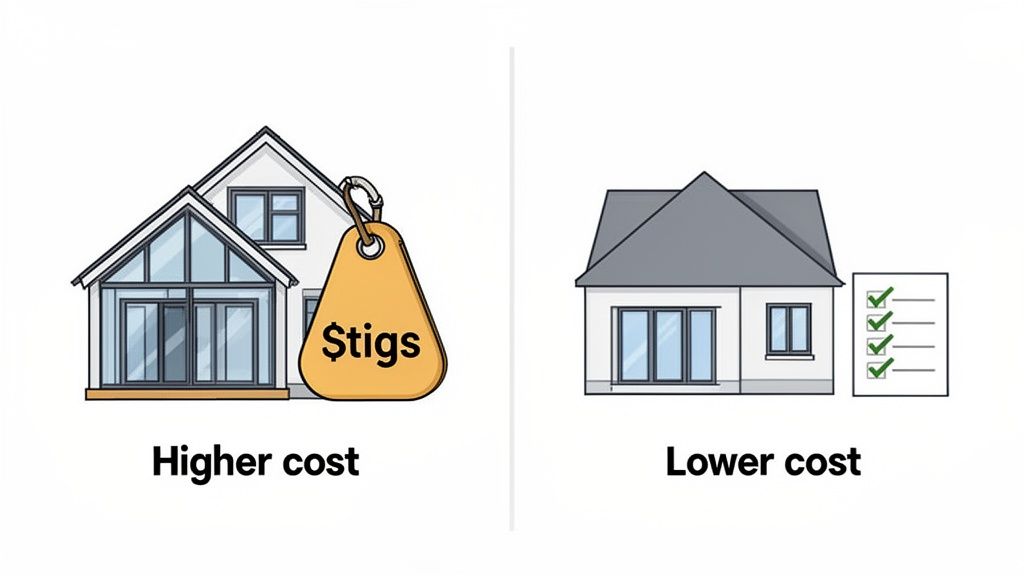
Simplify Your Design
Complexity costs money. The more unusual shapes and fancy angles you add, the more it demands in labour and specialist materials. Builders charge more for tricky work because it takes longer and has a higher risk of error.
Keeping the design simple is one of the most effective ways to control your budget. A straightforward rectangular footprint with a simple pitched roof is far cheaper to build than a complex L shaped extension.
Here are a few design choices that make a huge difference to the final bill:
Standard Sized Doors and Windows: Custom bifold doors look incredible but carry a high price. Opting for standard, off the shelf sizes can cut your costs by 30 to 50% for those items alone.
A Simple Roof Shape: A basic pitched or flat roof is significantly cheaper and quicker to build than one with multiple sections. Less complexity means fewer labour hours and materials.
Minimal Groundworks: Digging complex foundations on a sloped site or near large trees is expensive. A simple, level site reduces these costs substantially.
Manage the Project Yourself
Hiring a main contractor to oversee everything provides peace of mind, but you pay for it. Their fee is typically 15 to 25% of the total build cost. On a £60,000 build, that fee adds £9,000 to £15,000.
If you have the time and organisational skills, you can take on this project manager role yourself. By hiring individual trades like bricklayers and electricians directly, you cut out the main contractor’s fee.
This approach is not for everyone. It requires you to be on site regularly, coordinate schedules, and handle any issues. But for the right person, the potential savings are huge.
Remember, this path carries more risk. If there are delays, the responsibility to fix them is yours. A good main contractor earns their fee by making sure the project runs smoothly.
Be Smart with Materials and Finishes
Your choice of materials has a massive impact on the final bill. It is tempting to choose the highest specification items for everything, but a more balanced approach will help you stay on budget. The key is to know where to spend and where to save.
Invest your money in structural elements that are difficult and expensive to change later. Things like insulation, foundations, and the main roof structure are worth spending more on. You can always upgrade a kitchen tap or light fittings in a few years. You cannot easily change poor quality insulation hidden inside a wall.
Consider these cost saving material choices:
Cladding: Brick is a classic choice, but modern timber or composite cladding can be cheaper and faster to install.
Windows: While aluminium frames are popular, high quality uPVC windows now offer excellent thermal performance for a much lower price.
Kitchens: You do not need a bespoke kitchen to get a high end look. Many companies offer modular units that can be customised for a fraction of the cost.
Cost-Saving Decisions for Your Home Extension
Being thoughtful about these decisions can significantly reduce your extension cost while still creating a space that is functional and built to last. The table below summarises where your choices can make the biggest financial impact.
Area of Spend | Cost-Saving Approach | Potential Impact |
|---|---|---|
Design & Structure | Opt for a simple rectangular shape and a standard roof. | Can reduce build costs by 10-20% by simplifying labour and materials. |
Windows & Doors | Choose standard, off-the-shelf sizes instead of custom-made units. | Savings of 30-50% on glazing costs. |
Project Management | Manage the project yourself instead of hiring a main contractor. | Avoids a management fee of 15-25% of the total build cost. |
Interior Finishes | Spend on structure (insulation, roof) and save on easily replaceable items (taps, lights). | Allows you to upgrade finishes over time without compromising build quality. |
Materials | Use cost-effective alternatives like uPVC windows or non-brick cladding. | Can lower material costs significantly without a major drop in performance. |
Every project is a balance between your vision and your budget. By focusing your spending on the parts of the build that are hard to change later, you can achieve a fantastic result without breaking the bank.
How to Finance Your Home Extension
Very few people have tens of thousands of pounds sitting in a bank account. For most homeowners, borrowing is part of the plan. Understanding your options is key to finding a solution that fits your finances without causing sleepless nights.
The goal is to find funding you can comfortably afford over the long run. The wrong choice could mean paying thousands more in interest than necessary or being locked into an inflexible deal. This section walks you through the most common ways UK homeowners fund their projects.
Remortgaging Your Property
One of the most popular ways to raise money for a project is to remortgage your home. This means you end your current mortgage and take out a new, larger one. The extra money you borrow is released to you as a tax free lump sum to pay for the extension.
This can be an attractive route because mortgage interest rates are usually much lower than personal loan rates. By spreading the cost over the rest of your mortgage term, often 15 to 25 years, your monthly payments can feel more manageable. The downside is that the long repayment period means you could pay back much more in total interest.
Timing is also important. If you are in the middle of a fixed rate deal, leaving early to remortgage will likely trigger an Early Repayment Charge. These fees can be thousands of pounds and wipe out any potential savings.
Further Advances and Personal Loans
If remortgaging is not right for you, you have other choices.
A Further Advance: This is a second, smaller loan from your current mortgage provider that runs alongside your main mortgage. It is often quicker to arrange than a full remortgage, but the interest rate on the advance might be higher than on your main mortgage.
A Personal Loan: For smaller projects where the total extension cost is under £25,000, an unsecured personal loan can be a good option. The application is usually quick and the loan is not secured against your home. The interest rates are higher and repayment terms are much shorter, typically one to seven years, which means higher monthly payments.
Choosing how to finance your extension is as important as choosing your builder. The right option makes your project affordable. The wrong one can add years of financial pressure. Assess the total interest you will pay, not just the monthly cost.
Deciding between these options depends on your situation. Consider how much you need to borrow, how quickly you can pay it back, and your attitude to risk. It is always a good idea to speak with an independent financial adviser who can provide personalised guidance.
Your Questions About Extension Costs Answered
Diving into extension costs can feel confusing. Here are straightforward answers to the questions we hear most from UK homeowners.
Should I Tell My Builder My Budget?
Yes. It might feel like you are giving away your negotiating position, but being upfront about your budget is almost always the smarter move. A good builder can immediately tell you what is realistic for your price range. They can also suggest clever ways to save money, like tweaking the design or choosing different materials.
Keeping your budget a secret often leads to quotes that are far over what you can afford, or a design proposal that is disappointing. A clear budget gets everyone on the same page and stops you from wasting time on plans that will never work.
Is It Cheaper to Extend Up or Out?
As a general rule, extending upwards with a loft conversion is often cheaper per square metre than extending outwards. This is because you are not paying for new foundations and major groundworks, which are two of the biggest expenses in a ground floor extension.
However, a loft conversion probably will not give you the large, open plan kitchen diner you want. The cheapest option depends on the type of space you need. If you just need an extra bedroom, a loft conversion is usually the most cost effective choice.
What Is the VAT on Extension Work?
Most extension work done by a VAT registered builder will have the standard rate of 20% VAT added on top. You must check whether your builder’s quotes include or exclude VAT. A quote that looks like a bargain can suddenly jump by a fifth when the final invoice arrives.
For a build cost of £50,000, that is another £10,000 you need to find. Always ask for a written quote that clearly breaks down the VAT amount so there are no surprises.
Planning an extension is a huge financial commitment, and the risk of a planning refusal can mean losing thousands before a single brick is laid. SurePlan gives you an evidence-based report on your project's chances of success by analysing your local council's recent decisions. Get clarity on your plans and avoid costly mistakes with a Planning Confidence Report.