
Feb 20, 2026
If your house is near a shop, cafe, or office, you need to know about Use Class E. It's a planning rule for commercial buildings that can block your extension plans, costing you time and money. Getting this wrong could mean a rejected application and a wasted £258 refusal fee.
Why Use Class E Can Derail Your Home Project
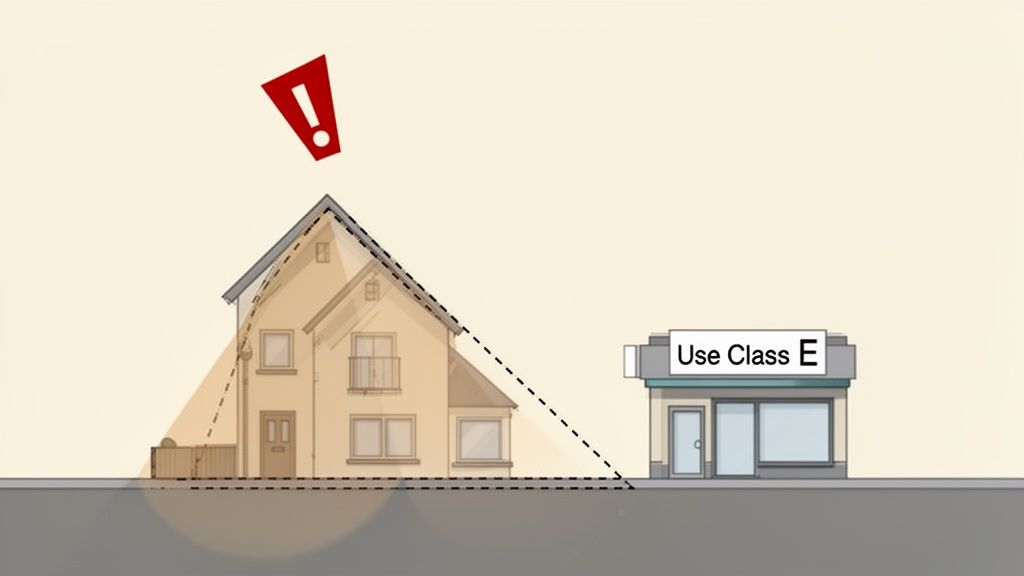
You have found the perfect spot for a rear extension. It will give your family more space and add value to your home. But what about the small office building at the back of your garden? That building could stop your project completely. This is where Use Class E becomes a critical factor for homeowners.
The Hidden Risk Next Door
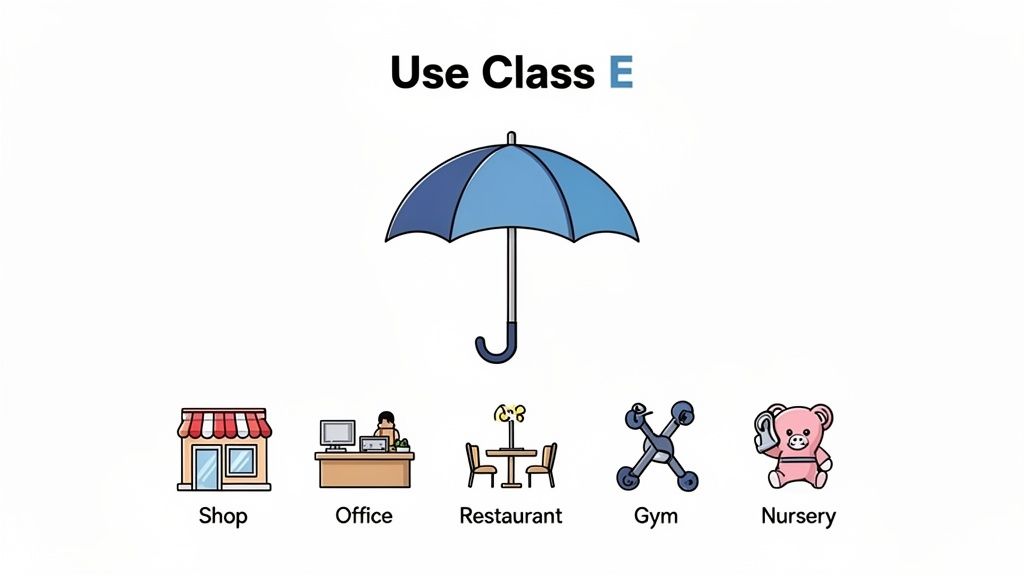
Use Class E is a broad category for most commercial and business uses. It includes shops, restaurants, gyms, and light industrial units. The rules give these businesses great flexibility to change what they do without planning permission.
This means the quiet office next door could become a busy cafe tomorrow. This would bring more noise, traffic, and potential overlooking issues to your property.
Your local council knows this. When they review your planning application, they consider the impact your project could have on that business. They also consider the impact the business could have on you. This creates a two way conflict that many homeowners are not ready for. Your extension might be refused if it:
Blocks daylight to a neighbouring office, harming its ability to operate.
Creates overlooking issues that affect a nursery's outdoor play area.
Is too close to a restaurant, creating potential for future noise complaints.
Avoiding A Costly Mistake
Proceeding without understanding these risks is a gamble. You could spend thousands on architectural drawings and surveys. Then your application could be refused for reasons you did not expect.
This guide explains in plain English how a nearby Use Class E property can affect your project’s chances of approval. It will help you avoid paying for drawings for a project that might fail.
By learning how councils view these situations, you can make smarter decisions. You can adjust your plans before you spend a lot of money. This can save you from months of delays and wasted funds.
Decoding Use Class E In Simple Terms
Understanding Use Class E is vital for homeowners. The quiet accountant's office next to your house could legally become a busy restaurant tomorrow. Nobody would need to ask for permission. This rule directly impacts your home’s privacy, noise levels, and even its value.
Before September 2020, things were different. A shop was a shop. An office was an office. Changing between them usually required a full planning application. This system gave neighbours a chance to object to changes that would affect their quality of life.
Now, Use Class E groups most high street businesses into one large category. It is like a single, flexible umbrella covering everything from professional services to gyms and nurseries.
This change gives commercial landlords and businesses huge freedom. They can switch from one type of business to another within Use Class E without notifying the council or residents. It is a key reason why your local high street might look very different from one year to the next.
What Falls Under The Use Class E Umbrella?
The wide range of businesses covered by Use Class E creates uncertainty for homeowners living nearby. It is good for commerce, but you need to know what could appear next door.
The table below shows the most common types of businesses now grouped together. This makes it easier to spot them in your neighbourhood.
Business Type | What This Means |
|---|---|
Shops and Retail | From small corner shops to large furniture showrooms. |
Cafés and Restaurants | As long as they are not mainly takeaways or bars. |
Offices | Including financial advisors, solicitors, and other professional services. |
Clinics and Health Centres | For medical services without overnight stays, like a dentist or physiotherapist. |
Crèches and Day Nurseries | Childcare facilities for the local community. |
Indoor Sport and Recreation | Such as gyms, yoga studios, and indoor climbing centres. |
As you can see, the list is very varied. For you, this means the risk is not what the neighbouring building is now. The risk is what it could become. A dental clinic with quiet 9 to 5 opening hours might be replaced by a restaurant. This could bring late night noise, cooking smells, and delivery drivers.
The council will not just consider the current business next door when you plan your home project. They must assess the "worst case" scenario of what that Use Class E building could become. They will also consider how your extension might be affected by it.
This potential for future conflict is a major red flag in planning applications. Your plans for a peaceful bedroom extension might be refused. It could be too close to a property that could legally operate as a noisy restaurant, even if it is currently a silent, empty office. Understanding this is the first step to avoiding a costly refusal.
How Nearby Businesses Impact Your Planning Application
Your home project does not exist in isolation. A council’s decision depends on how your plans affect the surrounding area. A neighbouring Use Class E property can create serious problems here. Your beautiful extension could be seen as harmful to a nearby business. Your whole project might be refused just to protect you from that business.
Councils must perform a difficult balancing act. They need to protect the economic health of local high streets. This means supporting those Use Class E businesses. But they also have to protect the amenity of residents. Amenity is planning language for your right to enjoy your home peacefully.
This conflict puts your application at risk. If your proposed extension would block a lot of daylight from a neighbouring office, the council might refuse it to protect the business. The same applies if it creates a serious overlooking issue for a nursery’s garden.
Why Your Future Comfort Matters Now
It is not just about your impact on the business. A planner has to consider what the business could legally become tomorrow under its flexible Use Class E status. A quiet shop could one day become a busy restaurant with late hours and cooking smells.
This is why a council might refuse your application to build a new bedroom window too close to the boundary. Their logic is that it would be unfair to a future resident. That resident might then have to endure noise and disturbance from a legal business activity. It is a proactive refusal. It is designed to prevent future complaints before they happen.
The council will often cite the need to protect the "amenity of future occupiers" when refusing an application. This means they are stopping you from building something that could put you, or a future owner, in a bad position next to a commercial property.
The Planning Terms That Signal Trouble
When you know the language planners use, you can spot potential problems early. A refusal notice will not just say "it's too close to the shop." It will use specific terms to justify the decision. Those terms are clues you can use to adjust your plans.
Watch for these phrases in local planning decisions:
Overbearing impact: Your extension would feel too large or imposing when seen from the neighbouring property.
Loss of light or overshadowing: Your new structure would cast a shadow over the business, making it feel dark.
Overlooking and loss of privacy: New windows in your extension would look directly into the commercial property or its outdoor areas.
Harm to residential amenity: A general term meaning the project would negatively affect a home's quality of life due to noise, smells, or disturbance.
Understanding these refusal reasons helps you anticipate objections. You can design an extension that minimises its impact. This greatly improves your chances of getting approval. You can learn more about spotting potential issues by exploring our guide to checking the impact on your neighbours. A small amount of proactive work can help you avoid months of delay and a costly refusal fee.
When Permitted Development Rights Disappear
Permitted development rights can feel like a free pass. They let you build certain projects without a full planning application. But these rights are not guaranteed. They can be removed, often surprising homeowners who then need formal permission they did not plan for.
This is a common trap, especially in areas with both homes and Use Class E properties. Councils can issue special restrictions called Article 4 Directions. These remove permitted development rights across a specific area. They usually do this to protect a neighbourhood's character. This is good for the area but could stop your project.
Assuming you have permitted development rights when you do not is a costly mistake. If the council finds out, they can issue an enforcement notice. This would force you to tear down everything you have built at your own expense.
The Problem With Protected Areas
The rules are even stricter in places with historical importance. If your property is in a conservation area, your permitted development rights are automatically reduced. The same applies to a listed building, where the rules are even tighter.
In these areas, even small changes might need formal consent. This includes altering windows or putting up a satellite dish. The council’s goal is to preserve what makes the area special. Any work you propose will be closely examined. Ignoring these rules is a serious planning breach.
Heritage rules strongly influence planning outcomes. While 86% of all planning permissions were granted nationally, the situation is different in protected zones. For example, Listed Building Consents for alterations had a 92% approval rate in 2023/24. This shows that well designed projects can succeed, even with extra rules. This matters because if you're in a conservation area, your loft conversion might need full permission and will face a tougher review. You can read more in the latest heritage planning statistics from Historic England.
How To Check If Your Rights Are Restricted
You must check for these restrictions before you start work. Your first step should be your local council’s website. Most councils have an interactive map that shows conservation areas, listed buildings, and any Article 4 Directions.
Finding out your property is affected does not mean your project is impossible. It just means you will almost certainly have to submit a full planning application. You will need to prove that your design is sensitive to the local character. You must show it will not harm the area’s unique feel. For more detail on this, read our guide on what an Article 4 Direction is. Knowing these limits upfront is the only way to avoid wasting money on plans that have no chance of approval.
Discover What Your Council Approves And Rejects
To predict your project’s future, look at its past. The best way to know your chances is to see what your local council has recently approved or refused for similar projects. This is powerful research you can do yourself.
By searching your local council’s online planning portal, you can find applications like yours. Look for those involving properties in Use Class E. Pay attention to the decision notices and officer reports. These documents reveal the real story behind each outcome and show important patterns.
This process gives you real insight into how planners in your area make decisions on building rights and restrictions.
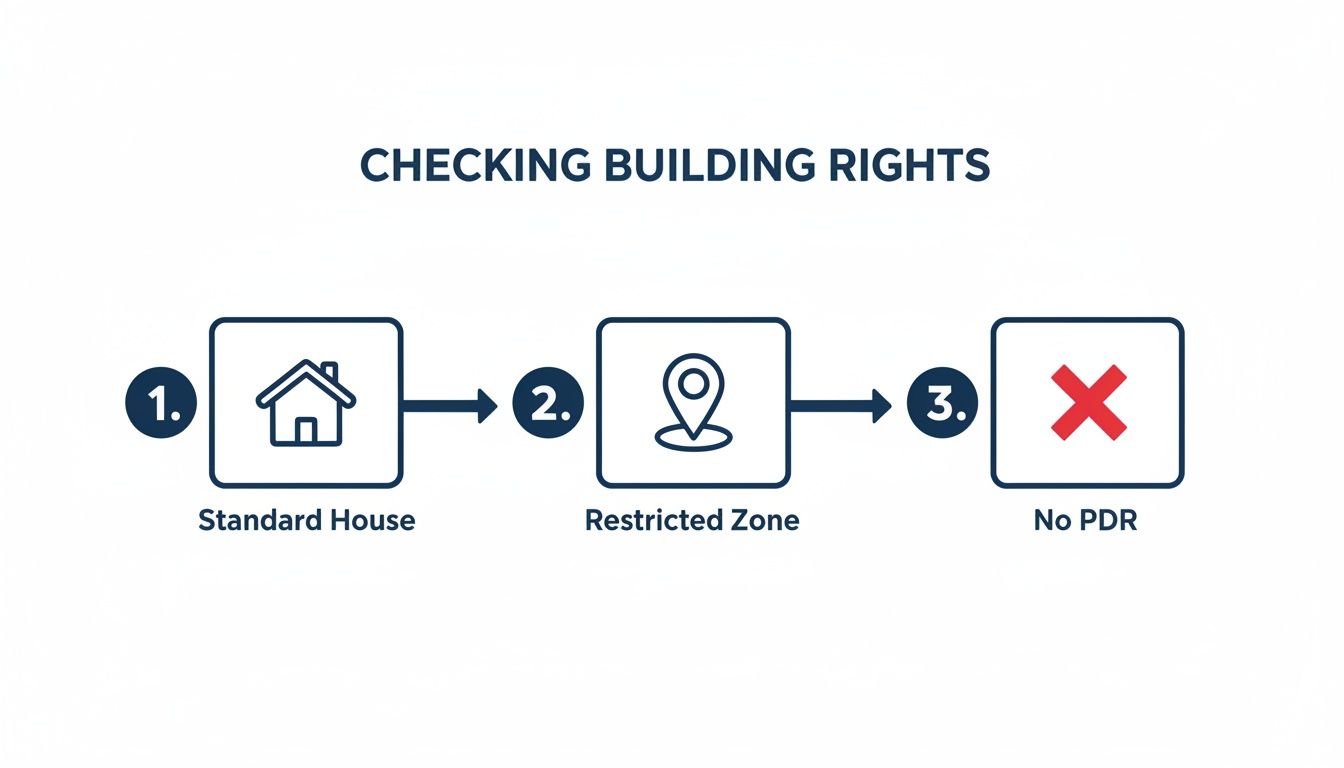
As this flow shows, even a standard house project can lose its permitted development rights if it is in a restricted zone.
Finding The Patterns In Past Decisions
This research is not about a simple yes or no. You are looking for the story behind the decision. What specific objections appeared repeatedly?
You might uncover important insights like:
Repeated refusals for rear extensions that overlook a neighbouring shop's garden.
A series of approvals for loft conversions that used specific materials to match the area's character.
Consistent rejections of plans that blocked morning light to a nearby office.
This kind of evidence is the best way to assess your odds before you spend money on drawings. It shows you exactly what the council values and what it considers a problem.
Understanding The Wider Planning Picture
Looking at local decisions provides a reality check that national statistics cannot. In 2025, UK planning authorities handled 688,151 applications and approved 81% of them. But the 19% rejection rate is a reminder that thousands of projects fail. More details are available in this breakdown of UK planning application approval rates on Searchland.
This is where a SurePlan report can help. We provide evidence, not guarantees. Our £49 report compares your project against recent local decisions. We flag refusal patterns early, such as design issues or neighbour objections that have stopped 10% to 15% of similar projects near you.
By understanding why other applications failed, you can guide your own plans away from the same mistakes. This research gives you the clarity to avoid costly errors, potentially saving you thousands in wasted fees and redesign costs. It is your best defence against a surprise rejection.
Get Planning Clarity Before You Spend Thousands
Researching local planning decisions is a powerful first step. But it takes a lot of time and can be very confusing. Trying to understand council documents full of technical language can feel like a full time job. It leaves you wondering if your home extension is a safe investment or a costly mistake.
This uncertainty is why many homeowners spend thousands on architectural drawings for a project that was likely to fail from the start.
A SurePlan Planning Confidence Report does this hard work for you. For just £49, we examine recent and relevant planning decisions from your local council. We focus on the specific risks your project faces, especially from nearby Use Class E properties that can complicate an approval.
What You Get in 24 Hours
Our report provides a clear, evidence based picture of your chances. We do not guess. You get a straightforward confidence score based on real outcomes in your area. We deliver it in a simple PDF within 24 hours.
Your report will highlight:
A clear confidence score for your project, based on local planning history.
Common reasons for refusal that have stopped similar projects nearby.
Red flags you need to know about, like Article 4 Directions or conservation area status.
We translate complex planning data into plain English. You get the critical information you need without decoding dense council policy documents. Our job is to give you clarity before you commit significant money.
With this evidence, you can have smarter conversations with your architect. You can adjust your plans to improve your chances of success. You might even rethink the project entirely before spending a fortune on fees. It puts you in control, using the same kind of data that planners use.
Whether you choose permitted development or need a full application, knowing the local context is vital. Our analysis helps you determine the most likely path forward. Learn more about choosing your route with our guide on permitted development vs the planning application process.
Frequently Asked Questions
When you are planning a home renovation, you do not want surprises from next door. Here are answers to common questions about Use Class E and how it can affect your project.
Can I Object To A Business Changing Under Use Class E?
In short, no. If a business changes from one use to another within the Use Class E category, you have no grounds to object. For example, a quiet office becomes a busy cafe.
This is because these changes do not require a planning application. The council has no say, and neighbours are not consulted. It happens under permitted development. This is a key reason why councils are cautious about approving extensions near commercial buildings. They know a quiet neighbour today could become a noisy one tomorrow.
How Can I Find Out If A Building Is Use Class E?
The easiest way is to check your local council’s online planning portal. Search for the property’s address and look at its planning history. The most recent approved use or decision notices should specify its official use class.
If the history is not clear, the council’s planning department can usually confirm the use class for a property. It is important to know this before you start planning any work.
Does Use Class E Affect My Property Value?
Yes, it can. The flexibility of Use Class E creates uncertainty for homeowners. A house next to a quiet bookshop is often more desirable than one next to a potential late night restaurant or gym.
This potential for change can make buyers more cautious. It may impact what they are willing to pay for your home.
The risk is not what the neighbouring property is, but what it could become. This uncertainty can be a major issue for potential buyers who want a peaceful home.
Planning is complex, but the first step does not have to be. For £49, a SurePlan Planning Confidence Report gives you evidence based insight into your project’s chances of success, delivered in just 24 hours. Get clarity before you commit thousands.