
Feb 5, 2026
A neighbour's letter objecting to your extension feels like a huge setback. But an objection is not a rejection. Knowing what the council actually cares about helps you avoid a costly refusal and get your project approved.
A Neighbour Objected. What Happens Now?
Receiving that official letter from the council can make your heart sink. It confirms a neighbour has formally objected. Your first thought might be that your project is in jeopardy. Before you panic, you need to understand what this letter really means.
The council is legally required to notify you about any comments. This is just part of the process. It does not mean the planning officer agrees with the points raised. Most homeowners are surprised to learn that the majority of objections carry little weight in the final decision.
Understanding the Council's Perspective
The planning system is not a popularity contest. A planning officer makes a professional judgement based on local and national policies. They do not decide based on how many neighbours are upset. They are trained to separate emotional complaints from real planning concerns.
This means they will almost certainly ignore arguments about:
A potential loss of property value.
The disruption during the building work.
A personal dislike of the design.
Issues covered by other laws, like party wall agreements.
Instead, they focus on valid issues like overlooking, loss of light, or whether the design clashes with the area's character. You can read more about what makes an objection valid in our guide to neighbour objections to planning permission.
Your goal is not to fight every point a neighbour makes. It is to understand which points the council might care about. Then you must ensure your application provides a strong, policy based reason for approval.
Knowing this helps you think strategically instead of feeling anxious. An objection is simply part of the process. Understanding how the system works is the first step to navigating it successfully.
Understanding Valid Planning Objections
Not all objections are equal. When a neighbour objects, councils are legally required to ignore most of their reasons. Decisions can only be based on material considerations. This is the official term for valid planning arguments.
Understanding this difference is your first advantage. It helps you filter the noise of personal complaints from the real risks that could stop your project. A complaint about construction disruption will be dismissed. A valid point about your new window overlooking their garden must be taken seriously.
This process is not about opinions. It is about whether your proposal aligns with planning policies.
Material vs Non Material Considerations
A planning officer is like a judge. They can only make a decision based on specific laws and evidence. Anything else is legally irrelevant. In planning, these "laws" are the material considerations.
An objection based on a non material consideration is set aside. These points fall outside the legal scope of the planning system.
Common examples the council will ignore include:
Loss of property value: Planning does not exist to protect private financial interests.
Noise and disruption during building: This is covered by other laws, not planning permission.
Boundary disputes: These are civil matters for solicitors.
Loss of a private view: No one has a legal right to a view over another person's property.
This diagram shows how a neighbour's objection is processed.
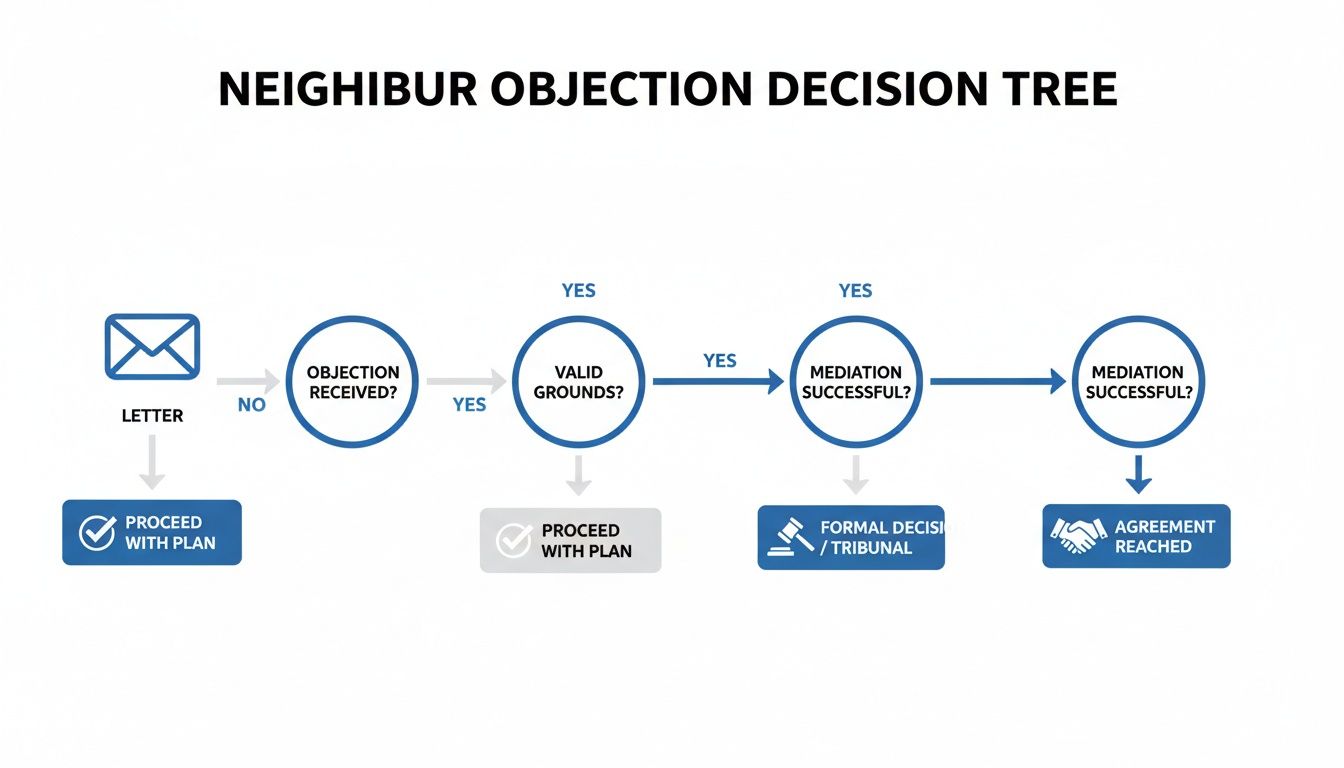
As the decision tree shows, the process filters objections to see if they are based on valid planning grounds.
In contrast, material considerations are the valid arguments that directly relate to planning policy. These are the points a planning officer will carefully assess. An objection that uses one of these points can genuinely threaten your application.
A single objection based on a valid material consideration carries more weight than twenty complaints based on personal feelings. Knowing the difference helps you focus on what really matters to the council.
Valid vs Invalid Planning Objections: A Clear Comparison
This table shows which arguments the council must consider and which ones they legally have to ignore. Understanding this helps you assess the real risk to your project.
Objection Type | Example | Does It Count As a Valid Reason for Refusal? |
|---|---|---|
Overlooking & Loss of Privacy | "Your new bedroom window looks directly into our garden and living room." | Yes. This is a classic material consideration. |
Loss of Light or Overshadowing | "The two storey extension will block all the afternoon sun from our kitchen." | Yes. Councils use specific tests to measure this and it is a very strong reason for refusal. |
Design & Appearance | "The modern metal cladding looks completely out of place on this street of Victorian brick houses." | Yes. The design must respect the character of the area. |
Highway Safety & Parking | "Removing the driveway means more cars will be parked on this already dangerous and narrow road." | Yes. If it creates a safety issue, the Highways department will likely object. |
Noise from Proposed Use | "Turning the garage into a commercial car repair workshop will create constant noise next to our house." | Yes. This relates to the ongoing use, not temporary building work. |
Loss of Property Value | "Your extension will devalue my home." | No. This is a non material consideration. Planning does not protect private financial interests. |
Disruption During Construction | "The building work will be too noisy and dusty for six months." | No. This is controlled by other regulations, not the planning system. |
Loss of a Private View | "We have always been able to see the hills from our lounge, but your new loft conversion will block it." | No. There is no legal 'right to a view' in planning law. |
Land Ownership Disputes | "Your proposed extension is going to be built over our boundary line." | No. This is a civil matter for solicitors and has no bearing on the planning decision. |
Focusing your efforts on valid objections helps you prepare a stronger application.
Examples of Valid Objections
What kind of objections does a council have to consider? These issues can lead to a refusal if you do not address them properly.
Overlooking and Loss of Privacy: This is one of the most common and powerful objections. The council will take this seriously if your new window or balcony directly overlooks a neighbour's private space.
Loss of Light or Overshadowing: Your extension cannot block an unreasonable amount of daylight from a neighbour's home or garden. Planners use specific tests, like the 45 degree rule, to measure this impact.
Parking and Highway Safety: The Highways department may object if your proposal removes parking or creates new traffic issues.
Design and Appearance: The design must respect the character of the house and the surrounding area. An extension that looks out of place can be refused.
Impact on a Conservation Area or Listed Building: Stricter rules apply in these protected areas.
Noise from the Proposed Use: This is different from building noise. For example, turning a garage into a workshop for a noisy business could be a valid objection.
Focusing on these valid points helps you anticipate problems and speak the same language as the planning officer. You can learn more about how councils assess the impact on neighbours in our detailed guide. This knowledge helps you build a stronger application from the start.
How a Council Actually Decides Your Application
When you submit your plans, it can feel like they disappear into a black box. Many homeowners think their application is decided by a popularity contest. The truth is different. The process is a professional balancing act.
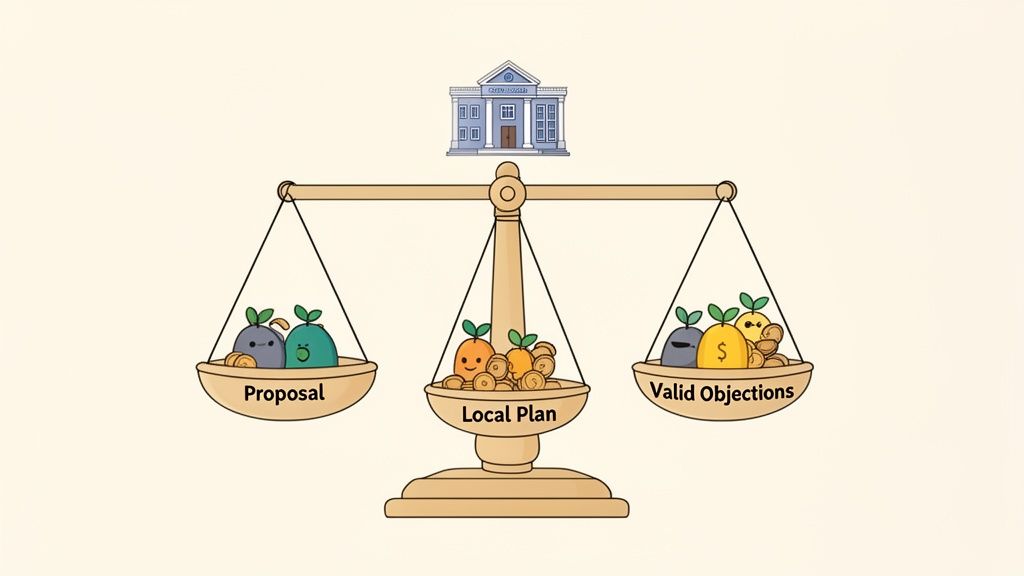
A planning officer’s decision weighs three core elements. Think of it like a set of scales.
On one side is your proposal. On the other are any valid planning permission objections. The pivot in the middle is the council’s Local Plan. This is the rulebook they must follow. Your application gets approved only if the officer decides it aligns with that rulebook. The benefits must be strong enough to outweigh any conflicts with policy and the harm raised by valid objections.
The Power of One Good Objection
It is vital to understand that quality beats quantity. The planning officer does not just count the number of letters for and against your project. Their job is to analyse the substance of the arguments.
This is why one well researched objection that references a specific planning policy can carry more weight than 20 generic complaints. An objector who correctly points out your extension breaches the council's "45 degree rule" presents a real, evidence based problem. A stack of letters complaining about construction noise will be set aside as non material.
The planning officer gathers evidence. Their recommendation is a professional conclusion based on how your proposal stands up against the council's own published rules.
This means you should not waste energy on local gossip. Instead, you need to focus on building a strong case that shows how your plans meet the required policies.
The Role of the Local Plan
Every council has a Local Plan. It is a large document that sets out the rules for all future development. It contains the specific policies your application will be judged against.
The Local Plan covers everything from design standards to environmental protection. For a home extension, the relevant policies will likely include rules on:
Design and Character: Ensuring new development respects the look of the area.
Residential Amenity: Protecting neighbours from issues like being overshadowed or losing privacy.
Highways and Parking: Making sure your project does not create unsafe road conditions.
The planning officer will check your proposal against each relevant policy. If your plans align with the Local Plan, they are already on firm ground for approval, even with objections.
The Balancing Act in Practice
The final decision comes down to professional judgement. If your project ticks every policy box, the officer will almost certainly recommend it for approval. If it clearly violates a key policy flagged in a valid objection, it is probably heading for a refusal.
The grey area is where the real balancing act happens. Sometimes, a project might conflict with one minor policy but offer other benefits. In these situations, the officer weighs the harm against the benefit to reach a final recommendation.
This process can vary hugely between councils. In London, for example, there are stark divides in how objections affect outcomes. Government data reveals distinct 'blockers and approvers' among the 32 boroughs. An objection citing specific local rules can be very powerful. Knowing the best way forward is often impossible without local insight. You can discover more about these local authority divides on London Forum.
Knowing the decision is a methodical, evidence based process is empowering. It lets you focus on presenting a solid case that addresses policy.
Proactive Steps to Avoid Costly Objections
The best way to deal with planning objections is to prevent them. A refusal after months of waiting is frustrating. It can also cost you thousands in wasted fees and redesigns. A proactive approach turns uncertainty into a clear strategy. You can save time, money, and stress before your application even goes in.
It is about preventing problems rather than reacting to them. A few simple actions can make a huge difference. You can show the council and your neighbours that you have carefully considered your project’s impact. This small investment of time upfront is the single best way to protect your bigger investment.
Start with a Simple Conversation
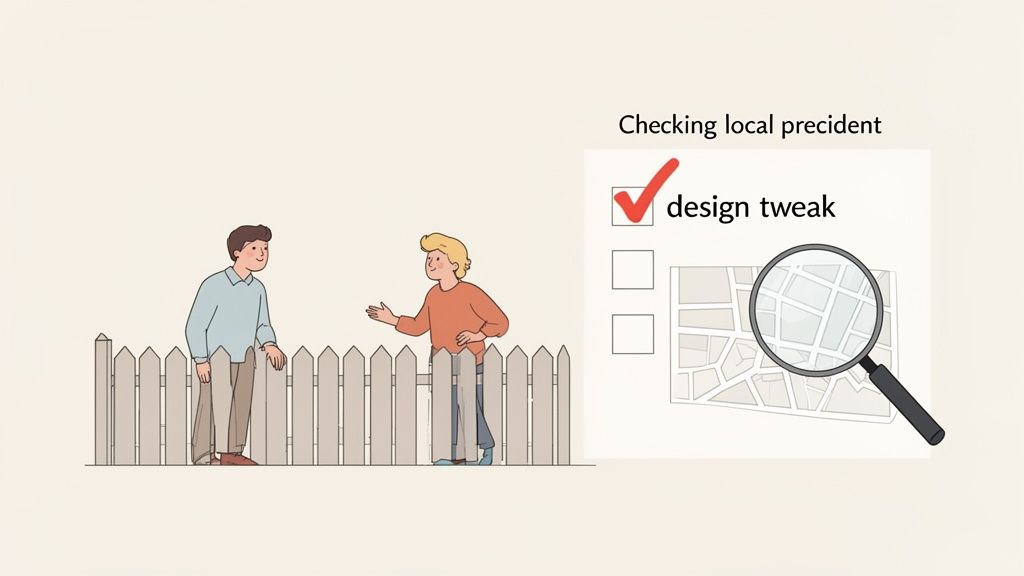
Before you submit any official documents, have a friendly chat with your immediate neighbours. This is not about asking for their permission. It is about politely letting them know what you are planning. It shows you have considered them from the start.
Most objections come from a fear of the unknown. A quick conversation where you show them a sketch can replace anxiety with understanding. You might learn about a specific concern, like a window placement, that you can easily adjust. This simple act builds goodwill and often stops objections before they are ever written.
Make Smart Design Tweaks
Small changes to your design can have a huge impact. By thinking ahead about the most common valid objections, you can address them in your initial plans.
Consider these minor adjustments:
Window Placement: Use obscured glass or position windows to avoid directly overlooking a neighbour’s garden or main rooms.
Roof Design: Choose a hipped roof instead of a flat one to reduce the visual bulk of an extension.
Material Choices: Select materials that complement your home and the character of the street.
These tweaks show the planning officer you are being considerate. It signals you have already worked to minimise any negative impact. This makes their job of approving your application much easier.
Your Secret Weapon: Local Planning Precedent
While chats and design tweaks are helpful, your most powerful tool is evidence. The best predictor of your project’s success is what has already been approved and refused on your street. This is called planning precedent.
Every decision your council makes is public. Analysing these past outcomes reveals clear patterns. It shows you what planners in your area are likely to approve. It tells you what they consider acceptable in size and design, and their common reasons for refusal.
UK planning decisions dipped slightly in 2023. Local authorities issued 80,800 decisions from April to June alone. Refusals can lead to appeals where the average inquiry time hit 34 weeks in June 2023. Objections can turn a simple extension into a year long ordeal. You can learn more about the latest planning application trends on Planning Resource.
Without knowing these local refusal patterns, you are gambling with your application.
Understanding local precedent is like being given the answers to the test before you take it. It removes guesswork and lets you build your case on a foundation of proven success.
However, sifting through hundreds of council documents is complicated. This is where evidence based tools become essential. An affordable SurePlan Planning Confidence Report does this difficult work for you. It analyses local data to flag the exact reasons similar projects were refused. This helps you avoid making the same expensive mistakes. Before you commit to any large costs, you can quickly check your project's planning refusal risk with objective, local data. This clarity gives you the power to proceed with confidence.
What to Do If Your Application Is Refused
Receiving a refusal notice feels final, but it is not the end of the road. Think of it as a fork in the road. One path can save you time and money. The other can cost you dearly.
Your two main options are to appeal the decision or to amend your plans and resubmit.
Making the right choice is vital. One path is a long, expensive, and uncertain gamble. The other offers a faster, cheaper, and more predictable route to approval.
Option 1: The Planning Appeal Gamble
Challenging the council's decision with the Planning Inspectorate might seem like the obvious first step. You feel the decision was unfair, so you want to fight it.
But this is a risky process. You should think very carefully before committing.
An appeal is not a quick fix. The process is long, often taking around six months from start to finish. During this time, your project is completely stalled.
More importantly, the odds are against you. In the UK, planning permission objections often lead homeowners down the costly path of appeals. Section 78 appeals against refusals saw only a 30% success rate in the final quarter of 2025.
According to the Planning Inspectorate, just 786 appeals were allowed between October and December 2025. This shows how tough it is to overturn a local council's decision. You can learn more about the latest planning appeal statistics directly from the source.
For homeowners, this statistic is a critical warning. Most appeals fail. They drag out timelines and inflate costs on professional fees and delays. These costs often exceed £10,000.
Option 2: The Smarter Path of Amending and Resubmitting
The smarter, safer, and cheaper option for most homeowners is to work with the council.
A refusal notice is not just a "no." It is a "no, because..." The reasons provided are a clear roadmap showing you exactly what needs to change.
This approach involves three simple steps:
Read the Decision Notice Carefully: The planning officer will have listed the specific policies your design failed to meet. This is free, expert feedback telling you precisely what to fix.
Amend Your Design: Work with your designer to make changes that directly address the reasons for refusal. This might mean moving a window or slightly reducing the size.
Resubmit Your Application: In most cases, you will not have to pay another council fee if you resubmit an amended application within 12 months.
This route is almost always faster and cheaper than an appeal. You are not starting from scratch. You are making small, informed adjustments based on clear instructions.
A refusal is not a personal rejection. It is a technical problem with a technical solution. Use the feedback to fix the problem and move forward with your project.
This entire situation shows the value of getting your application right the first time. By understanding local precedent and anticipating potential planning permission objections before you submit, you can avoid this stressful and expensive fork in the road.
An evidence based report can flag these risks early. This allows you to design a proposal that sails through the system without needing appeals or redesigns.
Frequently Asked Questions About Planning Objections
When objections start coming in, it is easy to feel overwhelmed. Here are straightforward answers to the questions we hear all the time from homeowners. The goal is to give you a clear path forward.
Can I Find Out Who Objected to My Planning Application
Yes. All comments and objection letters are public documents.
You can find them on your local council’s online planning portal. They usually include the name and address of the person who sent them. This transparency is a standard part of the UK planning process. Knowing who objected and what they said helps you see if their concerns are valid planning issues.
How Many Objections Does It Take to Stop an Application
There is no magic number. A planning decision is based on the quality of the objections, not the quantity. It is not a popularity contest.
A single, well argued objection that points to a specific planning policy can be enough to cause a refusal. On the other hand, dozens of objections based on personal feelings will be set aside by the planning officer. Their focus is always on policy, not public opinion.
Should I Withdraw My Application if Neighbours Object
Not necessarily. Your first move should be to calmly read their objections. Figure out if their concerns are based on legitimate planning matters, like loss of light or privacy.
If a neighbour raises a valid point, withdrawing your application to tweak the design can be a smart move. It shows the council you are willing to cooperate and could save you from a likely refusal.
However, if the objections are about non material issues, it is often best to let the application continue. The planning officer is trained to filter those out. They will make a professional judgement based on facts and policies.
Do I Need an Expensive Consultant to Handle Objections
For most straightforward home extensions, probably not. You or your architect can usually write a clear, polite response to the planning officer to address any valid concerns.
A planning consultant is usually only needed for very complex projects, or if objections raise tricky legal or technical challenges. Getting evidence on local planning precedent first can help you gauge the real risk. That insight will help you decide if you need to spend extra money on professional help.
Before you spend thousands on architects and application fees, get the facts. For just £49, SurePlan delivers a Planning Confidence Report that analyses recent decisions in your area. Understand the real risks and proceed with clarity. Get your report here.