
Feb 15, 2026
Getting planning permission for a loft conversion is a major worry for many homeowners. You might not need it at all. Understanding the rules first helps you avoid a common mistake that can cost you £258 in wasted application fees and months of delay.
The good news is most loft conversions do not need a full planning application. They often fall under a government scheme called Permitted Development Rights. This scheme allows common home improvements without a lengthy approval process. This saves you time, money, and stress.
Two Paths to Get Your Loft Approved
There are two ways to get approval for your loft conversion. You can use a fast pass to skip the main queue. Or you can wait in the standard line. Knowing which path your project needs is the first step to avoid a costly refusal.
This decision tree gives you a quick visual guide.
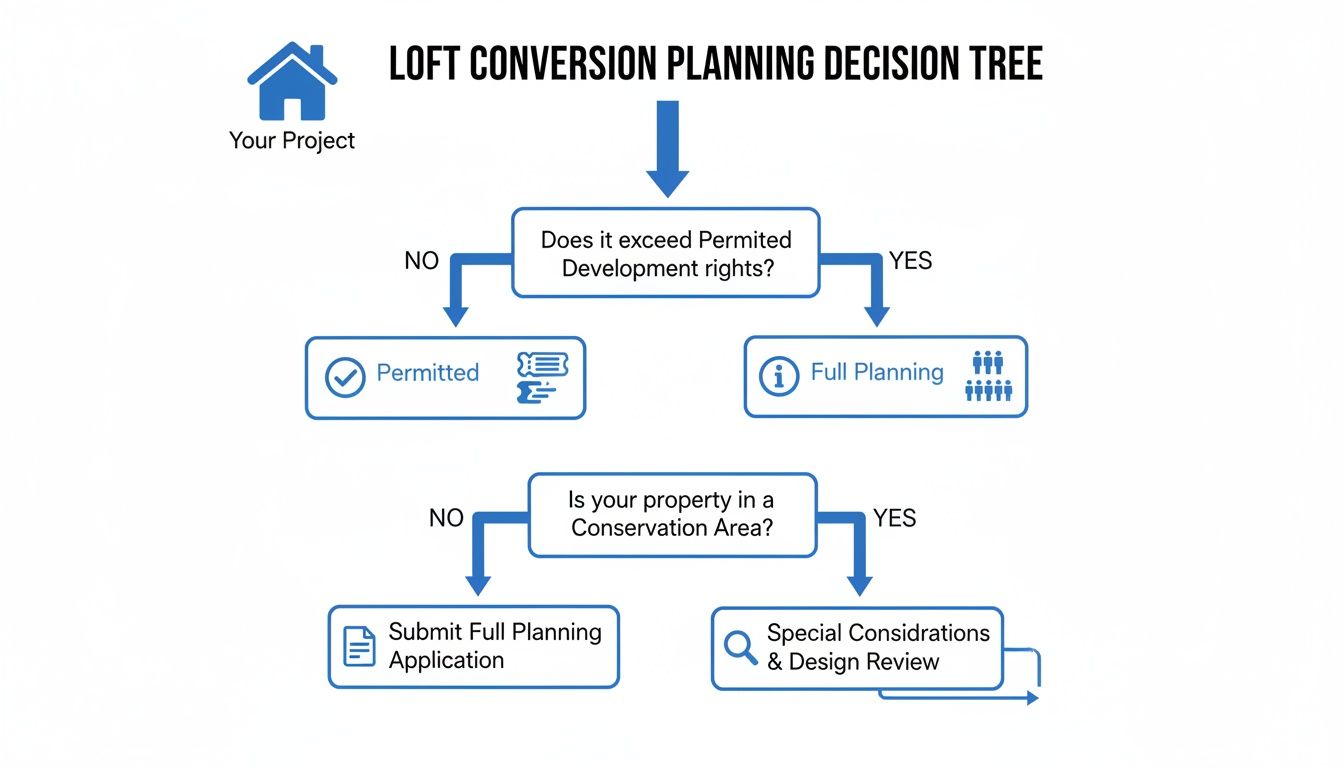
The flowchart shows the key question. Does your project qualify for Permitted Development? Or do special circumstances mean you need a full planning application?
The Fast Pass: The Permitted Development Route
Permitted Development (PD) Rights are like a pre approved green light from the government. If your loft conversion plans fit within a strict set of rules, you can bypass the main planning process. For most homeowners, this is the best route. It is faster, cheaper, and more predictable than a full application.
This fast pass has conditions. Your design must respect specific limits on size, height, and materials. If you go outside these rules, you lose your fast pass and have to join the main queue.
The Main Queue: The Full Planning Application Route
If your project does not meet the PD criteria, you must submit a full planning application. This often happens if your property is in a protected area, like a conservation area. It also happens if your design is ambitious. Adding a balcony or a large front facing dormer will almost always need full permission.
This process takes longer, typically 8 to 13 weeks. Your local council will carefully check your project's impact on your neighbours and the local area. A full application is more complex. But it is often the only way to build certain types of loft conversion.
This table shows the difference between the two paths.
Permitted Development vs Full Planning Permission
Factor | Permitted Development (Fast Pass Route) | Full Planning Application (Main Queue) |
|---|---|---|
Speed | Faster. A Lawful Development Certificate can take 8 weeks. | Slower. A decision typically takes 8 to 13 weeks. |
Cost | Less expensive. Certificate fees are lower than application fees. | More expensive. The application fee is £258 plus higher design costs. |
Process | A check against a fixed list of national rules. | A detailed assessment by a council planning officer. |
Certainty | More predictable if your plans meet the criteria. | Less predictable. The decision depends on local policies. |
Knowing which queue you are in from day one helps you plan a smooth, successful project.
The Rules for Permitted Development Lofts
Many loft conversions do not need a full planning application. Your project can avoid the time and cost of the planning route if it follows government rules known as Permitted Development. This is like a pre approved pass for home improvements.
You must get it right. If your plans break even one rule, you lose your Permitted Development rights. You will then have to submit a full planning application. We have translated the official rules into a simple checklist below.
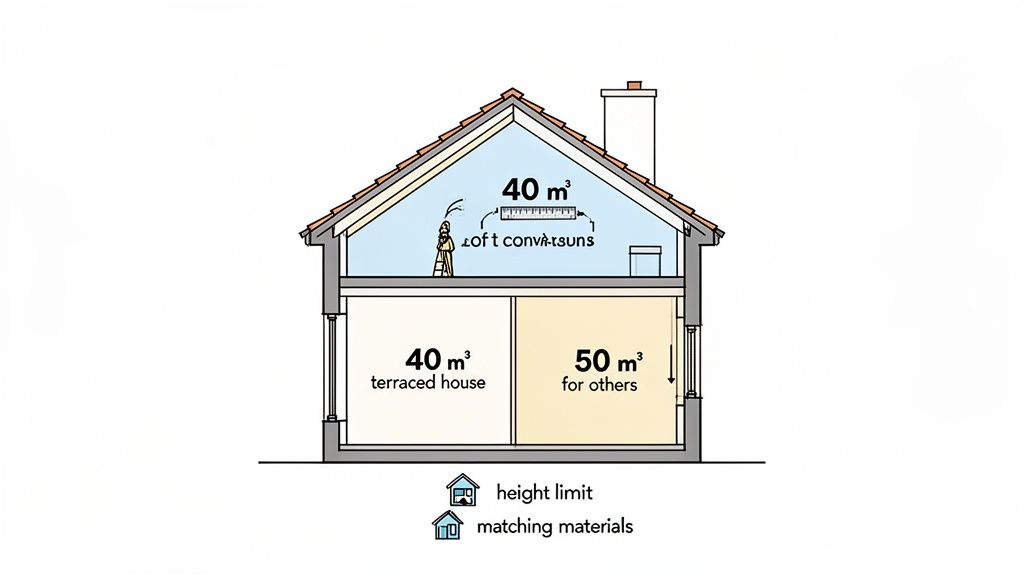
Permitted Development Checklist
Your loft design must follow these key rules. Each rule is there to limit the impact your conversion has on your neighbours and the street.
1. Volume Limits The new space cannot be larger than 40 cubic metres for a terraced house. It cannot be larger than 50 cubic metres for a semi detached or detached house. This volume includes any previous roof extensions.
Why you should care: This is a common problem. Miscalculating the volume can push your project into needing full planning permission. 40 cubic metres is a good size, like a large bedroom with an ensuite. But it is easy to go over the limit.
2. No Extensions at the Front Your extension cannot go beyond the main slope of the existing roof that faces the road. In simple terms, this means no dormer windows on the front of your house.
Why you should care: This rule protects the look of your street. Protruding front dormers can change a property's appearance. Councils want to control this through the full planning process.
3. Height Restrictions The loft conversion cannot be higher than the highest part of your original roof. The new structure should be contained within the existing roofline.
Why you should care: Raising the roof ridge is a major structural change that alters the skyline. Staying below the existing ridge line ensures your conversion is a subtle addition.
4. Use Similar Materials The materials used on the outside of your loft must look similar to those on the rest of the house. This applies to tiles, brickwork, and window frames.
Why you should care: This ensures your new loft blends in. Using materials that clash with your home’s character is a fast way to get unwanted attention from planners. You can learn more in our complete guide to Permitted Development rules in the UK.
5. No Balconies or Verandas You cannot add balconies, verandas, or raised platforms under Permitted Development. Juliet balconies, where doors open inwards behind a safety rail, are usually allowed.
Why you should care: Balconies create a direct line of sight into neighbouring gardens. This is a huge privacy concern. Councils almost always want to assess this impact through a full application.
6. Side Windows Must Be Obscure Any windows on the side of your loft must be obscure glazed. They must also be non opening, unless the opening part is at least 1.7 metres above the floor.
Why you should care: This rule protects your neighbours' privacy. Obscure glass lets in light without allowing you to look directly into their property.
Permitted Development is a shortcut. But it is an all or nothing deal. If your project ticks every box, you can move forward. If it fails just one, you need to prepare for a full planning application. Knowing these rules before you hire an architect gives you an advantage. You can shape your ideas around what is likely to get a quick approval. This saves you from paying for designs that are destined for the slower, more expensive planning route.
When You Must Get Full Planning Permission
The Permitted Development route is not an option for everyone. Certain red flags will automatically push your project into needing a full planning application. Spotting them early saves you from spending money on plans that will be rejected. If your property or your plans tick any of these boxes, you will need a full planning application.
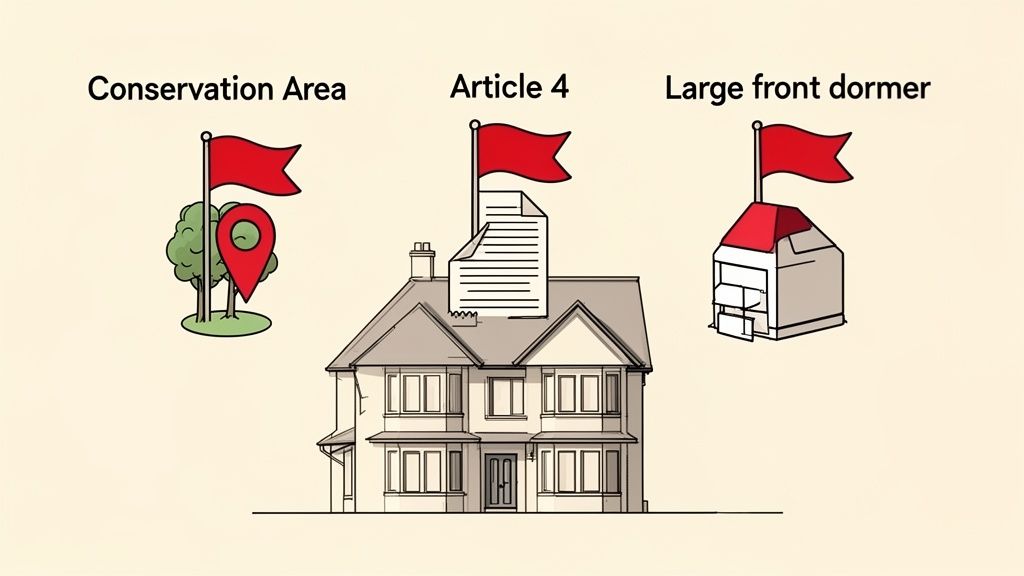
Living in a Protected Area
Your property's location is the first thing to check. If your home is in what planners call a designated area, your Permitted Development rights are often restricted or removed. These areas are protected for their special character or natural beauty.
Common designated areas include:
Conservation Areas: Zones with special architectural or historic interest. The council wants to preserve their character. Almost any external change will require full planning permission.
National Parks and The Broads: These protected landscapes have very strict rules to stop development spoiling their beauty.
Areas of Outstanding Natural Beauty (AONBs): Similar to National Parks, development in these areas is tightly controlled.
World Heritage Sites: These globally significant locations have the highest level of protection. Any proposed changes will be intensely checked.
If you live in one of these places, do not assume you can use Permitted Development. The council will want to look closely at how your loft conversion might impact the area.
When the Council Removes Your Rights
Sometimes a local council issues an Article 4 Direction. This is a legal tool they use to remove specific Permitted Development rights in a small area. Councils often do this to protect the character of a neighbourhood with a consistent look.
For example, a street of Victorian terraced houses might have an Article 4 Direction. This would stop homeowners adding modern dormers that could ruin the historic roofline. If an Article 4 Direction covers your property, you will need full planning permission for work that would normally be allowed. Check your local council's website for these restrictions.
Many homeowners do not realise their property is in a Conservation Area or under an Article 4 Direction until it is too late. This can lead to a rejected application and wasted architect fees.
Your Design Is Too Ambitious
Your design choices can also force you into a full application, even if your property has no restrictions. The moment your plans go outside the strict Permitted Development rules, you lose automatic approval.
This is a common issue. It usually happens when:
You want a dormer on the front of your house. The rules clearly state no extension can go beyond the roof plane that faces the road.
Your design is too big. Going over the 40 cubic metre limit for a terraced house or 50 cubic metres for others will trigger the need for a full application.
You plan to add a balcony. Verandas and balconies are forbidden under Permitted Development. This is mainly because of the impact on your neighbours' privacy.
Recent government data for early 2025 shows that 80% of prior approval applications for home extensions are approved. The remaining 20% are refused. These refusals often happen because plans clash with local restrictions like Article 4 Directions or conservation area rules. These situations demand the full check of a planning application.
Understanding these triggers is vital. Knowing from the start that you need a full application lets you budget correctly for the fees and longer timescales. You can find out more by reading our guide on when Permitted Development isn’t enough.
How the Planning Application Process Works
If your loft conversion plans fall outside Permitted Development, you need to go through the formal planning application process. It is a well known path. Once you understand the steps, it is less intimidating. We will break down the journey, from submitting drawings to getting the final decision. Knowing what to expect helps you plan your timeline and budget.
Prior Approval for Permitted Development
First, a quick note. Some larger projects that fall under Permitted Development still need the council to be notified. This is done through a process called Prior Approval. This is a much lighter and faster process than a full application. The council's main job is to check how your project might impact your immediate neighbours, such as overlooking or loss of light. It is for projects that are generally acceptable but need a quick, official check.
The Full Planning Application Journey
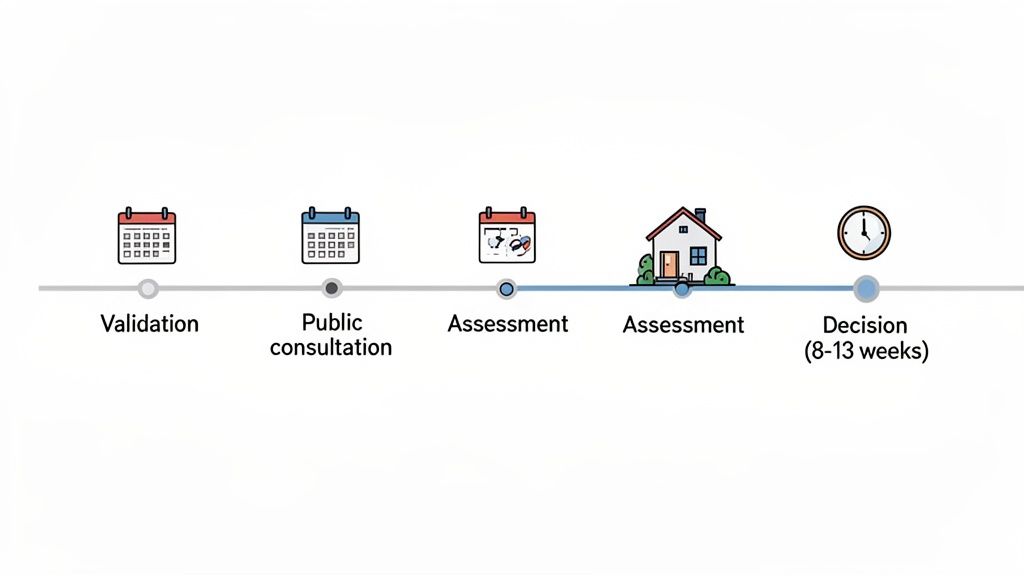
A full planning application usually takes between 8 and 13 weeks from start to finish. It has clear stages to make sure every project gets a fair assessment.
Here is what the timeline looks like step by step:
Submission and Validation: You or your architect will submit your application, drawings, and the £258 application fee. A council officer then checks that all the required documents are correct. This can take up to a week.
Public Consultation: Once validated, your application goes public. Your immediate neighbours will get a letter. Sometimes a notice is posted near your house. They typically have 21 days to send comments.
Site Visit and Assessment: A planning officer will usually visit your property to see the site. They will then assess your plans against local planning policies and consider any comments from neighbours.
Decision Making: Finally, the officer writes a report recommending either approval or refusal. For most small household projects like loft conversions, a senior officer makes the final call. It does not usually go to a committee meeting.
This structured process ensures that decisions are based on established local rules.
Why Most Applications Get Approved
The process can feel daunting, but the odds are in your favour. National statistics show that councils approve good quality home improvements that give families more space.
In the year ending September 2025, planning authorities in England approved 87% of all applications. This shows that well designed, sensible projects have a very strong chance of getting a green light. You can find out more about UK planning application statistics on GOV.UK.
Still, a 13% refusal rate means thousands of homeowners spent time and money on plans that failed. This is why it is vital to check your project against local rules and similar past applications before you apply. A successful application almost always comes down to good preparation. Understanding the council’s rules and submitting clear, professional drawings that respect the local character gives you the best possible chance of getting a yes.
Knowing the path your application will take makes the process clearer. It lets you plan with confidence. For more detailed advice, check out our guide on how to prepare a strong planning application.
How to Avoid a Planning Refusal
A planning refusal is a costly mistake. It can waste months of your time and thousands of pounds on architect’s fees for drawings you cannot use. Knowing why councils refuse certain loft conversions is the best way to avoid making the same errors. Learning from rejected applications gives you a head start. You can shape your design from day one to avoid the most common problems. This gives your project the strongest possible chance of success. This is not about finding loopholes. It is about smart preparation.
Out of Character Designs
A common reason for refusal is that the proposed loft conversion is 'out of character' with the street. This is a big issue in areas with a consistent look, like a row of Victorian terraces. A large, boxy dormer on a period property can be seen as jarring and damaging to the area’s appearance. For instance, a homeowner in a conservation area proposed a very modern dormer with zinc cladding. The council refused it because the materials and bulky design did not respect the historic character of the surrounding properties. You can tell your architect to design something more sympathetic from the start.
Too Large or Overbearing
Even if your design uses the right materials, its size and scale can still cause a refusal. Planners often reject designs they consider 'overbearing' or 'dominant'. This means the extension looks too big for the original house or it unbalances a pair of semi detached homes. Imagine a semi detached house where one owner builds a massive dormer. The council would likely refuse this, stating it creates a 'top heavy and unbalanced' appearance. Your design should feel like a natural addition to your home.
A successful design is often a subtle one. Planners are not against loft conversions. They are against designs that dominate the original house or disrupt the harmony of the street.
Overlooking and Loss of Privacy
One of the biggest concerns for a council is the impact on your neighbours. A new window that looks directly into a neighbour's bedroom or garden is a guaranteed red flag for any planning officer. This is known as 'overlooking', and it is a frequent and predictable cause of planning refusal.
Direct Overlooking: Windows that provide a clear view into a neighbour's private spaces like living rooms, bedrooms, or back gardens are almost certain to be rejected.
Perceived Overlooking: Even if the view is not direct, a new, large window can create an uncomfortable feeling of being watched. Planners take this seriously.
This is why Permitted Development rules insist on obscure glazing for side facing windows. If your project needs a full planning application, the position and screening of your new windows will be checked very closely.
Most homeowners do get their applications approved. Official government figures from spring 2025 show that householder projects had an 88% approval rate. Refusals still happen, often due to these predictable and avoidable issues. Getting ahead of them is the key to success. You can explore the latest UK government planning statistics to see these trends.
Your Next Step Before Spending Thousands
You now know that planning permission for a loft conversion is not always needed. Many projects are approved under Permitted Development. But the rules are complicated and local restrictions can catch you out. This can turn a simple project into a costly refusal.
The most expensive mistake is to assume your project is simple. Moving ahead based on guesswork can mean you spend thousands on architect’s fees for a design your local council would never approve. The key is to check the real risks for your specific property before you commit any serious money.
Get Evidence Before You Spend
A small, early investment can save you from a much larger one later. Instead of guessing, you can look at real local planning data. See what is being approved or refused on streets like yours.
A SurePlan Planning Confidence Report does exactly this. For £49, it gives you a clear, evidence based picture of your chances. We do not deal in opinions. We give you facts, based on your own council’s recent decisions. It is a tool designed to give you clarity before you are financially committed. This helps you reduce risk and move forward with confidence.
For just £49, a SurePlan report provides the evidence you need to talk to your architect and avoid costly mistakes. It is a small price for significant peace of mind.
What Your Report Will Tell You
You will get a simple PDF that translates complex planning data into plain English. It is not a guarantee of approval. It is a reality check. It is an evidence based tool that helps you understand the real world context for your project.
Here is what you get:
A Clear Confidence Score: Based on how your council has decided on similar projects nearby.
Hidden Risk Flags: We automatically check if your property is in a Conservation Area or under an Article 4 Direction. These are things that often trip homeowners up.
Local Approval and Refusal Patterns: You will see real life examples of what gets approved and what gets rejected in your neighbourhood.
Your Most Likely Path: We will outline whether your project is likely to fall under Permitted Development or will need a full planning application.
With this knowledge, you can approach architects and builders from a position of strength. You can ask the right questions and ensure your investment is built on a solid foundation of evidence, not just hope.
Frequently Asked Questions
Once you understand the main rules for loft conversions, a few other questions often come up. Thinking through these details now will save you from confusion and unexpected costs.
It is easy to get confused by the different types of approvals you might need. They can look similar but are separate processes. Knowing the difference is important.
What Is the Difference Between Planning Permission and Building Regulations?
This is a very common point of confusion. The distinction is simple.
Planning permission is about whether you are allowed to build it. It looks at the bigger picture. What will your conversion look like from the outside? How big is it? What impact might it have on your neighbours and the street?
Building Regulations are about how you build it. These are the technical rules that make sure the new structure is safe, warm, and structurally sound. You will almost certainly need Building Regulations approval, even if you do not need planning permission.
Do I Need a Party Wall Agreement for My Loft Conversion?
If you live in a terraced or semi detached house, then yes, it is very likely. You share a 'party wall' with your neighbour. The Party Wall Act is there to make sure any work affecting it is handled properly.
A typical loft conversion involves putting new steel beams into that shared wall to support the new floor. This work legally requires you to give your neighbours formal written notice before you start. It is a separate legal step from planning permission. It is designed to protect both you and your neighbours from disputes.
How Much Does a Planning Application for a Loft Cost?
The official application fee is low. In England, a standard householder application for an extension costs £258.
But that is just the council’s fee. The real cost comes from the professional services needed to prepare your application. You will need detailed architectural drawings and supporting documents. This can easily cost anywhere from £1,000 to £2,500. It can be more if the project is complex.
This is a serious investment in professional plans. It is why you need to be sure about your chances before you commit. If your application is refused, that money is wasted on drawings for a project that cannot be built. Getting a clear, evidence based view of your chances first helps you invest that money wisely.
Before you spend a single pound on architectural drawings, find out where you stand. SurePlan gives you an evidence-based report using your local council's own data to show you the real risks and opportunities for your property. Get your report at https://www.getsureplan.co.uk.