
Feb 12, 2026
Want to extend your home but dread applying for planning permission? You might be able to avoid the cost and the eight week wait. Understanding your permitted development rights lets you know if you can build without a full planning application.
These rights are a type of pre approved permission from the government for common projects like extensions or garden rooms. Knowing if you have them saves you time, money, and the risk of a costly planning refusal.
Build Your Extension Faster and With More Certainty
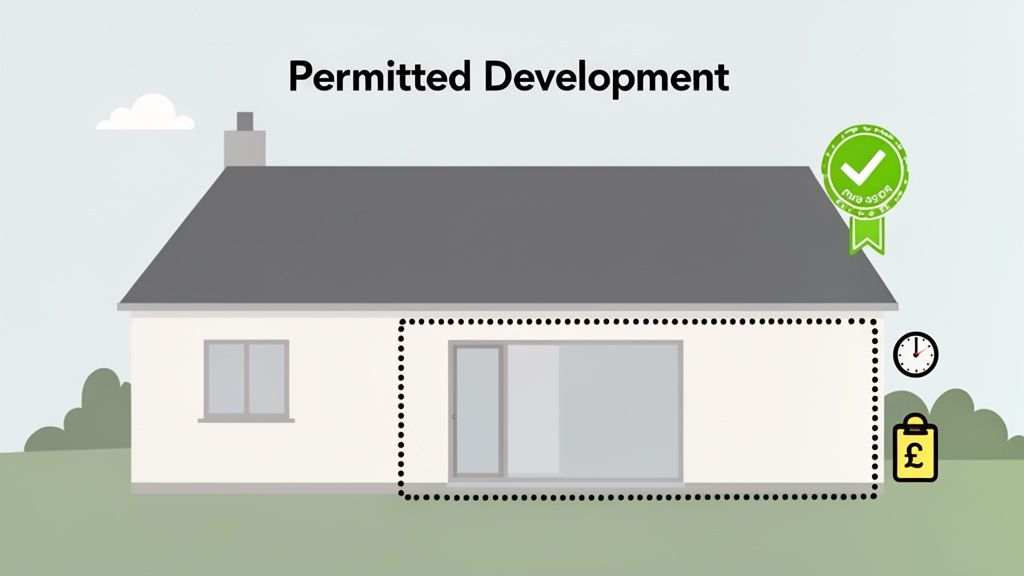
Many homeowners assume any major building work requires a full planning application. This process often takes eight weeks and involves fees for detailed drawings. If your application is refused, it could cost you another £258 for a householder application appeal. This is where knowing your rights really pays off.
Permitted development rights are a national grant of planning permission. They allow certain types of work without you needing to go through that lengthy and uncertain process.
Avoid Delays and Reduce Stress
The biggest benefit is avoiding delays. You can start your project much faster instead of waiting weeks for a council decision. This gives you an advantage when booking builders and ordering materials. It also removes a huge amount of stress from your plans.
For many homeowners, this is the key to building quickly and with less risk. Your project is judged against a clear set of national rules, not the subjective opinions of a local planning committee.
What Does This Mean For You?
If your project fits within the strict limits and conditions, you can often proceed with confidence. This could cover many popular home improvements:
Rear Extensions: Adding a kitchen diner or living space.
Loft Conversions: Creating an extra bedroom or a home office.
Garden Rooms and Outbuildings: Building a gym, workshop, or studio.
Garage Conversions: Turning a neglected space into a usable room.
The crucial thing is to know for certain if you qualify. Assuming you have these rights is a common and expensive mistake. An unauthorised build can lead to a council enforcement notice, forcing you to tear down all your hard work.
You need clarity before you spend any money on an architect. Verifying your property’s status is the most important first step. It tells you whether you can use this faster route or if you must prepare for a full planning application. This initial check gives you the evidence to move forward with confidence or to stop before making a costly error.
What You Can Build Under Permitted Development Rules
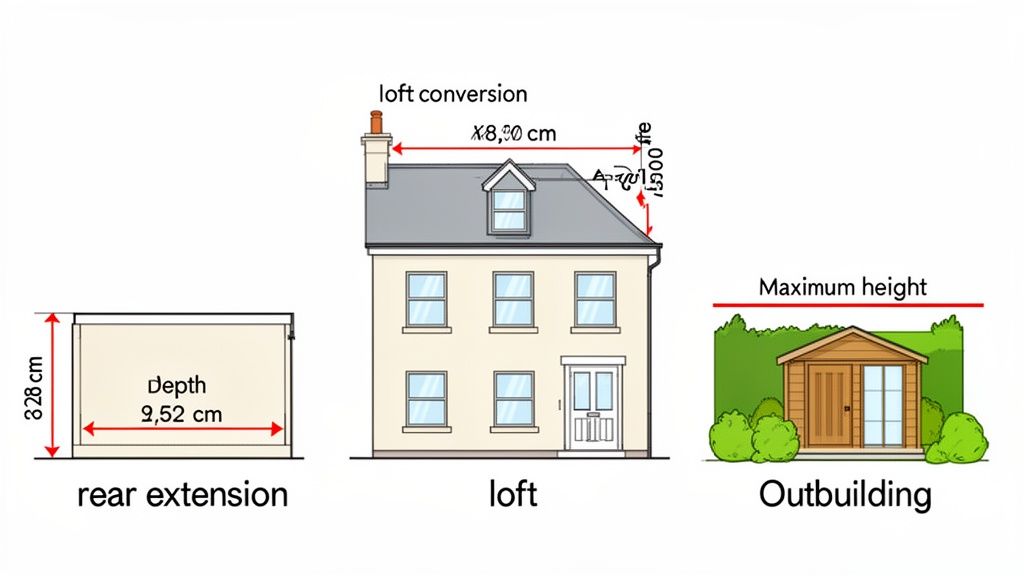
Permitted development rules allow many popular home improvements without a full planning application. But each project type has its own strict set of rules. Getting these wrong is a common mistake that can lead to refusal or an order to demolish what you have built.
Understanding the specific limits for extensions, loft conversions, and garden rooms helps you avoid simple measurement errors that put projects at risk. Think of this as a practical guide to what is possible for your home.
Key Terms You Need to Know
To see if your plans are viable, you need to understand two key terms planners use. Misinterpreting these is a common reason projects fail.
Principal Elevation: This is usually the front of your house which faces the road. Any extension in front of this wall will almost certainly need a full planning application.
Eaves Height: This is where the wall meets the roof, not the highest point of the roof. Many rules refer to the eaves height, so measuring this correctly is critical.
Understanding these concepts helps you accurately measure your plans against the official criteria. It can stop you spending money on designs that will not be approved.
Rear Extensions: How Far Can You Go?
Single storey rear extensions are the most common project homeowners tackle using permitted development. The rules are generous but they change depending on your house type.
For a terraced or semi detached house, you can usually extend up to three metres from the original rear wall. If you live in a detached house, that increases to four metres. These smaller projects typically do not require you to notify the council.
Want to build a larger extension? You might still be able to. Permitted development also allows extensions of up to six metres for a terraced or semi detached house and eight metres for a detached one. However, these larger projects require a process called Prior Approval. You must notify the council so they can consult your neighbours. We will explain this later.
Loft Conversions: Adding a Room at the Top
A loft conversion is a great way to gain a new bedroom or office without using your garden space. The permitted development rules allow for significant changes, but there are clear limits.
You can add up to 40 cubic metres of new roof space for a terraced house. For detached and semi detached properties, this allowance increases to 50 cubic metres.
A common mistake is forgetting that any previous roof extensions count towards this volume limit. If a past owner already extended the loft, your allowance might be smaller than you think. You must check the property's history.
The extension cannot be higher than the highest part of your existing roof. Any materials you use must also be similar in appearance to the existing house. This helps the new work blend in.
Garden Rooms and Outbuildings
Building an outbuilding like a home office, gym, or summer house is also a popular option. The key rule here is that these structures must be for purposes incidental to the enjoyment of the main house. You cannot build a self contained flat under these rules.
Here are the crucial limits:
Height: The outbuilding must be single storey with a maximum eaves height of 2.5 metres. The total height can reach four metres for a dual pitched roof or three metres for any other roof type.
Positioning: If the building is within two metres of your property boundary, the overall height is restricted to 2.5 metres.
Coverage: Outbuildings and sheds must not cover more than 50% of the total land around your original house.
These homeowner friendly rules are very popular. Official statistics show how important this route is for extending properties. In one recent quarter, planning authorities in England handled 6,200 applications for prior approvals. Large householder extensions made up 51% of all cases.
Here is a quick summary of the key limits for the most common projects.
Permitted Development Limits for Common Projects
Project Type | Key Dimensional Limits | Common Mistakes to Avoid |
|---|---|---|
Rear Extension | Up to 3m (terraced/semi) or 4m (detached). Up to 8m with Prior Approval. Max height of 4m. | Forgetting limits are measured from the original rear wall, not existing extensions. |
Loft Conversion | Up to 40m³ (terraced) or 50m³ (detached/semi). Must not exceed existing roof height. | Not accounting for previous loft extensions that reduce your available volume. |
Garden Outbuilding | Max eaves height of 2.5m. Max overall height of 4m (pitched) or 3m (other). Limited to 2.5m high within 2m of a boundary. | Covering more than 50% of the garden area with sheds and extensions combined. |
You must stick to these measurements to avoid a full planning application.
Permitted development rights are a fantastic opportunity if you follow the rules exactly. Understanding these core principles helps you have more informed conversations with architects and builders. For a deeper dive, read our guide on permitted development rights explained. This knowledge will help you avoid costly errors and move forward with confidence.
When Permitted Development Rules Don't Apply
Assuming your property has permitted development rights is a costly mistake. These national rules offer a great shortcut but they do not apply everywhere. Spotting these red flags early can save you thousands in wasted design fees.
Many people get caught out when they discover their local council has restricted or removed these rights. Understanding your property's specific status is the most critical first step you can take.
Property Types That Are Automatically Excluded
Certain homes are completely excluded from permitted development. The rules were written for houses, not other types of dwellings.
This means if you live in one of the following, you will need to apply for full planning permission for almost any external change:
Flats
Maisonettes
Apartments
These property types do not have permitted development rights. Any plans for extensions or major alterations will always require a formal application to the council.
Listed Buildings: A Different Set of Rules
If you live in a listed building, you are a custodian of its unique character. Because of this special status, standard permitted development rules do not apply.
Making unauthorised changes to a listed building is a criminal offence. You will need to apply for Listed Building Consent for most types of work, even for jobs that seem like minor internal repairs. The process is far more detailed and is focused on protecting the historical integrity of your home.
Designated Land: Geographical Red Flags
Your property's location can also limit your rights. Local authorities can protect areas of special character or natural beauty. These designations almost always bring stricter planning controls.
You need to check if your property falls within any of these key areas:
Conservation Areas
National Parks
Areas of Outstanding Natural Beauty (AONB)
World Heritage Sites
The Norfolk or Suffolk Broads
Living in one of these "designated areas" means your permitted development rights are significantly reduced. For example, you cannot install any cladding, and side extensions are completely ruled out. Any work will be judged on whether it "preserves or enhances" the special character of the area. This is a much higher bar to clear.
A common mistake is assuming you can build an extension because a neighbour in a conservation area did. The rules may have changed. Their project may have received full planning permission under different circumstances. Always check the current status for your own property.
Article 4 Directions: The Council’s Veto
Even if your property is a standard house outside a designated area, the council can still remove specific permitted development rights. They use something called an Article 4 Direction.
This is a legal tool councils use to protect the character of a place. A council might use an Article 4 Direction on a housing estate to stop homeowners from paving over front gardens or changing original windows. It gives them back control over minor changes that would otherwise be allowed.
These directions are common, especially in conservation areas, and can stop a project entirely. The history of permitted development rules in the UK began in 1948 to create a faster route for homeowners. However, local rules like Article 4 directions can remove these rights. You can find more detail on the historical timeline of planning regulations.
A SurePlan report flags these local restrictions using recent council data. It helps you see if permitted development is realistic or if a full application is your only choice. Knowing about an Article 4 Direction early avoids the cost of designing a project that cannot be built.
Navigating The Prior Approval Process
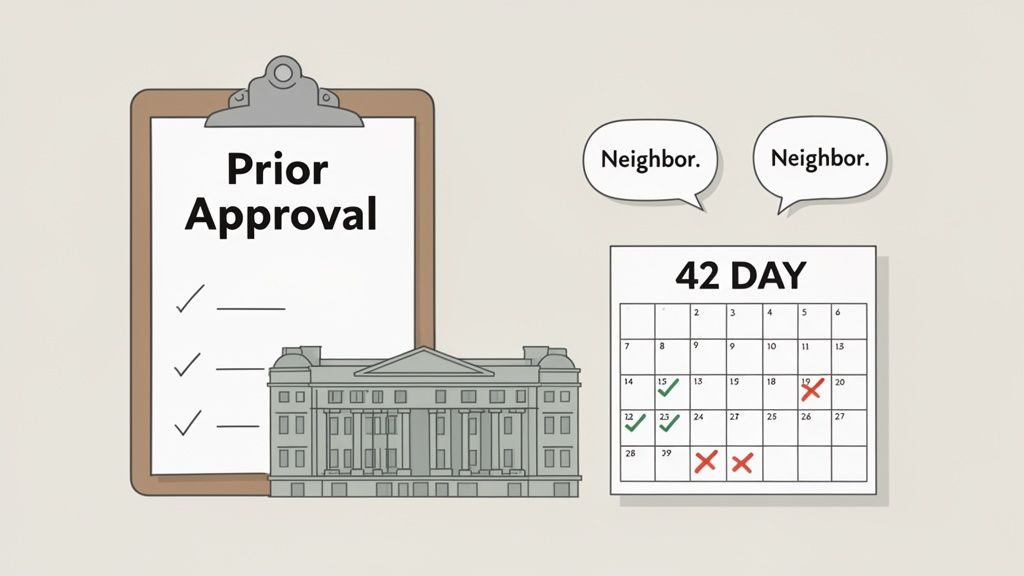
If your project fits within the permitted development rules, you may still need to notify your council before you start building. This step is called Prior Approval, and it is a common stumbling block for homeowners.
Getting this part right is vital for larger extensions. Prior Approval is a lightweight planning process. You need it for larger single storey rear extensions. This means anything between three and six metres for a terraced or semi detached house, or between four and eight metres for a detached house.
The council’s main job is to ensure your plans will not cause serious problems for your neighbours. It is a focused check, not a full planning application. The council will write to your immediate neighbours to ask if they have any objections.
What The Council Actually Considers
During the Prior Approval process, the planning officer is not worried about your architectural style or materials. Their focus is on how the size of your extension will affect the people living next door.
The main factors they assess are:
Loss of Light: Will your new structure cast a significant shadow over your neighbour's windows or garden?
Overlooking: Does the design create a direct view into a neighbour's private space, like a bedroom window?
Overbearing Impact: Is the extension so large and close to the boundary that it creates an oppressive feeling for your neighbour?
Your neighbours have 21 days to submit objections. If nobody complains and the council sees no other issues, your project can usually go ahead. If a neighbour objects, the council has to weigh their concerns against planning policies to make a final decision.
The 42 Day Timeline and What You Need to Submit
Once you submit your Prior Approval application, the clock starts. The council has a strict 42 day deadline, which is six weeks, to make a decision. If you do not hear from them within this timeframe, permission is granted by default.
To start the process, you will need to provide the council with some basic information. It is less demanding than a full application but still needs to be accurate.
You will typically need to submit:
A written description of your proposed extension with its dimensions.
A simple plan showing the site and the proposed development.
The addresses of any adjoining properties, including those to the rear.
Your contact details and the £96 application fee.
This information gives the council everything it needs to assess the impact and consult your neighbours. You can learn more about how prior approval for larger rear extensions works and when you will need it.
A well reasoned objection from a neighbour can lead to a refusal, even if your plans meet all the dimensional limits of permitted development.
This is why it is often a good idea to have a friendly chat with your neighbours before you submit the application. You might be able to resolve any potential issues before they become formal objections.
Understanding The Council's Decision
After the 42 day period ends, you will receive one of two outcomes.
Prior Approval Granted: The council has checked your plans, consulted your neighbours, and has no objection. You can build as long as you complete the work within three years.
Prior Approval Refused: The council has decided your extension would have an unacceptable impact on your neighbours. Your only options are to redesign the project or to submit a full planning application.
How to Check Your Real Chances of Success
National permitted development rules are a starting point, but they are only half the story. Your local council holds the real power. Understanding their specific stance is the most important step you can take to avoid a costly refusal. This is where you move from guesswork to an evidence based decision.
Knowing your local planning landscape reveals the true risks for your project. You need to look at local data before you commit thousands of pounds to drawings. This will tell you what the council is actually approving and refusing right now in your neighbourhood.
Start With Your Property's Official Status
The first check is simple. You must find out if any special restrictions apply to your property that could remove your permitted development rights. A quick search on your local council's website should have a planning map or database.
You need to confirm if your home is in any of the following:
A Conservation Area where rules are stricter.
An Area of Outstanding Natural Beauty (AONB) or National Park.
An area covered by an Article 4 Direction where specific rights have been removed.
Finding out you are in one of these areas early is crucial. It tells you permitted development is likely not an option and a full planning application is your only path.
Look for Local Evidence on Your Street
With the basic checks done, you need to become a local planning detective. Your council’s online planning portal is a goldmine of information. It lists every planning application and decision made in your area.
Search for recent applications on your street and nearby roads for projects similar to yours. Look for loft conversions, rear extensions, or outbuildings. Pay close attention to the refusals. Read the planning officer's report for each refused application.
These reports explain exactly why a project was rejected. You will quickly see patterns. Perhaps the council consistently refuses extensions it considers "overbearing" or that block a neighbour's light. This is invaluable intelligence for your own design.
This manual research is time consuming, but it is the best predictor of your project's outcome. It shows you how national rules are being interpreted and applied at your local level.
Automate the Research for a Clearer Picture
Sifting through hundreds of planning documents is a huge task. Technology can give you a massive shortcut and a clearer answer. Services exist that automate this entire process for you.
Permitted development rules have accelerated some types of conversions in the UK, turning offices and farms into homes without a full planning battle. This can mean converting a garage is a real possibility for homeowners. However, as one study on residential conversions notes, 65% of such applications were approved outright. This shows that success is common but not guaranteed. Discover more insights about these conversion trends on journals.sagepub.com.
Instead of you spending days on the council website, these services analyse years of local approval and refusal data in minutes. They benchmark your project against hundreds of similar, recent applications in your specific local authority.
The result is a simple, data driven confidence score. It tells you the statistical likelihood of your project getting approved based on real evidence. This approach replaces assumptions with hard data and highlights specific refusal patterns in your area.
A SurePlan report, for example, can provide this clarity. It helps you understand your real chances before you spend anything. You can check your own planning refusal risk to see how this works. This evidence based check is the smartest investment you can make at the start of your journey.
So, Permitted Development or a Full Application?
Once you understand the national rules and your local council’s habits, you can choose the right path forward. This decision will shape your project’s timeline, cost, and complexity.
One route offers speed and simplicity. The other gives you flexibility for more ambitious designs.
Getting this wrong can be painful. Committing to a permitted development project that is not viable locally means paying for architectural drawings you cannot use. On the other hand, starting a full application when a simpler route was available adds unnecessary months and expense to your project.
Permitted Development or Full Application
Your project’s details will point you towards the most sensible option. There is no single right answer, just the best fit for your circumstances. Think of it as picking the right tool for the job.
Here is a quick checklist to see which path is more likely for you:
Choose Permitted Development if: Your project fits within all the strict dimensional limits. Your property is not in a restricted area, and there are no Article 4 Directions in the way. You want to build as quickly and cheaply as possible.
Choose a Full Application if: Your design goes beyond the limits, even by a little. Your property is in a conservation area or is a listed building. You want something unique that needs a more subjective assessment from planners.
This decision path gives you a simple way to get clarity on where you stand.
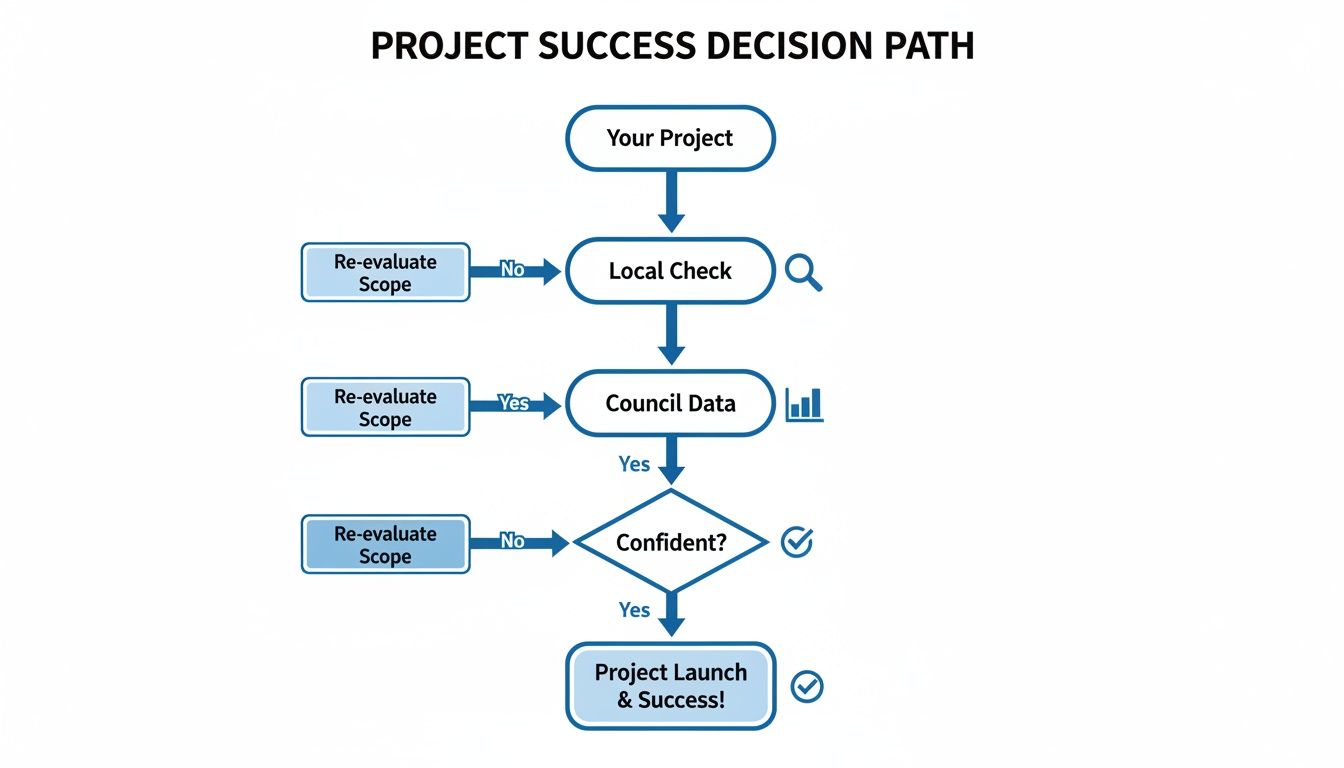
As the chart shows, digging into local data is the critical fork in the road. It tells you whether you can proceed with confidence or need to go back to the drawing board.
Securing Peace of Mind with a Lawful Development Certificate
Even when your project is a clear case of permitted development, you can make its status official. You do this by applying to your council for a Lawful Development Certificate (LDC). This is not the same as asking for planning permission.
An LDC is official proof from your local authority confirming your proposed build is lawful. It gives you certainty that no enforcement action can be taken against the project. It costs about half the price of a full planning application, and the council's decision is based on hard evidence, not subjective opinion.
An LDC is particularly valuable when you sell your home. A buyer’s solicitor will ask for proof that any extension work was properly authorised. Handing over an LDC answers difficult questions, avoids delays, and provides concrete proof that everything is correct.
Making the right choice at this stage sets the foundation for a successful project. By using local evidence to choose between permitted development and a full application, you can move forward with a clear plan. It means you can have more productive conversations with your architect and builder, ensuring everyone is working towards a realistic goal.
Got Questions? We've Got Answers
Do I Still Need Building Regulations Approval?
Yes. People often confuse these two, but permitted development and Building Regulations are completely separate. One is about whether the council lets you build. The other is about how you build it.
Building Regulations cover the technical side of construction. They ensure your new extension is structurally sound, safe, and energy efficient. Even if your project is a clear case of permitted development, it will almost certainly need Building Regulations approval. You will need to arrange this with your council or a private inspector before you start work.
How Long Do Permitted Development Rights Last?
The rights themselves do not have an expiry date. They are a national grant of permission from the government. However, they can be taken away. If your local council applies an Article 4 Direction to your area, your permitted development rights could be removed for future projects.
It is different if you get Prior Approval for a larger extension. That specific permission is only valid for three years. If you do not finish the work within that time, you will have to apply again.
What Happens If I Break The Rules?
This is a mistake you do not want to make. Building something that does not comply with the permitted development rules UK is a serious problem. Your local council can issue an enforcement notice.
This is not just a warning. It is a legal order that could force you to alter the work or, in the worst case, demolish the entire structure at your own cost. It is incredibly stressful and creates major problems when you try to sell your home.
The only way to avoid this is to double check you have the right permissions before you start. A simple check upfront can save you from significant financial and legal trouble later on.
Before you commit to costly architectural drawings, find out if your project has a real chance of success. SurePlan provides an evidence-based Planning Confidence Report that analyses recent, similar planning decisions from your local council. Get clarity on your project's risks and opportunities within 24 hours. Learn more at https://www.getsureplan.co.uk.