
Feb 2, 2026
Getting your project approved is the goal. But rushing to get drawings can lead to a costly refusal, wasting thousands on architect fees and months of your time. This guide explains how to get the right drawings for your project and avoid expensive mistakes before you commit.
Why Your Drawings Are More Than Just a Sketch
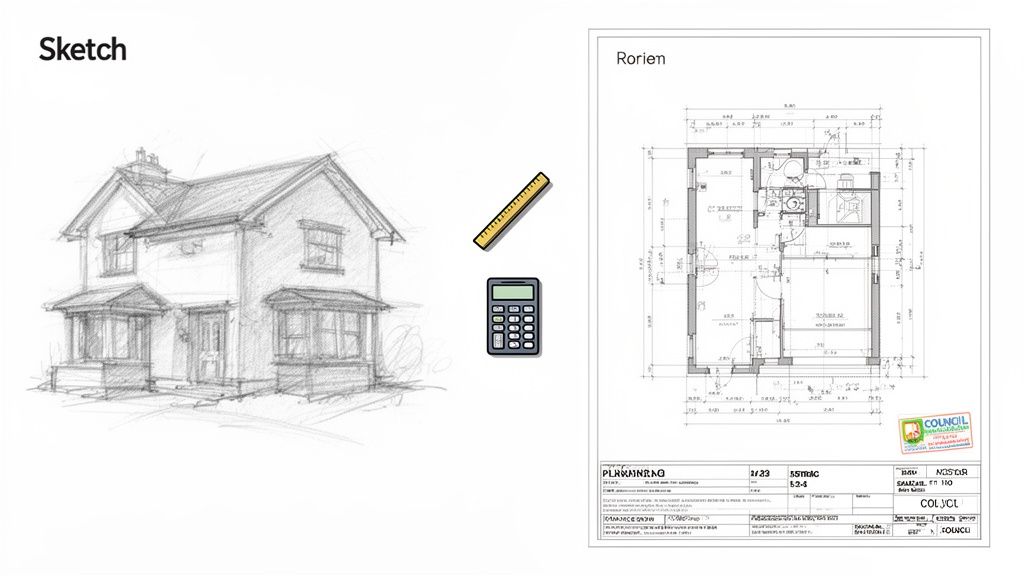
Paying for planning permission drawings is often the first big cost for your extension or loft conversion. It is the point where your idea becomes a real project with real expenses. Getting this step wrong can be a painful and expensive mistake that stops your project before it starts.
If your council refuses your application, you lose more than the application fee, which is often £548. The real cost is the thousands you paid an architect for drawings that are now useless. You have also wasted months waiting for a decision.
The Dangers of Moving Too Fast
Many homeowners get excited and hire a designer too early. They do not know the local planning rules they need to follow. The council's decision is not just about how your design looks. It depends heavily on local policies, past planning decisions in your area, and specific rules affecting your property.
National approval rates do not tell the whole story. For example, in 2023/24, London councils only processed 67% of listed building consent applications on time. This shows how local backlogs and pressures can cause major delays. Paying for a full set of drawings without first understanding these local factors is a gamble.
The biggest risk is paying thousands for architectural drawings for a project your local council was never going to approve. It is like booking non refundable flights before checking if you can get the time off work.
Commissioning drawings without doing your research first is a bet you are likely to lose. The cost in both money and wasted time can be huge.
Key Risks of Commissioning Drawings Too Early
Risk | Potential Cost | How to Avoid It |
|---|---|---|
Wasted Architect Fees | £2,000 to £5,000+ | Check if your project is feasible before committing to full drawings. |
Lost Application Fees | £548+ per application | Only apply for a project that has a realistic chance of approval based on research. |
Months of Wasted Time | 3 to 6 months or more | Find potential problems like conservation area rules at the very beginning. |
Cost of Redesigns | £500 to £2,000+ | Get early feedback from the council before the design is finalised to reduce costs. |
The smartest move you can make is to understand your project's chances of success before paying for drawings. It protects your money and gives you a much better chance of getting approval.
Know Your Chances Before You Pay
When you know your project's chances upfront, the entire process changes. You will be able to:
Avoid wasting money on a project that will fail.
Tell your architect exactly what you need with confidence.
Spot any potential problems early.
Create a design that is much more likely to be approved.
By gathering evidence first, you turn a hopeful guess into an informed decision. This is especially important when design detail matters more than size in sensitive areas like Conservation Areas. It ensures your investment in drawings is built on solid evidence, not just hope.
What Drawings Does the Council Actually Need?
To get planning permission, you cannot send the council a few simple sketches. They need a specific set of technical drawings. Each drawing tells a crucial part of your project's story. Getting this package right is the only way to prevent your application from being rejected before a planner even looks at it.
Each drawing is a piece of evidence a planning officer needs to make a fair decision. Without the complete set, they cannot assess your project's impact on your home, your neighbours, or the local area.
The Essential Drawing Checklist
Your application will need several types of drawings, each created to a precise scale. The scale, such as 1:100, means that one centimetre on the drawing represents 100 centimetres, or one metre, in real life. This level of detail is required.
Here are the core drawings your council will almost certainly ask for:
Site Location Plan: A map showing your property and the surrounding streets. It tells the council exactly where your project is happening. The standard scale is usually 1:1250.
Block Plan (or Site Plan): This plan zooms in closer. It shows your entire property boundary, your house, and where your proposed extension will sit. It includes important details like trees and driveways.
Existing Floor Plans and Elevations: These drawings show your home exactly as it is today from every angle. They give the planning officer a clear 'before' picture to understand what is changing.
Proposed Floor Plans and Elevations: This shows what your home will look like after the work is done. These drawings must clearly detail the new layout and how the building will look from the outside.
The council needs to compare the 'before' and 'after' to understand the true impact of your project. Without clear 'existing' and 'proposed' drawings, your application is incomplete and will be refused.
Why This Level of Detail Matters
Each of these drawings answers different questions for the planning officer. An elevation shows if your new extension will block a neighbour's light. A floor plan shows if the new rooms are a good size. A site plan shows how your project affects things like parking.
These drawings are not just pictures. They are data. They provide the factual evidence needed to approve your project. This is why drawing them yourself is a huge risk. Small errors in scale or missing information can lead to a refusal. This would force you to start over and pay all the fees again.
Understanding what drawings to include is the first step in how to prepare a strong planning application that gives you the best chance of success.
Do You Even Need Planning Permission Drawings?
Before you spend any money on professional drawings, you need to answer one vital question. Does your project actually need a full planning application? Many homeowners pay for detailed drawings they do not need. This is because they are not aware of an alternative called Permitted Development.
Permitted Development rights are a list of common home improvements granted by the government. These rights allow you to do certain types of building work without applying for formal planning permission. For example, a small rear extension often falls under these rights.
The savings can be huge. You avoid the £548+ application fee and the typical eight week wait for a decision. You also avoid the stress of a potential refusal. But these rights are not guaranteed and come with very strict limits.
When Permitted Development Rights Disappear
It is crucial to understand that these rights can be removed. If your property is in one of the categories below, you will almost certainly need full planning permission.
You might lose your Permitted Development rights if:
Your property is in a designated area: This includes Conservation Areas, National Parks, or an Area of Outstanding Natural Beauty.
An Article 4 Direction is in place: Your local council may have issued an Article 4 Direction for your area. This removes specific rights to protect the local character.
Your property is a listed building: Any work that affects a listed building requires a separate Listed Building Consent.
Previous extensions have used up your allowance: Your home only has a certain development allowance. Past work can limit what you are allowed to do now.
This flowchart helps show the key questions that determine which path your project might take.
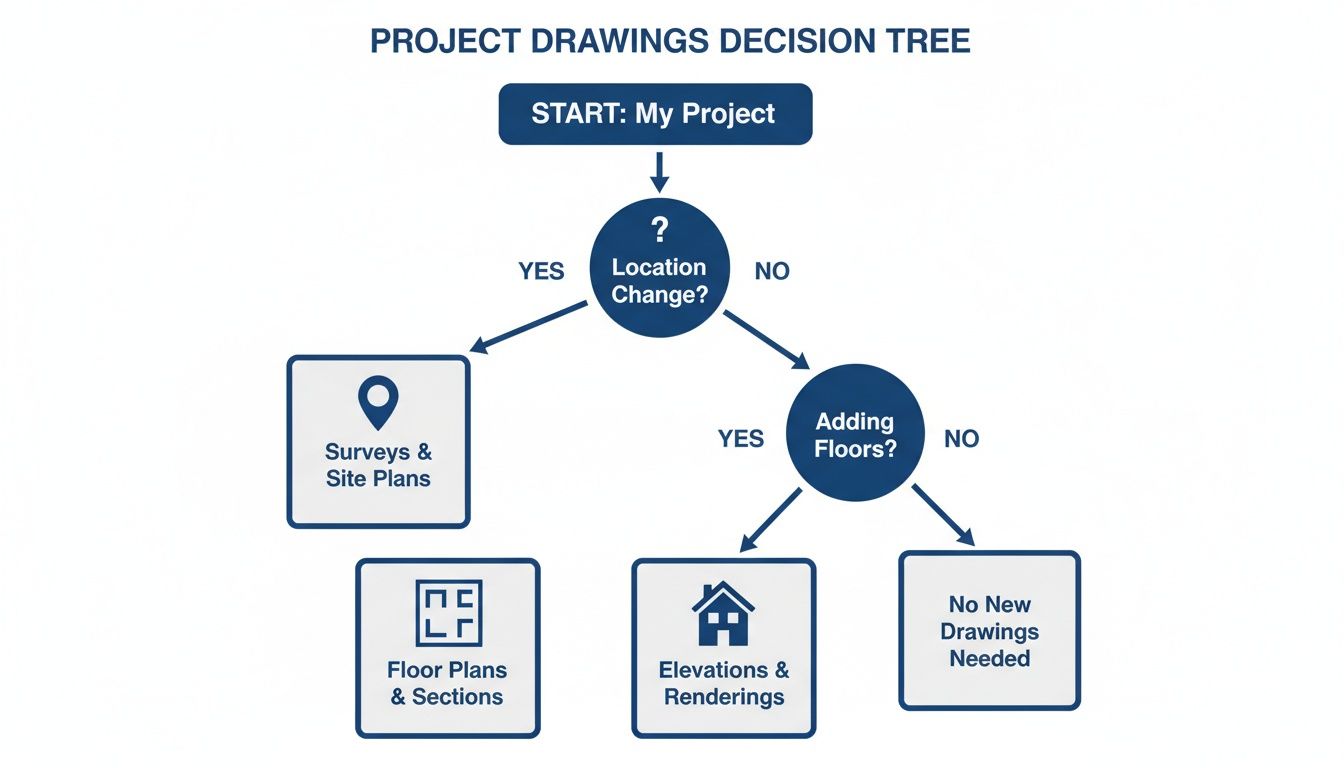
As you can see, your property's location and the size of your plans are the first major hurdles. Building illegally because you assumed you had Permitted Development rights is a serious and costly mistake. The council can force you to tear down the entire structure at your own expense.
You can learn more in our guide to Permitted Development vs Planning Permission.
Confirming your property’s status from day one is essential. It is the only way to avoid paying for unnecessary drawings or facing costly legal action.
Who Creates Planning Drawings and What Do They Cost?
Let us talk about who creates these drawings and what you should expect to pay. Getting quotes can be confusing. Understanding who does what and what a fair price looks like will protect you from overpaying or getting poor quality drawings that the council will reject.
First, you do not always need a fully registered architect to produce your planning drawings. While they offer a complete design service, other professionals can produce the exact documents your council requires, often for a lower fee. This gives you more control over your budget.
Who Can Create Your Drawings?
You have two main choices. You can hire an architect or an architectural technologist. The title 'architect' is legally protected. It means the person is registered with the Architects Registration Board (ARB) and has completed years of training.
An architectural technologist is a specialist in how buildings are put together. They are experts at producing the detailed technical drawings needed for planning permission and Building Regulations. For a straightforward extension, their expertise is often exactly what you need and can be much more cost effective.
It depends on your project's complexity. For a standard extension, an architectural technologist provides fantastic value. If you are planning a complex new build, the full service of an architect is probably the smarter investment.
Typical Costs and Timescales for Drawings
The cost of your planning drawings will depend on the size and complexity of your project. A quote that seems too good to be true probably is. You risk getting poor quality drawings that will be refused. A very high quote might mean you are being sold a full design service you do not need yet.
For a typical single storey extension in the UK, you should budget between £1,500 and £3,000 for a complete set of planning drawings. That fee should cover a measured survey of your house and the work of drafting all the required plans.
This is not a job that happens overnight. A professional will need to visit and survey your property. They will then spend time turning those measurements into accurate drawings. From giving the go ahead to having the final drawings ready, the whole process usually takes between four and eight weeks.
Knowing these figures helps you have informed conversations with designers and confidently compare quotes.
Typical Costs and Timescales for Planning Drawings
This table shows the average costs and timeframes for common UK home renovation projects. This can help you budget more effectively.
Project Type | Typical Drawing Cost | Estimated Timescale |
|---|---|---|
Single Storey Rear Extension | £1,500 to £3,000 | 4 to 8 weeks |
Two Storey Extension | £2,500 to £4,500 | 6 to 10 weeks |
Loft Conversion (Dormer) | £1,800 to £3,500 | 5 to 9 weeks |
Garage Conversion | £1,200 to £2,000 | 3 to 6 weeks |
New Build House (3 Bed) | £5,000 to £10,000+ | 10 to 16 weeks |
Keep in mind that these are just average figures. Prices can be higher based on your location, the complexity of the design, and the level of service included. Always get a few detailed quotes before you decide.
Common Reasons Drawings Get Refused
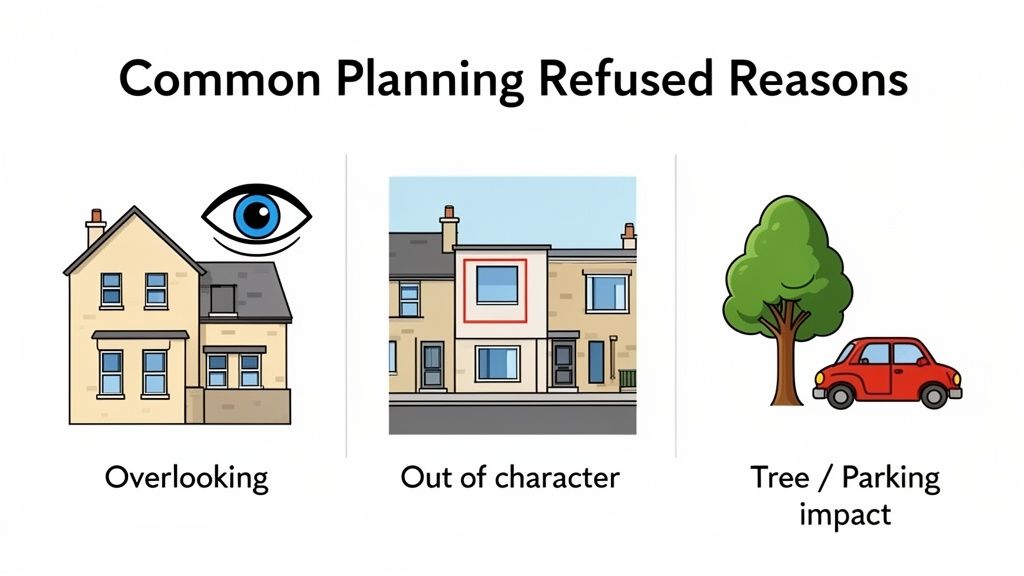
A planning refusal is not just a disappointment. It is an expensive setback. It costs you time and money. It often sends you back to the beginning after months of waiting.
Knowing why councils refuse applications is the key to avoiding these problems. The reasons are rarely a surprise. They are usually predictable issues that could have been identified and solved long before any final drawings were paid for.
Overlooking and Loss of Privacy
This is one of the most common reasons for refusal. If your proposed extension or new windows look directly into a neighbour’s garden or living rooms, a planning officer will likely see it as a loss of privacy. The rules are there to protect a reasonable quality of life for everyone.
To avoid this risk, your design needs to be smart about window placement. Using frosted glass for sensitive windows, like in a bathroom, or placing them higher up can often solve the problem.
Out of Character with the Area
Your local council has a duty to protect the character of the neighbourhood. Any design that feels too big, uses clashing materials, or is simply out of keeping with the local style is likely to be refused.
If you live on a street of traditional Victorian houses, a giant, modern glass box on the front of your home will almost certainly be rejected. The solution is a design that respects its surroundings. You could use similar materials or match the shape of neighbouring houses.
A refusal is rarely about your personal taste. It is about whether your drawings show that your project respects the local area and the privacy of your neighbours.
Understanding what your council consistently approves is vital. UK planning authorities follow local policies and are influenced by recent decisions. Without checking these local precedents, you risk producing drawings for a project that officers are likely to refuse. You can explore how local data influences planning by reviewing government technical notes.
Other Common Red Flags
Beyond those two main issues, several other factors regularly cause applications to fail. Being aware of them gives you a big advantage.
Impact on Trees: Many councils have Tree Preservation Orders on important trees. If your plans involve removing a protected tree or building too close to it, this is a major problem.
Parking and Highway Safety: Your project must not make parking worse or create a road safety hazard. An extension that removes the only off street parking space can be enough for a refusal.
Overdevelopment of the Site: This means trying to build too much on your plot of land. If your extension leaves you with a very small garden, the council may decide it is an overdevelopment.
By thinking about these common reasons for refusal before you hire a designer, you can create a plan for a project that has a much stronger chance of success.
Your Smartest Move Before Hiring Anyone
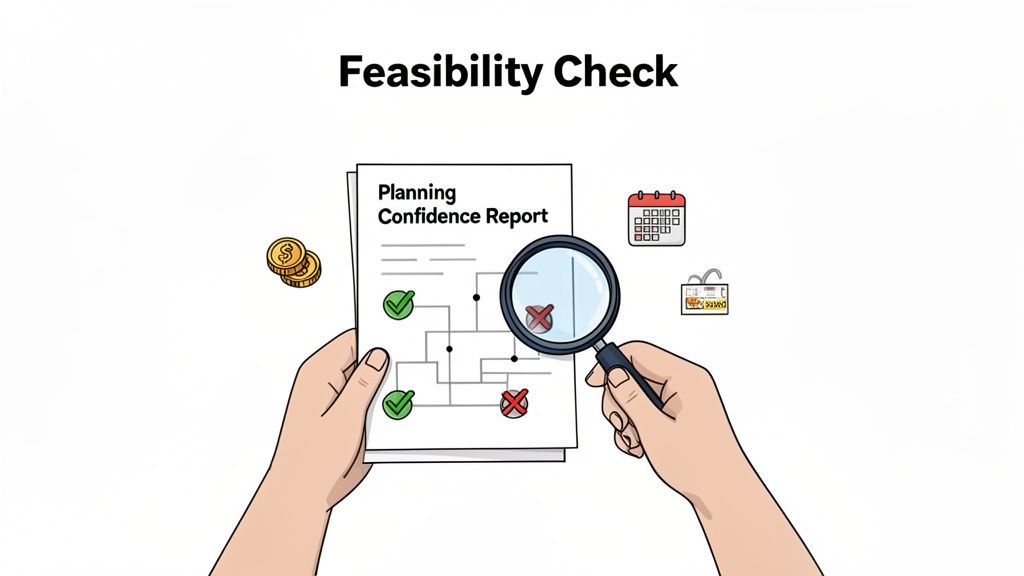
Before you commit thousands of pounds to a designer, you need one thing above all else. You need clarity. Paying for a full set of planning permission drawings is a major financial step. But what if the council was never likely to approve your idea in the first place? This is a costly mistake thousands of homeowners make every year.
There is a smarter way to begin. Instead of guessing, you can get hard evidence on your project's chances of success before spending money on design work. This research is the most important step you can take to protect your time and your money.
Get Evidence Before You Get Drawings
Imagine knowing what your local council thinks about projects like yours before you hire someone. A small, upfront check can uncover the specific reasons similar applications have been refused in your area. This gives you powerful insight that can shape your entire project.
An evidence based report does this work for you. Here at SurePlan, we analyse real planning decisions from your specific council for projects nearby. Our £49 Planning Confidence Report gives you this crucial data in plain English. This is not a guarantee of success. It is the evidence you need to make an informed decision.
Understanding your chances upfront changes the entire conversation. You move from simply hoping for the best to planning for success. You will be armed with facts about what your local authority approves and rejects.
The report gives you a clear, realistic picture of your project's chances. You will learn about local red flags, understand the most likely path forward, and see how your idea compares to others in the area. This clarity means you can go into that first meeting with an architect far more prepared. You can instruct them with confidence, knowing your money is being spent on a project with a realistic shot at getting approved.
Got Questions? We’ve Got Answers
When it comes to planning permission drawings, a few practical questions come up again and again. Let us get them answered so you can move forward with more clarity.
Can I Draw My Own Planning Permission Drawings?
Technically, you can. But it is a huge risk for most projects. Councils are very strict about the scale, level of detail, and specific information required on these drawings.
If you get it wrong, your application will likely be rejected immediately. Common mistakes include incorrect scaling or missing details. This means you will lose your application fee, which is often £548 or more, and set your project back by months. Hiring a professional gives your application the best possible chance of success.
What Happens If My Application Is Refused?
A refusal is not the end of the road. If your planning application is refused, the council must give you a written decision explaining why. From there, you have three main options.
You can:
Adjust and Resubmit: This is the most common route. You adjust the drawings to fix the issues the council raised. The good news is your first resubmission for a similar project is usually free.
Appeal the Decision: If you believe the council’s decision was unfair, you can appeal to the national Planning Inspectorate. Be warned, this can be a long and uncertain process.
Walk Away: Sometimes, the reasons for refusal are fundamental. In these cases, it might make more sense to abandon the project in its current form.
The smartest move is to understand the potential reasons for refusal before you even apply. That is the best way to avoid this whole situation.
Do My Drawings Need to Show the Interior Layout?
Yes. Your proposed floor plans must clearly show the internal layout of your project. This includes where all the rooms, doors, and windows will be. You do not need to show furniture placement, but the layout itself is required.
Why? Planning officers use this information to assess important factors. They check if the new spaces will get enough natural light and provide a good quality of living space. It is a core part of what they look at.
Before you commit thousands to drawings, get the evidence you need to proceed with confidence. SurePlan provides a tailored Planning Confidence Report that analyses real planning decisions from your local council, giving you a clear view of your project's chances. Get your report at https://getsureplan.co.uk.