
Feb 16, 2026
Getting your extension refused over a rule you have never heard of is a costly mistake. The planning 45-degree rule is a test councils use to check if your extension will block your neighbour's daylight. Understanding it before you hire an architect can save you a failed £258 planning application and £3,200 in useless drawings.
This guide shows you how to spot a problem early. You will learn how the rule works and how to avoid a common planning failure.
Why the 45-Degree Rule Matters to You
A planning refusal costs you money and time. The £258 council fee is just the start. The real loss is the average £3,200 spent on architect drawings that the council has rejected. The 45-degree rule is a major reason for these failures. You can often spot the risk yourself before you spend a penny.
This rule is not a law. It is a standard test most UK councils use. It stops your new extension from casting your neighbour's home into shadow.
Protecting Your Neighbour's Daylight
The council must check if your new building will unfairly block light to your neighbour's main rooms. The 45-degree rule gives them a simple way to measure this. If your extension plans fail this test, you are heading for a refusal.
The idea is straightforward. An extension should not cross a 45-degree line drawn from the centre of your neighbour's nearest main window. If your building crosses this line, the council will see it as a major problem.
Which Rooms Are Most Important?
Councils focus on protecting the rooms people use most. Knowing which windows matter helps you see your project's biggest risks from the start.
The 45-degree rule protects these main rooms:
Living rooms and lounges. These are always a high priority for daylight.
Kitchens and dining rooms. These are central to family life so light is vital.
Bedrooms. A bedroom window is also a main window and will be protected.
The rule generally ignores windows in other rooms. This means rooms like bathrooms, utility rooms, hallways or landings are not usually considered. This is important. It helps you and your designer focus on the real challenges of your project.
How Planners Measure the Impact on Your Neighbour
A planning officer uses a consistent method to test your plans. Getting this wrong is a common reason for a failed application. Understanding how they measure it helps you avoid an expensive mistake.
The officer starts by finding your neighbour's closest main room window. They find the centre of that window. From this point, they draw a horizontal line at a 45-degree angle. This line extends towards your proposed extension.
If any part of your new building crosses this line, it fails the test. This tells the council your project could block too much daylight. It suggests your extension will make your neighbour's home feel darker and more enclosed.
Single Storey vs Two Storey Extensions
The way the 45-degree rule is measured changes with the height of your extension. The starting point on your neighbour's window is the same. The angle is just checked differently.
Single Storey: The 45-degree line is drawn horizontally on a plan view. The test checks if the corner of your extension crosses this line on the 2D drawing.
Two Storey: The test becomes three dimensional. The line is projected upwards at a 45-degree angle from your neighbour's window. This checks if the upper floor will loom over their property and block light from the sky.
This concept map shows the core ideas a planner considers when applying the planning 45-degree rule.
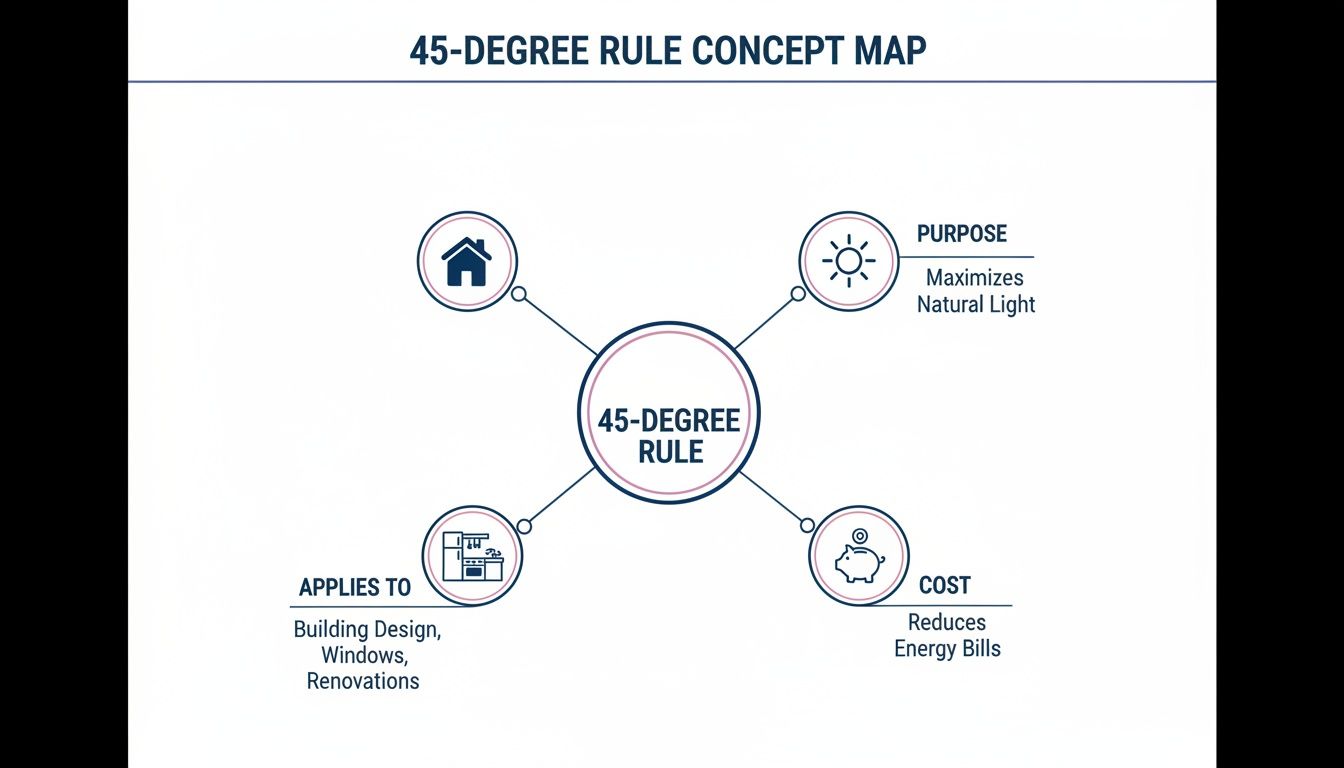
As you can see, the rule's job is to protect sunlight. It focuses on rooms like kitchens. Understanding it helps you avoid costly refusals.
The Real Cost of Getting It Wrong
Ignoring this rule is a gamble. Loss of daylight is a primary reason councils refuse extensions. Government data shows that between 2018 and 2023, over 28% of rejected homeowner applications mentioned impact on neighbours. Breaches of this daylight test were a major factor.
The rule is not absolute. But it provides a strong benchmark. A design that clearly fails this test will face a tough review. It is very likely to be rejected without big changes.
Understanding how councils check the impact on your neighbours is vital. This test is a key part of that process. You can learn more in our complete guide on how councils view neighbour impact.
By knowing how a planner will measure your design, you can work with your architect to create plans with a much better chance of success. This helps you avoid months of delays and wasted fees.
Does This Rule Even Apply to Your Project?
The planning 45-degree rule does not apply to every project. Knowing if it affects your plans can save you a lot of stress. The rule is mainly for larger projects that need a full planning application.
Many smaller home extensions can avoid this strict test. They can do this using Permitted Development Rights. These rights give homeowners pre-approved permission for certain extensions. You just have to follow a list of size and height limits.
If your extension qualifies for permitted development, it generally will not have to pass the 45-degree test. The council will look at a different and simpler set of rules instead.
The Permitted Development Lifeline
Permitted development is a great help for many homeowners. It offers a way to bypass the detailed checks of a full planning application. Government technical guidance is clear. Rear extensions built under these rights are not subject to the 45-degree test. This applies to extensions up to 4 metres deep for detached homes and 3 metres for others. They are judged on clear rules about height and garden coverage instead.
Department for Levelling Up, Housing and Communities data shows that between 2022 and 2024, 235,000 permitted development notifications were processed. Only 4% were challenged on neighbour impact grounds. For full applications, 23% were refused, with breaches of the 45-degree rule being a major factor. You can find more insights on daylight rules at PagerPower.com.
Simply put, if your extension is small enough for permitted development, you probably will not have to worry about the 45-degree rule.
What About Conversions and Other Projects?
The rule is applied differently for different types of work. Understanding this gives you clarity.
Loft Conversions: A simple rooflight conversion will rarely trigger the rule. A large dormer at the back of your property is different. That could be assessed, especially if it overlooks a neighbour's main window.
Garage Conversions: If you only convert the inside of an existing garage, the 45-degree rule does not apply. The building is already there. You are not creating a new impact on your neighbour's light.
The planning 45-degree rule is mainly for assessing new structures. If your project is permitted development or involves internal changes, you might avoid this planning hurdle completely.
A Simple Check You Can Do Yourself
You can do a quick check yourself before you spend money on professional advice. This can tell you if your extension ideas might fail the 45-degree rule. Think of it as an early warning system. It will not replace a proper survey. But it can help you spot a potential refusal that could cost you £258 in wasted fees and months of delay.
This check gives you a quick sense of the impact on your neighbour's light. If it reveals a problem, you will know to discuss it with your designer immediately.
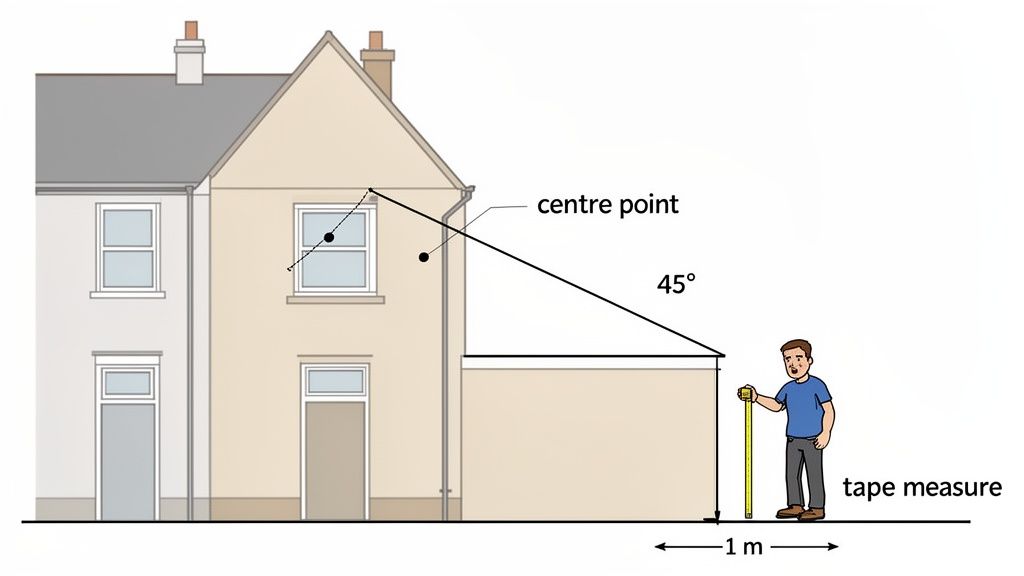
A Worked Example for a Terraced House
Imagine you want a three metre deep, single storey extension on your terraced house. Your neighbour's nearest window is their kitchen window. It is set back one metre from the rear wall of their house.
Here is a simple way to get a rough idea of the impact.
First, find the centre of your neighbour’s window. Then, measure horizontally to where the corner of your proposed extension would be.
Let's break it down.
Find the centre point. Your neighbour’s kitchen window is one metre back from their main rear wall.
Measure across to your extension. Now measure sideways from that point to the corner of your new three metre extension.
Check the 1 to 1 ratio. The 45-degree rule is basically a 1 to 1 ratio. If your extension sticks out by three metres, it needs to be at least three metres away from the centre of your neighbour’s window to pass.
In this case, the window is already set back one metre. The corner of your extension will be less than three metres away. This means it would likely fail the council's test and face an objection.
This simple "distance out should equal distance across" check is the fastest way to spot a clear problem. If the numbers are not roughly equal, your design needs a rethink.
Quick 45 Degree Rule Checkup
This rough calculation is a great start. Remember, a formal assessment is much more detailed. Here is a quick checklist to help you spot potential red flags.
Check | What to Look For | Potential Red Flag If... |
|---|---|---|
Neighbour's Window Position | Find the closest main window on your neighbour's rear wall. Is it flush or set back? | The window is already set back from their main wall. |
Extension Depth | How far out from your rear wall will your extension go? E.g. 3 metres. | You are planning a deep extension of 3m or more. |
Sideways Distance | Measure horizontally from the centre of that window to the corner of your proposed extension. | This distance is less than your planned extension depth. |
Overall Ratio | Compare the extension depth to the sideways distance. | The numbers are not close to a 1 to 1 ratio. |
Spotting an issue here does not mean your project is impossible. It means you need to be smart about your next steps.
For a more precise analysis, you can use an online tool. A dedicated neighbour impact checker can help you see potential issues before they become expensive problems.
This five minute check gives you crucial information. You can have a better conversation with your architect. You can ask them to adjust the design to avoid a clear planning failure. This proactive step can save you thousands in wasted design fees. It also prevents the disappointment of a rejected application.
Common Misconceptions and Costly Mistakes to Avoid
Knowing what the 45-degree rule is is only half the battle. You also need to know what it is not. Believing common myths can lead to a costly rejection from your local council.
Let’s clear these up now to prevent expensive mistakes.
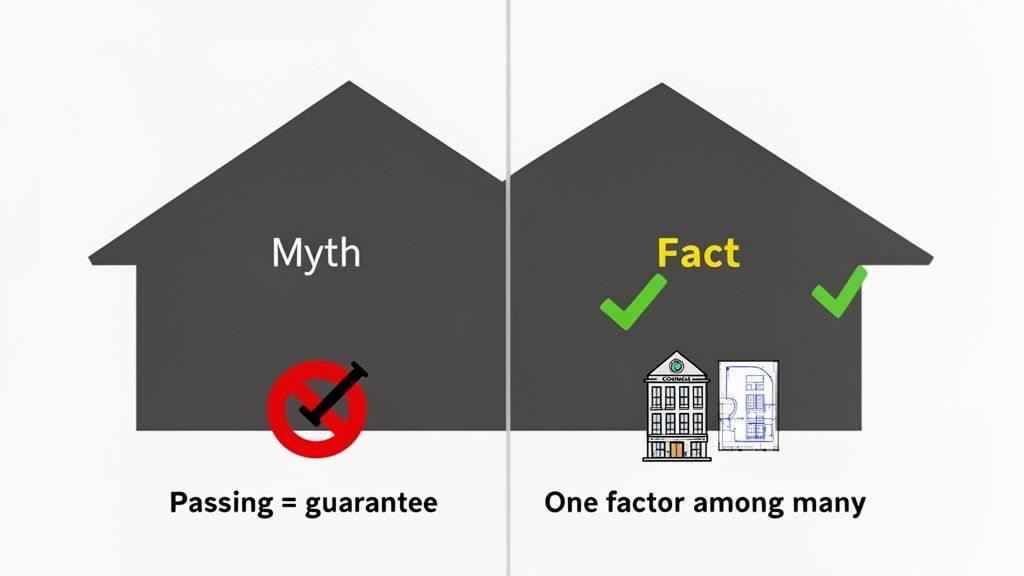
Myth 1 Passing the Test Guarantees Approval
This is the most dangerous myth. Passing the 45-degree test does not mean your project gets automatic approval.
It is just one of many things a planning officer considers. Your extension must also avoid being overbearing or causing a loss of privacy. It should not look out of character with the area. A planner looks at the bigger picture.
A design that technically passes the 45-degree test might be refused for other reasons. You should learn about the different reasons why extensions get refused. You can learn more in our guide on loss of light, overbearing, and privacy issues.
Myth 2 You Can Ignore Your Neighbour’s New Extension
Another classic mistake is basing your calculation on your neighbour’s original house. You cannot ignore the new extension they built last year. This is a sure way to get your application rejected.
The measurement must be taken from the window of their property as it is today.
If your neighbour has a new kitchen with a window looking towards your property, the council will measure from that window. Ignoring it means your plans are based on wrong information. This sets you up for an almost certain refusal.
The planning assessment is based on the current reality of the site, not its past layout. You must factor in any recent changes to a neighbouring property.
Myth 3 The Rule Is Relaxed in Modern Areas
Some homeowners think special planning rules only apply to old buildings. But the planning 45-degree rule is applied just as strictly in modern housing estates.
The rules can be even tougher if your property is in a Conservation Area or has an Article 4 Direction.
In these areas, permitted development rights are often removed. This means even a small extension needs full planning permission and will be checked carefully. Department for Levelling Up, Housing and Communities data shows that in 2023, 62% of approved suburban extensions followed this rule. In Manchester, 41% of rejections in Article 4 zones cited 45-degree issues. You can find more information in these government technical guidelines.
How to Get Clarity Before You Commit to Plans
Now you understand the risks of the planning 45-degree rule. So what is the safest next step? You need evidence before you spend thousands on architect drawings. You can find out how your local council applies this rule to projects just like yours.
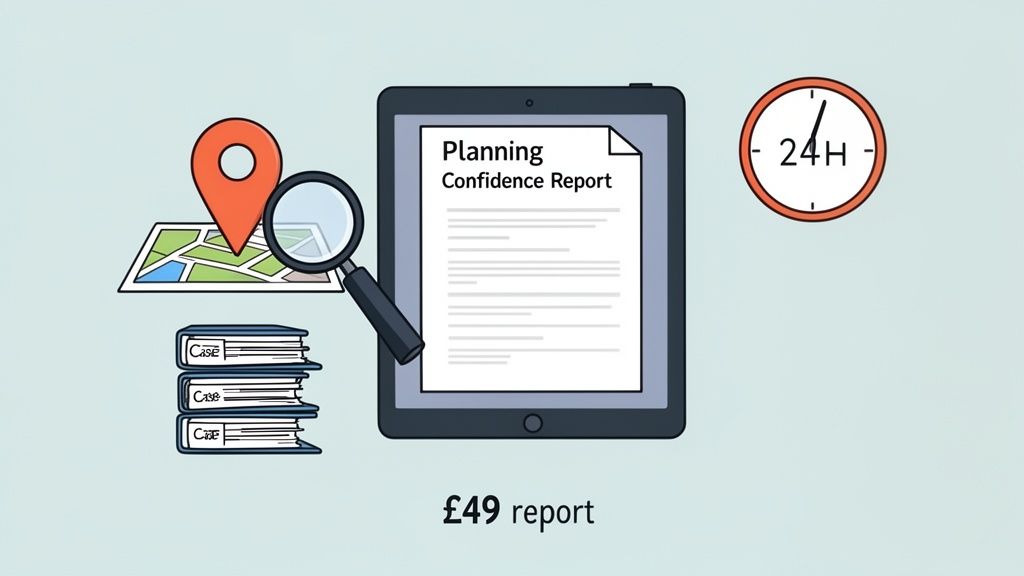
This is a complicated topic, but getting clarity is simple. An evidence based report is the smart move before you commit to costly plans that might be rejected.
Get Local Evidence, Not Generic Advice
SurePlan provides a £49 Planning Confidence Report. It looks at real, recent planning decisions from your specific local council. Within 24 hours, you get a clear PDF. It shows how applications for similar extensions succeeded or failed.
The report highlights cases where the 45-degree rule was a key factor in the council's decision. This gives you a big advantage.
This is not a guarantee of planning permission. It is evidence from your council's recent history. It helps you see what they approve and what they refuse. This lets you move forward with confidence or change your design early.
With this information, you can avoid the common problems that lead to a £258 refusal fee and thousands in wasted design costs. The report shows you the local planning reality. This helps you ask smarter questions and make better decisions.
You can then work with your architect with useful knowledge, not just a vague idea. It replaces uncertainty with evidence. You can move forward without risking a fortune on a design that was destined to fail.
Your 45-Degree Rule Questions Answered
Homeowners often have questions about how the 45-degree rule works. Getting the answers right helps you avoid expensive planning mistakes.
What if My Extension Only Fails by a Small Amount?
Failing the test, even by a small amount, is a big problem for a planning officer. It is not an automatic refusal. The planning 45 degree rule is a guideline, not a strict law.
If your design just goes over the line, the council might look at other factors. For example, you might get approval if your extension is very well designed. But you will need a strong argument to convince them.
Does the Rule Apply to Garden Buildings?
The short answer is no. The rule generally does not apply to separate outbuildings like sheds or garden rooms. This is true as long as they fall under Permitted Development rights.
Those buildings are judged by different rules. These rules usually focus on their height and how close they are to your boundary. The 45-degree test is for extensions attached to the main house.
What if Our Houses Are on a Slope?
Sloping ground makes the check more complicated. The main principle stays the same. A planner will still draw that 45-degree line from the centre of your neighbour’s window.
The difference is how carefully they will measure the vertical and horizontal positions of your homes. An extension built downhill from a neighbour is less likely to block light. An extension built uphill will face a much tougher review and is more likely to fail the test.
Don't guess if your plans will pass. The SurePlan Planning Confidence Report gives you evidence from your specific council, showing how they've ruled on projects like yours. Get clarity before you commit at https://www.getsureplan.co.uk.