
Feb 8, 2026
A Design and Access Statement explains the thinking behind your project. It tells the council the story of your plans. Getting it wrong can get your application rejected before it is even reviewed.
Submitting a flawed statement is an easy way to have your application thrown out. This mistake can cost you the non refundable application fee, typically £258 for a home extension. It can also delay your project by months.
Do You Need a Design and Access Statement?
Getting the rules wrong on a Design and Access Statement is one of the easiest ways to have your planning application invalidated on day one. It is a simple mistake. But it can cost you the non refundable application fee, typically £258 for a home extension, and push your project back by months.
This section gives you clarity on whether your project needs a DAS. Knowing this helps you avoid wasting time and money.
For many standard home extensions or loft conversions, a DAS is not needed. However, the rules can change completely depending on where your property is.
Key Triggers for a Mandatory DAS
The need for a statement usually depends on two things. The scale of your project and its location.
The rules have been simplified for most homeowners since 2013. The regulations now state that these statements are generally required for major projects or any work in protected areas. You can find the official government guidance on the Planning Portal.
You will almost certainly need to provide a DAS if your project falls into one of these categories:
It is in a Conservation Area. Even small projects that need planning permission in these zones often require a DAS. The statement must justify how the design respects the local character.
It involves a Listed Building. Any application for Listed Building Consent must come with a statement. This document explains and justifies the proposed changes.
It qualifies as a 'major development'. This is less common for homeowners. It includes big projects like building 10 or more new homes or a new building with over 1,000 square metres of floor space.
This simple decision tree helps you see if your project is likely to need a statement.
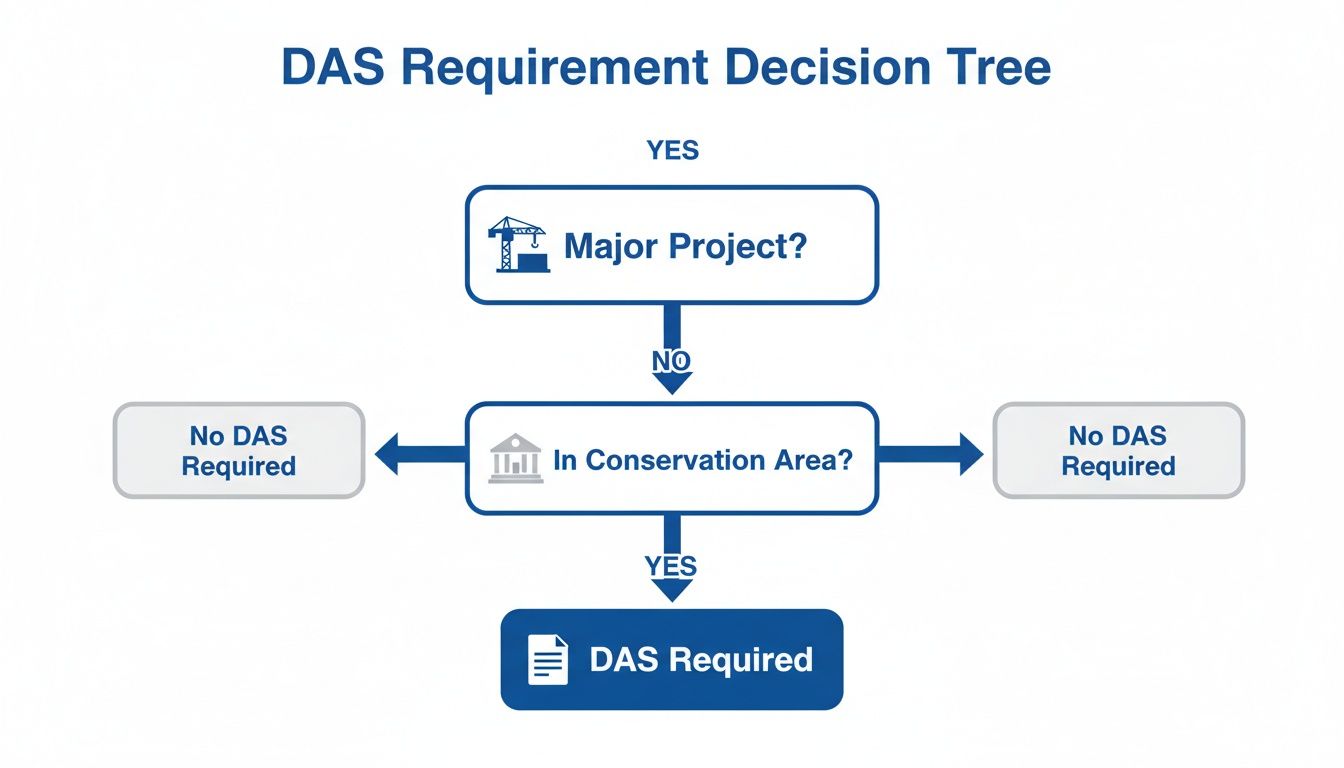
As the diagram shows, being in a Conservation Area is the most common reason a homeowner will need to prepare a Design and Access Statement.
Common Homeowner Scenarios
So what does this mean for typical home projects? Let’s break it down.
If your planned extension falls under permitted development rights, you will not need a DAS. This is because you are not submitting a full planning application. You can find out more in our guide on when planning permission is required.
A good rule of thumb is this: if your project requires full planning permission and your home is in any kind of designated or sensitive area, you should assume a Design and Access Statement is required until the council tells you otherwise.
Ignoring this can be a costly assumption. It is far better to prepare a short, clear document you might not need than to have your application made invalid for missing one. A quick check on your local council's website or a simple phone call can give you a definite answer. This can save you a massive headache later.
Quick Check: When a DAS is Required for Home Projects
Use this guide to quickly see if your home project and its location likely require a Design and Access Statement.
Project Type | Is a DAS Usually Required? | Key Considerations |
|---|---|---|
Small Rear Extension (Permitted Development) | No | PD rights mean no full planning application, so no DAS needed. |
Loft Conversion (Permitted Development) | No | Same as above. If it's within PD limits, you're clear. |
Large Rear Extension (Needs Planning Permission) | No (unless in a protected area) | Scale alone doesn't trigger it for a house, but location might. |
Any Extension in a Conservation Area | Yes | Any project needing planning permission here will almost certainly need a DAS. |
Work on a Listed Building | Yes | Always required for Listed Building Consent applications. |
New Porch or Outbuilding | No (unless in a protected area) | If the project needs planning permission due to location, a DAS may be required. |
This table is a starting point. The golden rule remains the same. Always confirm with your local planning authority before submitting your application.
What Planners Expect to See in Your Statement
Think of a Design and Access Statement as your chance to tell the council the story of your project. You should use language they understand. It is not about using flashy architectural jargon. It is about showing you have thought carefully about your plans and their impact. Getting this right stops your application from getting stuck or refused just because a planning officer could not follow your thinking.
A planning officer essentially works through a checklist. Your statement needs to give them the information to tick every box confidently. This clarity moves an application from the "maybe" pile straight into the "approved" one.
Justifying Your Design Choices
Your statement has to break down the key parts of your project. It must explain the ‘why’ behind each decision. Planners see vague descriptions like "a modern extension" as a red flag. What they really want to see is that your design is a direct, thoughtful response to your home and its setting.
A strong statement connects every design choice back to the character of your street and the needs of your family. It explains how you are improving your home without causing problems for the neighbourhood.
The Core Components of Your Statement
Planners are trained to look for specific sections to make their assessment. Your statement should be structured around these key themes.
Use: What will the new space actually be for? Say if it is a kitchen diner, a home office, or an extra bedroom for a growing family. This gives the planner context and helps them understand the reason for the project.
Amount: This is all about how much you are proposing to build. For an extension, that means stating the total new floor area in square metres. Be precise with your numbers.
Layout: How is the new space arranged? How does it connect to the rest of the house and the garden? Explain where the doors and windows are going and why. For instance, you might explain that a window was deliberately positioned to avoid looking into a neighbour's garden.
Scale: This covers the height, width, and length of your project. How big will it be in relation to your own house? And just as importantly, in relation to your neighbours’ properties?
Landscaping: How will the work affect your garden or any outdoor space? If you are adding a new patio, path, or planting as part of the job, mention it here.
Appearance: What will your extension look like from the outside? You need to describe the materials you plan to use. For example, the type of brick, roof tile, or window style. Then explain your choices. A common and solid justification is that the materials will match the existing house.
To help you see how this works for a typical homeowner project, here is a simple breakdown.
Core Components of a Homeowner's DAS
DAS Component | What It Means for Your Project | Example Explanation for an Extension |
|---|---|---|
Use | What will the new space be used for? | "The new single storey extension will create an open plan kitchen and dining area for our growing family." |
Amount | How big is the new structure in square metres? | "The proposed extension adds 25 square metres of new internal floor space to the property." |
Layout | How are rooms and openings arranged? | "New bi fold doors open onto the garden, and a high level window on the side elevation prevents overlooking the neighbouring property." |
Scale | What are the dimensions (height, width, depth)? | "The extension has a flat roof design with a maximum height of 3.1 metres, which is lower than the existing house's eaves." |
Landscaping | How will it affect your garden? | "A new patio area will be laid adjacent to the extension, using reclaimed paving slabs to match the existing garden path." |
Appearance | What materials and styles will you use? | "The walls will be built with reclaimed London stock bricks and the windows will have dark grey aluminium frames to match the existing house." |
Presenting this information logically makes the planner’s job much easier. For more tips on putting together a solid case, check out our guide on how to prepare a strong planning application.
Explaining Access to Your Property
The 'access' part of the statement is just as crucial as the 'design'. It is not just about how you will get into the building. It is also about showing that your project considers everyone, including people with mobility challenges.
Your statement must explain how people will access the new part of your home. This covers both pedestrian access from the street and internal access into the new rooms from the existing house.
For most homeowner projects, this section can be pretty straightforward. You might simply state that the existing front door and path will remain the main access point. If you are changing anything, like moving a gate or creating a new path, you must detail and justify it here.
Do not underestimate the impact of a clear, concise statement. Research shows that applications with a proportionate statement see approval rates that are 18% higher. This is because they directly address the council's main concerns. You can explore the data behind these design and access statement findings to see the difference it really makes.
Navigating Stricter Rules in Conservation Areas
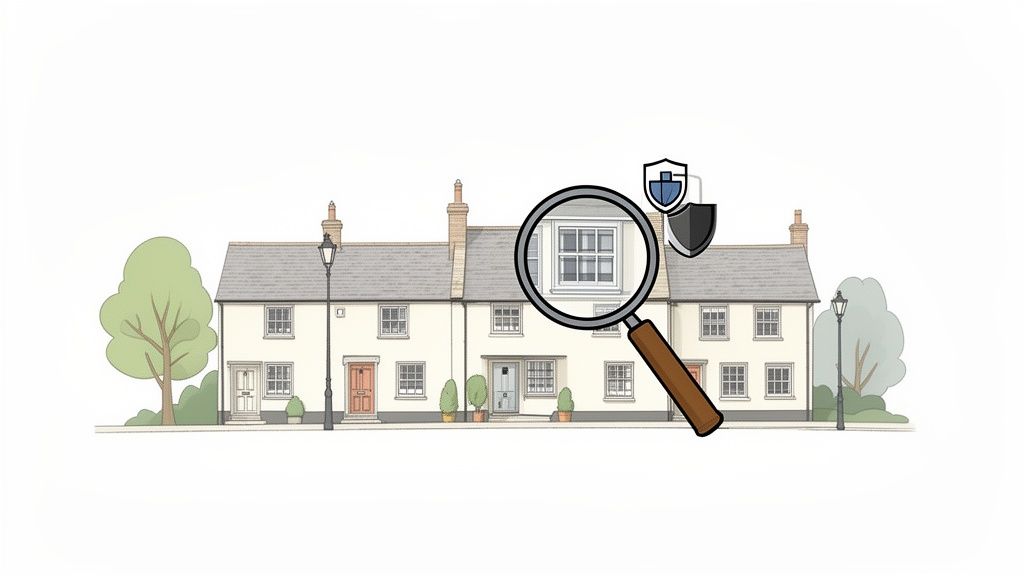
Living in a Conservation Area means the council looks at your planning application under a microscope. A project that might sail through elsewhere suddenly faces a much higher bar. This is because these areas are protected for their special architectural or historic character. The planners’ primary job is to preserve that unique quality.
This is why your Design and Access Statement becomes one of the most critical documents you will submit. It is your single best chance to prove you understand what makes the neighbourhood special and that your plans respect it. A weak statement here is a very common reason for a costly and frustrating refusal.
Why the Rules Are Tougher
Conservation Areas are not just about old buildings. They are about the complete picture. This includes the style of the houses, the types of materials used, the layout of the streets, and even the trees and green spaces. Your council will have specific policies that define this character. These are often detailed in a "Conservation Area Appraisal."
Your DAS must show that you have not only read this document but that your design is a direct and positive response to it. You are not just describing your extension. You are justifying it as a sensitive addition that preserves, or even enhances, the area’s unique qualities. Failing to do this is a critical mistake.
What Your Statement Must Demonstrate
In a Conservation Area, a standard, boilerplate DAS will not work. You need to provide a much deeper level of detail. It must directly address the area's heritage.
Your statement needs to nail these key points:
Understanding of Character: Show you have analysed what makes the area special. Mention specific features like the local brick bonding, common window styles, or the roof shapes on your street.
Material Choices: Justifying your materials is vital. If you propose using modern aluminium windows when every other house has timber sashes, you need a very compelling reason. Your DAS has to explain why your choices are appropriate.
Scale and Form: Your statement must prove the size and shape of your proposed work will not dominate the original house. It should also not look out of place next to your neighbours. It is about showing respect for the established rhythm of the street.
Historical Significance: You need to explain the impact of your proposal on the historic value of both your property and the wider area. This shows the planner you have thought seriously about heritage.
A successful statement in a Conservation Area tells a story of careful consideration. It proves your project is a thoughtful evolution, not a disruptive change. It preempts the planner’s concerns about protecting local character.
Dealing With Article 4 Directions
Some Conservation Areas have even stricter controls called Article 4 Directions. These remove many of your "permitted development" rights. This means you need full planning permission for what would normally be minor works, like changing windows or painting your front door. If your property is covered by an Article 4 Direction, your DAS has to be exceptionally robust.
These rules exist to stop small, incremental changes from slowly eroding the character of the area. For homes in Article 4 areas, which account for 5% to 10% of urban properties, a strong DAS is essential. It can help overcome common refusal reasons, like concerns that an extension is too dominant. You do this by clearly explaining how your design respects local policies. A well argued statement can mitigate around 40% of these typical refusal patterns.
The key is to use your statement to show that you are not fighting against the rules, but working thoughtfully within them. You are proposing a high quality design that is a worthy addition to a protected neighbourhood. For a deeper dive, you might find our guide on getting planning permission in Conservation Areas really helpful.
How to Write a Statement That Gets Approved
Writing a Design and Access Statement can feel like a dreaded homework assignment. But it does not have to be that way. The best approach is to think of it as telling the story of your project in a clear, logical way. A good statement simply makes it easy for the planning officer to understand your vision, tick their boxes, and approve your plans without fuss.
Your goal is to be persuasive, not poetic. Plain English is far more effective than trying to sound like a seasoned architect. Keep your statement short, focused, and easy to skim. A rambling document stuffed with jargon will only frustrate a busy planning officer. It might even plant seeds of doubt about your proposal.
Tell a Clear and Simple Story
Your statement must answer the ‘why’ behind every single decision. It needs to explain the problems you are trying to solve. It should also show how your design provides the best solution, not just for your home, but for the surrounding area too. Structure your document with clear headings that match the core components planners are looking for, like Layout, Scale, and Appearance.
This narrative approach is absolutely crucial. For instance, instead of just stating "the extension will have a flat roof," you need to explain why that choice was made. A much better justification would be: "A flat roof was chosen to keep the extension's height below the first floor windows of the main house. This minimises its visual impact." This small shift from just describing to actively justifying makes all the difference.
Use Visuals to Support Your Words
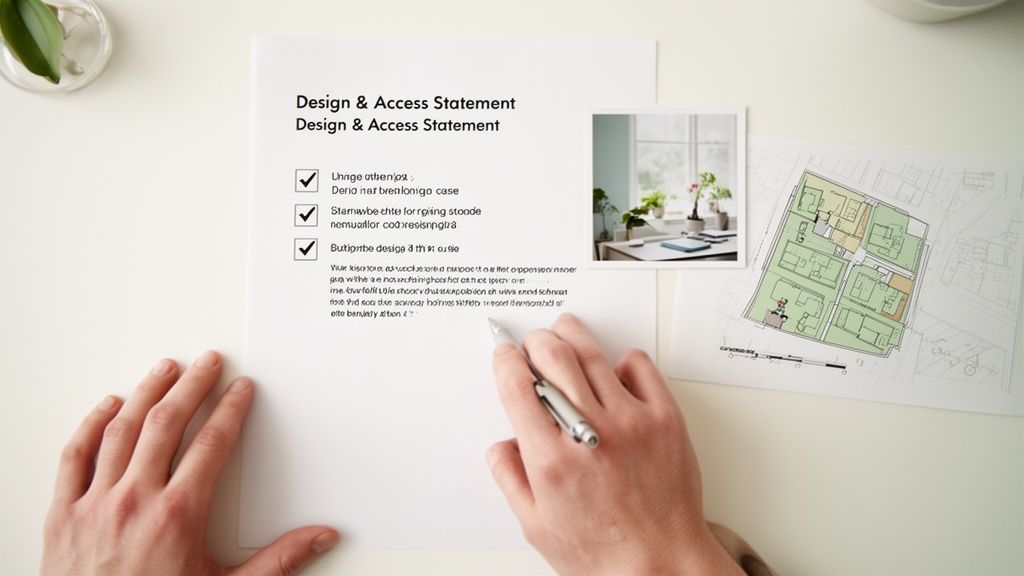
A picture really is worth a thousand words, especially in a planning application. Your statement becomes much more powerful when you include simple visuals to back up what you are saying. You do not need slick, professional 3D renderings. Basic tools can be incredibly effective.
Consider adding these visual aids:
Annotated Photos: Take clear photos of your property and the street it is on. Use simple arrows and text boxes to point out key features you mention in your text. This could be the roofline of a neighbouring house or the materials you plan to match.
Simple Diagrams: A basic floor plan or a simple side on drawing can instantly clarify concepts. For example, access routes or how the new extension sits in relation to the existing house. This helps the planner visualise your proposal without constantly flipping back to the formal architectural drawings.
These simple additions make your arguments tangible. They are also much easier for someone unfamiliar with your property to grasp quickly.
Connect Your Plans to Local Policies
While you should avoid pasting in dense legal text, briefly referencing your council's local planning policies shows you have done your homework. You do not need to quote long passages. Instead, find the key policies that relate to residential extensions or design in your area. Then explain how your project aligns with them.
A statement that says "our design uses brickwork that matches the existing house, in line with Local Plan Policy HOU5 which requires new development to respect local character" is incredibly effective. It shows the planning officer you understand the rules and have designed your project to comply with them.
This straightforward step demonstrates you are a considerate applicant who respects the local context. It proactively answers the questions the planner is required to ask. This helps smooth the path to approval. In 2022, over 320,000 residential applications were lodged in the UK. Issues with Design and Access Statements contributed to 12% of all refusals or invalidations. This highlights how getting the justification right from the start can prevent costly redesigns and delays. You can learn more by exploring the government's research into design and access statement effectiveness.
By keeping your statement clear, visually supported, and linked to local rules, you give your application the best possible chance of a swift and positive outcome.
Common Mistakes That Trigger a Planning Refusal
Getting a planning refusal is not just disappointing. It is an expensive and time consuming setback that can stop your project dead in its tracks. The frustrating part is that many rejections stem from simple, avoidable mistakes in the Design and Access Statement. Understanding these common pitfalls is your best defence.
Knowing what not to do is just as important as knowing what to do. Getting this document wrong can lead straight to a refusal. This forces you to pay a new application fee and wait another eight weeks for a decision. Let's walk through the most common mistakes so you can steer clear of them.
Describing Instead of Justifying
This is without a doubt the biggest and most common error we see. A statement that simply describes your project is almost useless to a planning officer. They already have your architectural drawings. They know what you are building. The statement's job is to explain why.
Think of it like this:
Weak (Describing): "The extension will have bi fold doors and a flat roof."
Strong (Justifying): "We chose a flat roof to ensure the extension's height remains below the eaves of the main house, minimising its visual impact. The bi fold doors are positioned on the rear elevation to maximise natural light without overlooking any neighbouring properties."
The second example gives the planner the logic they need to see. It shows you have thought through the impact of your choices, which is exactly what they are assessing.
Being Too Vague or Generic
Planners read dozens of these documents every week. They can spot a generic, copy and paste statement a mile away. Phrases like "a high quality design" or "in keeping with the local area" are completely meaningless without specific evidence to back them up.
Your statement has to be tailored to your specific house on your specific street.
A vague statement signals to the planner that you have not properly considered the context of your project. This lack of detail is a major red flag and makes it much easier for them to refuse your application.
Instead of just saying your design is "in keeping," explain how. For example, "The proposed red brickwork directly matches the Victorian brick on the main house, ensuring a seamless visual blend." That level of detail shows you have actually done your homework.
Ignoring the Access Component
The 'Access' part of the statement is not an optional extra. Failing to explain how people will get to and into the property is a critical mistake. It can lead to an instant refusal. This section needs to cover the entire journey, from the public pavement right into your proposed new space.
It also means considering inclusive access. You are not expected to make a private home fully wheelchair accessible like a public building. But you must show you have thought about it. Government data shows that, historically, poor access explanations were a huge issue. For instance, applications for listed building consent, which always need a DAS, faced 22% more refusals before 2013 due to weak access justifications. You can learn more about the history of these planning system requirements.
Common Refusal Traps Checklist
To sidestep these all too common errors, ask yourself these direct questions before you hit submit.
Does it justify every key decision? Go through your plans and make sure you have a clear 'why' for the scale, materials, layout, and appearance.
Is it specific to my property? Does it mention your street, your neighbours, and the particular style of your house?
Have I explained access clearly? Is it obvious how someone will get to and use the new space?
Is it focused and easy to read? Have you cut out the vague waffle and used plain English?
Avoiding these mistakes costs nothing but a bit of extra thought. It is one of the most effective ways to shield yourself from the cost and stress of a planning refusal. It gives your project the strongest possible chance of success from day one.
Your Final Checklist Before You Submit
Before you send your planning application, that last review of your Design and Access Statement is your final line of defence. It is your best chance to catch a small mistake that could lead to an eight week delay or even a £258 refusal fee. Rushing this last step is a costly error.
Take ten minutes to read through your statement one last time. Put yourself in the planning officer's shoes. Does it tell a clear, logical story? Is it easy to understand why you have made certain design choices? This final check will give you the confidence that you have submitted a solid document.
The Self Audit Questions
Ask yourself these simple questions. If the answer to any of them is no, take the time to make those quick edits. It is well worth it.
Is it specific? Does the statement mention your street name and the specific character of neighbouring houses, or is it full of vague phrases like "in keeping with the area"?
Does it justify, not just describe? Have you explained why the roof is flat or why the bricks match the main house?
Have all mandatory sections been covered? Quickly scan for the core components: Use, Amount, Layout, Scale, Landscaping, Appearance, and Access.
Does it address obvious concerns? Have you explained how you will avoid overlooking a neighbour's garden or blocking their light?
Is the 'access' part clear? Is it obvious how someone will get from the street to and into the new extension?
Think of this checklist as the final proofread before an important exam. Catching a simple error now prevents a big problem later. It ensures you have given the council every piece of information they need to say yes.
This quick review process helps ensure your statement is robust, compliant, and persuasive. It is a small investment of time that protects your larger investment in the project. This helps your application move smoothly towards an approval.
Your DAS Questions Answered
Homeowners often have the same few questions when it comes to Design and Access Statements. Getting clear, straightforward answers can help you avoid simple mistakes. These mistakes might delay your project or even get your plans refused. Here are a few of the most common queries we hear.
How Long Should a DAS Be for a House Extension?
For a typical home extension, keep it short and to the point. A good statement is usually between two and five pages.
The goal here is clarity, not waffle. Planning officers prefer a concise document that clearly justifies your design choices. They do not want a long, complicated report they have to wade through. Just focus on covering the key requirements like layout, scale, and access without unnecessary padding.
Can I Write the DAS Myself or Do I Need an Architect?
You can absolutely write a DAS yourself. For a straightforward project like a small extension, it is very manageable if you stick to the core principles.
However, an architect or planning consultant has years of experience framing arguments to align with picky local planning policies. Their expertise is particularly valuable in sensitive spots like Conservation Areas. If your project is complex or in a tricky location, getting professional help is a wise investment. It helps you avoid a costly refusal.
What Is the Difference Between a DAS and a Planning Statement?
This is a common point of confusion. The difference is actually quite simple when you break it down.
A Design and Access Statement is all about explaining the design choices. It also covers how people will physically get into and around the property. Think of it as the "why" and "how" of your design.
A Planning Statement is a much broader document. It justifies the entire project against a whole range of national and local planning policies.
For most small homeowner projects, you will only need a Design and Access Statement. A full blown Planning Statement is usually reserved for larger or more controversial developments. It is unlikely you will need one for a typical extension.
Before spending thousands on architectural drawings, find out if your plans have a realistic chance of success. SurePlan provides an evidence-based Planning Confidence Report for just £49, analysing recent council decisions in your area to give you clarity in 24 hours. Get your report at getsureplan.co.uk.