
Feb 2, 2026
Getting planning permission wrong can force you to tear down your project and pay huge fines. But many home improvements do not need formal planning permission at all. Knowing the difference is the first step to avoiding a costly mistake and making sure your project succeeds.
Why You Must Get Planning Permission Right
You must know if your project needs planning permission before you hire a builder. This single question shapes your timeline, your budget, and whether your project even happens. Getting it wrong is not a minor slip. The council can issue an enforcement notice. This legally requires you to demolish everything you have built.
The planning system manages how our towns develop. For you, it means answering one key question. Can I build under Permitted Development rights, or do I need a full planning application?
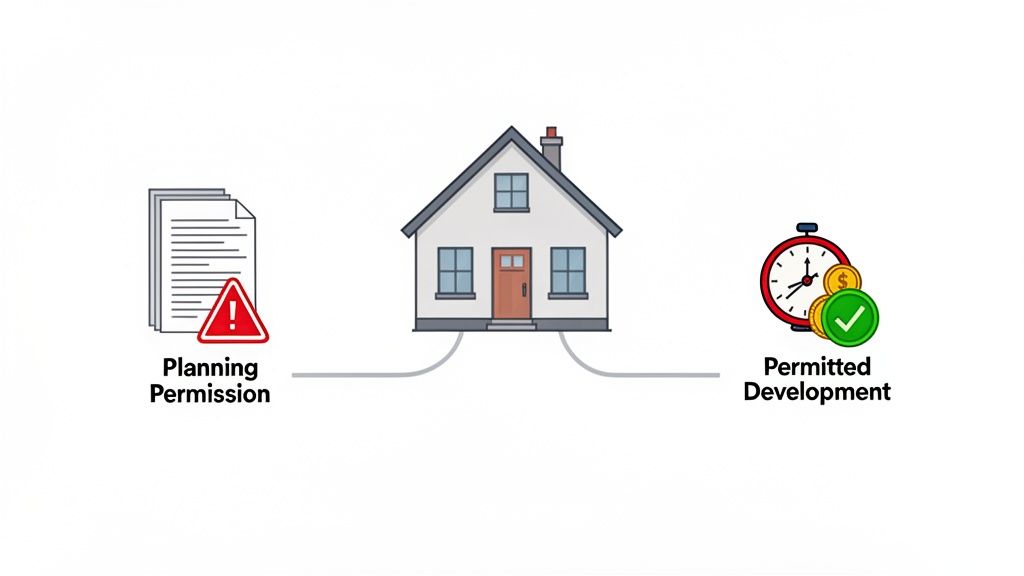
Permitted Development (PD): These are national rights. They let you make certain changes without a full application. Think of it as a pre-approved green light for common projects like small extensions. You must follow strict size and design rules. This is the faster, cheaper route. If you’re unsure where your project stands, our planning permission FAQs cover the most common questions.
Full Planning Application: This is the formal process of asking your council for permission. You need it for larger projects that fall outside PD rules. It involves submitting detailed drawings, paying a fee of around £548 in England, and waiting up to eight weeks for a decision.
A Common Hurdle for Homeowners
Figuring this out is a common problem. In just three months of early 2024, UK councils decided on 38,700 applications from homeowners for projects like extensions. These made up 51% of all planning decisions. Many people are in the same position as you. You can discover more about the latest planning application trends to see more data.
This decision tree shows how to think about your project from the start.
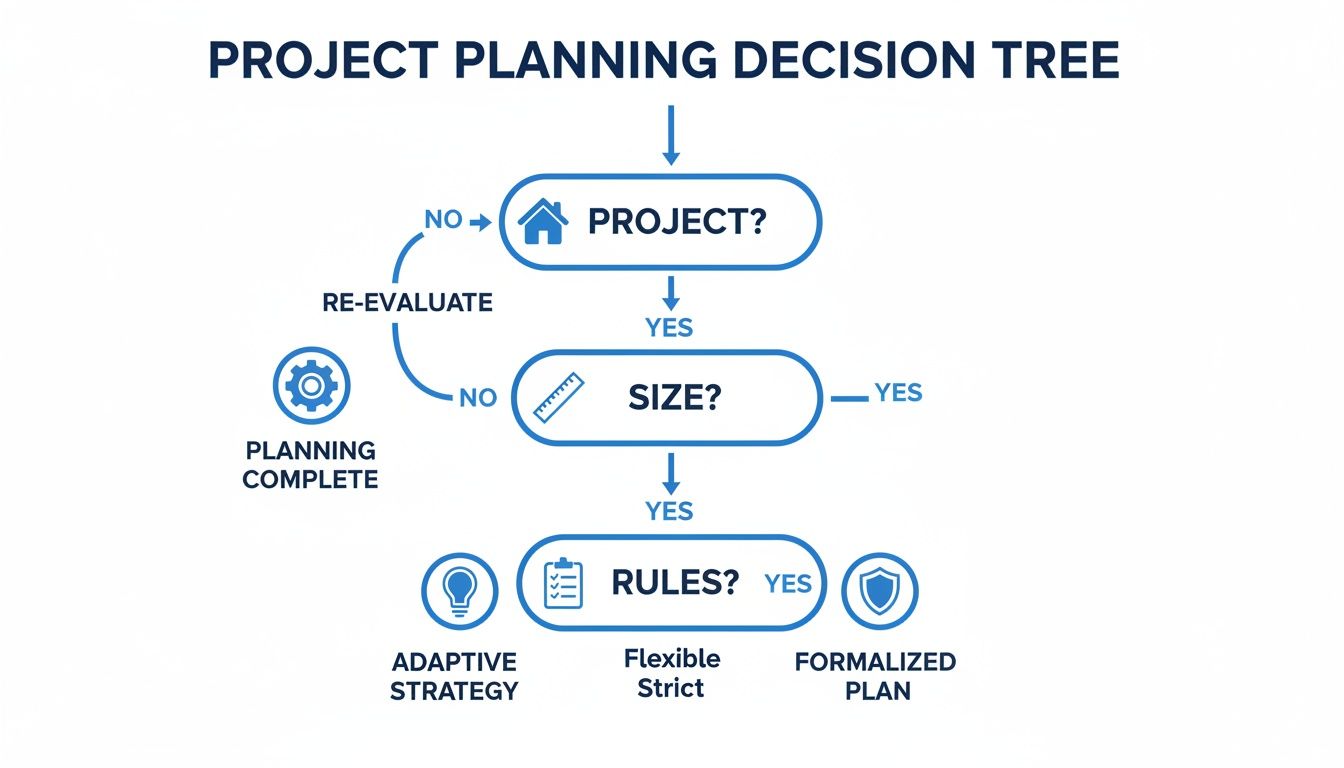
As the chart shows, the project's type, size, and location are the key factors that decide which path you must take.
Use Permitted Development to Save Time and Money
You can avoid the full planning process for many home improvements. The government gives a national grant of permission for certain projects. This is known as Permitted Development. You can build without submitting a formal application.
This is the fastest and simplest way to get your project started. It lets you build sooner and avoid application fees. It is like a pre-approved agreement for common projects. It is designed to reduce bureaucracy.
What Can You Build Under Permitted Development?
These rights cover the most common projects that homeowners undertake. The government has set clear limits on size, height, and location. This ensures projects do not cause major problems for neighbours.
Here are some common examples and their basic rules:
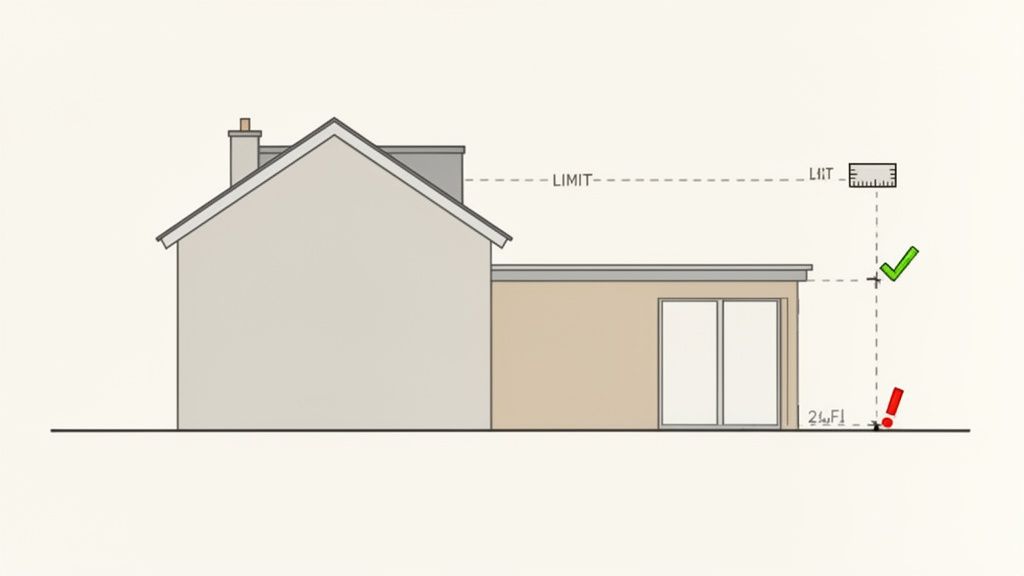
Single-Storey Rear Extensions: You can extend a detached house by up to eight metres from the back wall. For any other house type, the limit is six metres. The extension cannot be higher than four metres.
Loft Conversions: You can add up to 40 cubic metres of roof space to a terraced house. The limit is 50 cubic metres for a semi detached or detached home. The extension cannot be higher than the highest part of your existing roof.
Garden Rooms and Outbuildings: You can build sheds and home offices. The total area of all outbuildings cannot cover more than 50% of your garden. The building must also be single storey with a maximum eaves height of 2.5 metres.
These are just the headline numbers to give you an idea. The rules are very detailed. Getting one measurement wrong could make your rights invalid. You should explore a detailed breakdown of the permitted development vs planning permission routes to see which path your project is likely to take.
Common Traps That Could Cost You Thousands
Permitted Development is a great shortcut, but it has limits. Some key exceptions catch people out. This can lead to an enforcement notice that forces you to tear down your work.
The most common mistake is assuming Permitted Development rights apply to every property. Your home's location and type can remove these rights entirely. This can turn a simple project into a complex planning issue.
You need to know that these rights do not apply to flats or maisonettes. They are only for dwellinghouses.
The official Planning Portal has guidance on common projects. It is a good place to see the basic rules. But local restrictions can and do override these national guidelines.
How to Check Your Permitted Development Rights
Meeting the size criteria is not enough. You must confirm your PD rights are still intact before you spend any money. Local councils can restrict or remove them in certain areas to protect local character.
Here are the key restrictions to check for:
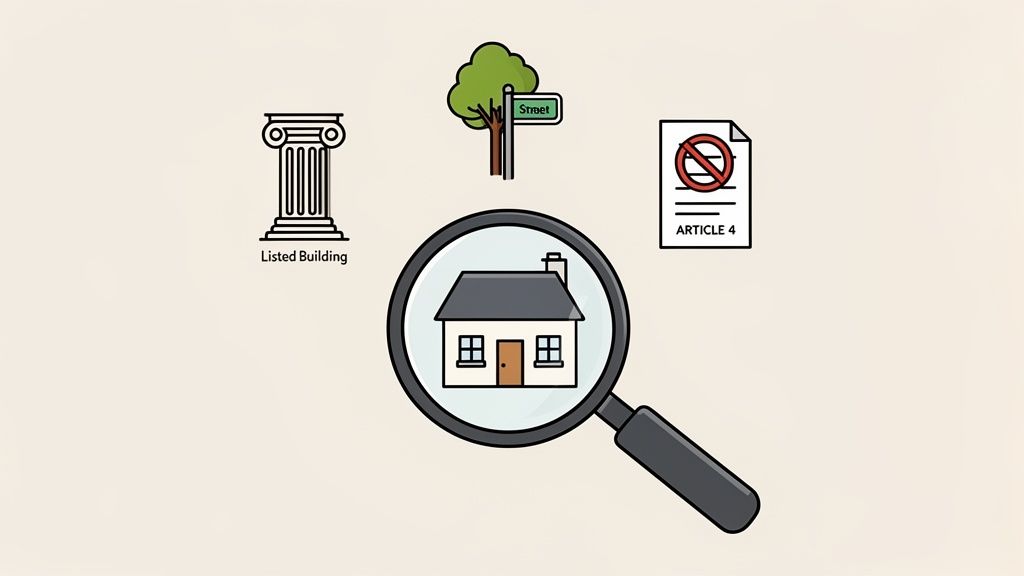
Conservation Areas: If your property is in a conservation area, your rights are often limited. For instance, you usually cannot add cladding to the exterior.
Article 4 Directions: A council can issue an Article 4 Direction for an area, a street, or one house. This removes some or all Permitted Development rights. You will need full planning permission for minor work like changing windows.
Listed Buildings: If your home is a listed building, forget Permitted Development. You will need Listed Building Consent for almost any work.
The only way to be certain is to check your local council's website or get professional advice. A small amount of research now can save you from an expensive mistake later. Getting this step wrong is one of the biggest risks in any home renovation project.
When You Must Get a Full Planning Application
Some projects are too big for Permitted Development. When your plans go past the strict limits, a full planning application is your only option. Trying to avoid this can lead to an enforcement notice forcing you to tear everything down.
Knowing the red lines that trigger this process helps you plan properly. Creating a new home, like a house in your garden or splitting your property into two flats, always requires a full application. There are no shortcuts.
Major changes to the front of your property will also almost certainly require a formal application. Planners are very protective of a neighbourhood's appearance.
Understanding the Formal Process
A full planning application is a formal request to your council for permission to build. It is different from Permitted Development because your project is judged against local and national planning policies. A planning officer will decide if your project gets approved.
The process gives the council and your neighbours a chance to comment on your plans. This scrutiny is why getting your application right is so important. A poor application will likely be refused. This wastes your time and money.
Submitting a full planning application is not just about drawings. It is about making a case that your project improves your home without harming your neighbours or the local area.
To succeed, you must prepare the right documents and pay the correct fee. It is a predictable but strict procedure.
What to Expect: Time, Cost, and Paperwork
A full application can seem intimidating. But the process is clear if you know what is required. An application for a home extension in England currently costs £548. This fee is not refundable, even if your application is refused. You want to get it right the first time.
Once you submit your application, the council aims to decide within a standard timeframe.
Timeline: For most home projects, the target is eight weeks from the date your application is validated.
Validation: The council first checks you have submitted all documents and paid the fee. Missing information is the most common cause of delays.
Consultation: During the eight weeks, your neighbours will be notified and given time to comment. Local councillors may also be consulted.
The core of your application is the detailed drawings of your proposal. These must be accurate and show the property as it is now and how it will look after the work.
Key Documents for Your Application
Your application must be complete to avoid delays. Specific requirements can vary between councils, but you will almost always need to provide these items.
Application Form: The standard national form, usually completed online via the Planning Portal.
Location Plan: Shows your property and the surrounding area, with the site boundary marked in red.
Site Plan (or Block Plan): A more detailed plan showing the proposed work and property boundaries.
Existing and Proposed Drawings: These include floor plans and elevations showing the building before and after the work.
Design and Access Statement: Sometimes needed in sensitive areas like Conservation Areas. It explains your design choices.
The Correct Fee: Currently £548 for a householder application in England.
Gathering these documents is the first practical step. It ensures your application is reviewed quickly and is not rejected on a technicality.
How Hidden Rules Can Stop Your Project
You could have the perfect extension planned that seems to meet every Permitted Development rule. But your project could be stopped dead. This is because where you live matters just as much as what you plan to build.
Ignoring these hidden local rules is the fastest way to waste thousands on architect drawings that will be refused. Your property can have special designations that override national rules. This completely changes what you are allowed to do.
This part trips up many homeowners. You must understand these restrictions early to avoid an expensive and frustrating mistake.
Conservation Areas: Protecting Local Character
If your home is in a Conservation Area, your council believes the neighbourhood has a special character worth protecting. This adds an extra layer of scrutiny to any changes you want to make.
Permitted Development rights are not removed completely, but they are often severely restricted. For example, you typically lose the right to add any cladding to the outside of your house. Two storey extensions are also usually not allowed without full planning permission.
The council's goal is simple. Any change you make must "preserve or enhance" the area's special character. This means materials, design, and scale will be judged much more harshly.
Article 4 Directions: When Your Rights Are Removed
An Article 4 Direction is a tool councils use to remove specific Permitted Development rights in a targeted area. It could apply to an entire estate, a single street, or just one property.
This is where it gets very complicated. An Article 4 can be very specific. A council might use one to remove your right to build a porch or change your windows without getting full planning permission first.
An Article 4 Direction forces you to apply for permission for something your neighbour across the street might be able to do freely. It is designed to protect local character where the council believes normal rules are not enough.
These directions are common in Conservation Areas but can be applied anywhere. We have a detailed guide on what an Article 4 Direction means for your home that is worth reading. You must check if one applies to your property before you do anything else.
Listed Buildings: The Highest Level of Protection
If your property is a Listed Building, you are in a different league of regulation. Permitted Development rights do not apply at all.
Almost any work you want to do, inside or out, will require a special application called Listed Building Consent.
This is because the building itself is considered nationally important. Even small internal changes like moving a wall could need formal consent. Making unauthorised changes to a listed building is a criminal offence. The stakes are very high.
You can quickly check if your property is listed by using the official national database.
The search results will tell you if your property is listed. They will also show its Grade (Grade I, II*, or II), which signals its historic importance.
The impact of these rules is significant. National approval rates for planning applications in England were around 86% in 2023. But this figure hides huge regional differences and challenges in protected areas. For instance, in one quarter of 2023, there were 1,300 refusals for extension applications in areas with Article 4 directions. You can discover more insights about planning application statistics and see how location impacts outcomes.
Knowing if your home falls into one of these categories is the first and most important step in figuring out your next move.
See What Your Council Is Likely to Approve
You can predict how your local planning department might react to your extension before you spend any money on architects. The best way to know what your council wants is to look at what they have already approved and refused on your street.
Every planning decision is public information. This gives you a library of real world examples. These examples reveal the specific rules your council really cares about. This research is a secret weapon for designing a project with a higher chance of success.
Using Your Council's Planning Portal
Every local planning authority has an online planning portal. It is a searchable database of every planning application in your area. It is the single most valuable resource for understanding local priorities without reading dense policy documents.
Finding it is usually easy. A web search for "[Your Council Name] planning search" will get you there. Once you are in, you can search for projects similar to yours.
To start, search by address. Look up your own street and nearby roads to find applications for projects like extensions. You can often filter the results by application type and date to focus on recent and relevant decisions.
What to Look for in Past Applications
Once you find a few similar projects, do not just look at the decision. The real value is in the details. For each application, you should be able to view all the documents. This gives you the full story of why one project succeeded and another failed.
Pay close attention to these key documents:
Application Form and Drawings: See what was proposed. Look at the size, materials, and design. How does it compare to your ideas?
Officer's Report: This is the most important document. It is the planning officer's detailed assessment, explaining how they reached their decision.
Decision Notice: This is the official confirmation of approval or refusal. If it was refused, it lists the specific reasons why.
Neighbour Comments: See what objections were raised. Common issues include loss of light, overlooking, or being out of character.
By reviewing a few local applications, you will quickly spot patterns. You might find your council often refuses two storey side extensions. This is hard evidence you can use to shape your own plans.
This insight is critical. The national approval rate for planning applications is around 87%. But this figure hides big local differences. For example, in early 2025, approval rates in London were as low as 82% while the North East hit 91%. Your postcode really can make a difference, as you can see in this analysis of planning application statistics.
Turn Research into a Stronger Application
This process is about gathering evidence to build a stronger case for your own project. By understanding the common reasons for refusal in your area, you can design your extension to avoid those same problems.
For example, if you see multiple refusals on your street citing "loss of light" to a neighbour, you know to pay attention to your proposal's position and height. Bringing this research to your architect will help them design a project that is far more likely to get approved. This saves you time and the cost of a failed application. A quick planning permission checker can also help you spot initial red flags before you dive too deep.
Your Game Plan for Getting it Right
You now understand the rules and the risks. Let's create a straightforward checklist to move you forward with confidence. Starting your project the right way means knowing the risks from day one.
Think of it as a simple three step process. Each step gives you a clearer picture of your project’s chances before you commit serious money.
Step 1: Confirm Your Starting Point
First, work out which path your project is likely to take. The big question is can you use your Permitted Development rights?
Get a tape measure. Carefully measure your planned extension, loft conversion, or outbuilding.
Compare these dimensions against the specific limits for your property type. Do not guess.
Getting even one measurement wrong can invalidate your rights. It happens often.
Step 2: Check for Hidden Restrictions
Next, you must confirm your Permitted Development rights have not been removed by local rules. This step catches out many homeowners.
Check if your property is in a Conservation Area. This changes the rules.
Find out if a specific Article 4 Direction applies to your street or home.
Confirm if your property has Listed Building status. If it does, the process is completely different.
Step 3: See What the Council Likes (and Hates)
Finally, do some local detective work. Look at what your council has already approved or refused on streets like yours. This is the best evidence for what they are likely to accept from you.
A SurePlan report does this research for you. It digs into recent, relevant planning decisions in your area and flags the common reasons for refusal. This gives you a clear confidence score before you hire an architect.
When you hire an architect, ask them how they have considered these local precedents and risks in your design. This ensures they are planning for success from the beginning.
Common Planning Permission Questions Answered
Here are some quick, straightforward answers to common questions about planning permission.
How Long Does Planning Permission Last?
Once you get planning permission, it is valid for three years. You must start the work within that time. If you do not, it expires. You will need to submit a new application.
"Starting" the work does not mean the project must be nearly finished. Legally, you just need to make a "material start," which can be as simple as digging the foundations.
What Happens If I Build Without Permission?
Building without the correct permission is a serious mistake. If the council finds out, they can issue an enforcement notice. This is a legal order to undo all the work. That could mean tearing down your new extension.
Ignoring an enforcement notice is a criminal offence. It can lead to large fines and a court summons. It is a costly and stressful mistake that can turn your project into a nightmare.
The council has up to four years after the work is mostly complete to take enforcement action. This extends to ten years for a change of use or for breaking a specific planning condition.
Do I Need Planning Permission for Solar Panels?
For most homes, adding solar panels to your roof is covered by Permitted Development rights. This means you will not need full planning permission.
However, you must meet a few conditions:
The panels cannot stick out more than 200mm from your roof surface.
They must not be installed higher than the highest part of your roof.
Your home must not be a listed building or in a conservation area, where special rules apply.
If you are thinking about ground mounted panels or you live in a protected area, you must check with your local planning authority first.
Can My Neighbours Object to My Plans?
Yes, they can. When you submit a full planning application, the council opens an eight week consultation period. During this time, neighbours can comment on your proposal.
But their objections must be based on valid material planning considerations. This includes things like overlooking, loss of privacy, or a design that is out of character with the street. Personal issues or concerns about property value are not valid planning reasons for a council to refuse your application.
Stop guessing and start planning with confidence. A SurePlan report gives you evidence based on real, local planning decisions, so you know where you stand before you spend money on drawings. Get your Planning Confidence Report today. Find out more at https://getsureplan.co.uk.