
Feb 19, 2026
Owning an old farm building could mean you are sitting on a potential new home. A special rule called Class Q lets you convert agricultural buildings into houses, often without a full planning application. This guide explains how you can save thousands in fees and months of waiting, or avoid a costly refusal before you spend a penny.
Could Your Barn Become a House?
Class Q is a planning shortcut for turning certain farm buildings into homes. It uses a simpler process called 'permitted development'. This is very different from a full planning application which is often more complex, expensive, and uncertain. Understanding this difference is the first step to knowing if your project is realistic.
The normal planning system can feel like a gamble. In 2025, UK councils refused 19% of all planning applications. That means nearly one in five projects were rejected, often due to local rules the owner did not know about. A refusal can waste thousands of pounds. You can learn more about national planning statistics and what they mean for homeowners.
What Are Permitted Development Rights?
Permitted development rights are a national grant of planning permission. They allow certain building projects to go ahead without a full application. You just need to follow a strict set of rules.
Class Q uses a lighter system called 'prior approval'. You tell the council your plans, and they only check if your project meets a specific list of technical criteria. This route was created to help turn existing rural buildings into much needed homes.
For a homeowner, this offers clear benefits:
More Certainty: The rules are clearer than the subjective judgements in full planning.
Faster Decisions: Councils must decide on a prior approval application within 56 days.
Lower Costs: Application fees are lower, and you may not need expensive architectural drawings upfront.
Why This Matters for Your Project
You must find out if your barn conversion qualifies for Class Q before you spend money. Many people hire an architect and pay for expensive plans only to learn their building is not eligible. This is a sure way to waste thousands of pounds and months of your time.
See Class Q as a specific path with its own set of rules. If your project fits the rules, the journey is much smoother. If it does not, you will need a full planning application.
This guide gives you the clarity to assess your property's potential from the start. We will explain the essential rules, common mistakes, and the practical steps involved. By understanding the basics of permitted development rights, you can make an informed decision and avoid the costly errors that catch others out.
The Three Critical Tests Your Barn Must Pass
Not every farm building can be converted under Class Q. Before you picture your dream home, you must understand the strict tests councils use. Failing just one will lead to a refusal, costing you time and the £258 application fee.
Your barn must pass three checks. These cover its history, its strength, and its location. Understand these now, and you will have a much clearer idea of your chances before spending any serious money.
Test 1: The Agricultural Use Rule
First, your building needs a real farming history. This is a strict legal requirement. For a Class Q project, the building must have been used solely for an agricultural trade or business on 24th July 2023.
If the building only started farm use after that date, you must wait 10 years before it becomes eligible. This rule stops people from putting up new sheds and immediately trying to turn them into houses.
What does "solely for agricultural use" mean?
Real Farming: The building must have been essential to the farm, such as housing livestock or storing crops.
No Mixed Use: If it was also used to store a classic car or for recreational horse riding, it will likely fail this test.
Evidence is Key: You will need to prove its history to the council. Old photos, tenancy agreements, or farm accounts can make your case.
This is a simple yes or no question. If your building does not have the right history, your Class Q journey stops here.
This flowchart shows the decision process for Class Q, starting with the building's use and structural readiness.
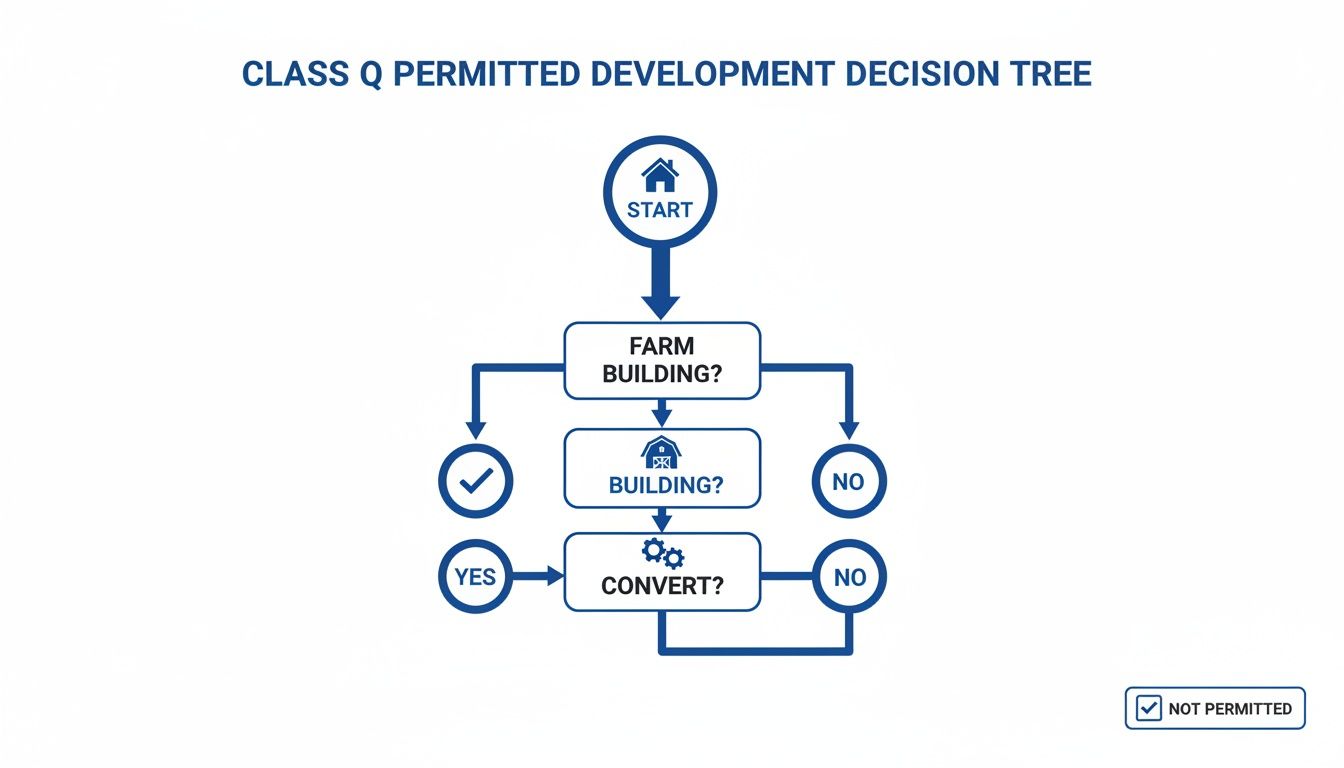
The visual makes it clear. Passing both the 'farm building' and 'convertible' tests is essential for any Class Q project.
Test 2: The Structural Integrity Rule
This is a major hurdle where many applications fail. Your barn must be strong enough to be converted without a major rebuild. Class Q allows a conversion, not a demolition and new build in disguise.
The work you propose must only be what is reasonably necessary to make the building a home. You cannot build a new house and just call it a barn conversion.
The core principle is that the original agricultural structure must be retained. If your plans involve knocking down and rebuilding external walls, you are going beyond what Class Q allows.
Planners will check this point carefully. They need to be sure the existing frame, walls, and foundations can support the new home. If your barn is a ruin or needs significant new structural work, your application will be refused. A structural engineer’s report is often vital to prove the building is suitable.
Test 3: The Location Rule
Finally, the barn's location can disqualify it immediately. Class Q permitted development rights do not apply in certain protected areas. This is a straightforward check you can do yourself.
Your project cannot go ahead under Class Q if the building is in any of these locations:
A National Park (like the Lake District or Peak District)
An Area of Outstanding Natural Beauty (AONB), now called National Landscapes
A Site of Special Scientific Interest (SSSI)
The Broads
A World Heritage Site
Also, if the barn is a Listed Building, Class Q rights do not apply. These areas have much stricter planning controls. If your property is in one of these zones, you must apply for full planning permission, which is a much more difficult path.
Navigating the Prior Approval Process
If your barn passes the three main tests, you still need to get prior approval from your local council. This is a formal step you cannot skip. It is simpler than a full planning application but still critical.
Think of it as a focused check. The council does not judge whether a house should be there. That right is already granted by Class Q. Instead, they just check your project against a specific list of practical issues.
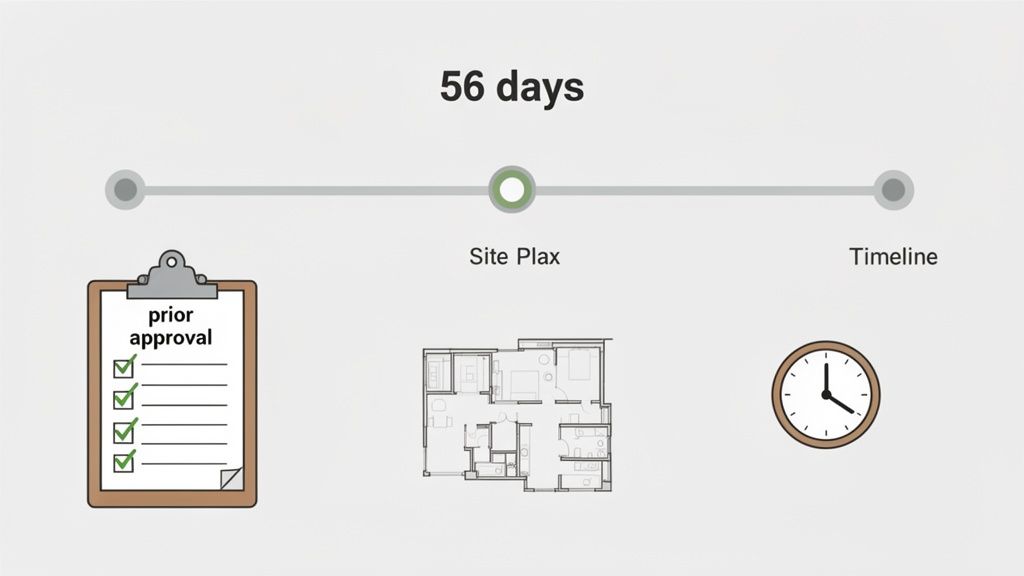
Understanding this process helps you prepare properly. Getting it right avoids simple mistakes that cause delays or a costly £258 refusal fee.
What the Council Actually Checks
During prior approval, planning officers do not decide if they like your design. Their job is to review a limited set of factors to ensure your home will not cause major problems.
The council will look at these five points:
Transport and Highways: They check if the new home has safe access to the road. Can you see clearly when pulling out?
Noise Impacts: They consider how farm noise might affect you, and how noise from your home might affect the farm.
Contamination Risks: Farmland can sometimes be contaminated. The council needs to be sure the site is safe to live on.
Flood Risk: They check if the property is in a flood risk area and if your plans address this.
Location and Siting: Is the building’s location impractical for a home? For example, is it too close to smelly farm operations?
If you want to understand this process in more detail, see our article on how prior approval works for home extensions.
The Critical 56-Day Timeline
A huge advantage of prior approval is its strict timeline. Once your application is accepted, the council has exactly 56 days to make a decision. This gives you a certainty that you do not get with full planning applications, which can drag on for months.
This 56 day deadline is legal. If the council does not give a decision in time, you can legally proceed with your project as if they had approved it.
This is a powerful protection, but you should not rely on it. The best approach is to give the planner a well prepared application so they can say "yes" well within the deadline.
Documents You Will Need to Submit
A prior approval application needs less paperwork than a full planning application. But you still must provide clear and accurate information. A weak or incomplete application is a fast track to refusal.
You will typically need:
A written description of your proposed conversion.
A site plan showing the barn and its boundary.
Floor plans and elevations showing the building now and your proposed changes.
The application fee, currently £258 for each new home.
You may also need extra evidence like a structural survey or a contamination report. Getting this right from the start shows the council you are serious and makes an approval more likely.
Why Class Q Applications Get Refused
The best way to get your barn conversion approved is to understand why others fail. Knowing the common pitfalls helps you spot red flags early. This can save you from wasting thousands on an application that will be rejected.
Councils check every detail. Getting it wrong leads to a refusal. The most common reasons are predictable if you know what to look for.
Structural Issues: The Number One Dealbreaker
By far, the biggest reason Class Q applications fail is due to structural problems. People often underestimate the difference between a conversion and a rebuild. Class Q lets you convert a building. It does not let you knock it down and build a new one.
Your work must be limited to what is reasonably necessary to make the building a home. The original structure, especially its frame and external walls, must be strong enough to support the conversion.
If your plans involve rebuilding external walls because the current ones are in poor condition, your application will almost certainly be refused. The original agricultural building must be capable of conversion as it is.
This is where a structural engineer's report is essential. It gives the council proof that the building is sound. It shows your plans do not cross the line from conversion into a rebuild. Without this evidence, you are inviting a refusal.
The Building Was Not Solely in Agricultural Use
This is another common and avoidable reason for failure. The rules are strict. The building must have been used solely for agriculture on 24th July 2023. There is no grey area.
What does this mean in practice?
No Hobby Farming: Keeping horses for recreational riding does not count as an agricultural trade.
No Mixed Storage: If the barn was also used to store a classic car or business equipment, it fails the "solely" test.
Hard Evidence: Councils will ask for proof. This could be old photos, tenancy agreements, or farm business accounts.
If the building’s history is not clear, your application is on thin ice. This is a simple check that can save you a lot of trouble.
Unsafe Access and Awkward Locations
Even if your barn is structurally perfect with a solid farming history, its location can still sink your application. The council must ensure the new home will be a safe and reasonable place to live.
A common reason for refusal is poor access. The farm track a tractor uses is not always safe for daily car use. The council will look at visibility onto the main road. If they think it is dangerous, they will refuse permission.
Another problem is the building's siting. If the barn is very close to loud or smelly farm operations, like a slurry pit, the council can refuse it. They have a duty to prevent problems between new residents and existing farms. Your proposed garden must also be a reasonable size.
Here is a quick rundown of the most common reasons councils say no.
Top 5 Class Q Refusal Reasons and How to Avoid Them
Reason for Refusal | Why It Happens | How to Prepare |
|---|---|---|
1. Structural Rebuild | Plans involve too much demolition and new building. The council decides it is a "new build" not a "conversion". | Get a structural engineer's report early. It must confirm the existing frame and walls can support the conversion. |
2. Not "Solely" Agricultural | The building was used for non farm items (e.g., a caravan) or for equestrian hobbies. | Gather evidence of agricultural use on the key date: dated photos, farm accounts, or tenancy agreements. |
3. Poor Highway Access | The track onto a public road is unsafe due to poor visibility or being too close to a high speed road. | Get a highways report from a transport consultant. This can assess visibility and propose safe access solutions. |
4. Impractical Location | The barn is too close to noisy or smelly farm activities like livestock sheds, making it an unsuitable place to live. | Provide a detailed site plan showing separation distances. Explain how your design minimises any potential problems. |
5. The Building is Too New | The barn was built after the cut off date. A new barn must have existed for at least 10 years before you apply. | Check the building's history. Use old aerial photos or planning records to prove it meets the 10 year rule if it was built after 2013. |
Thinking through these points before you start greatly increases your chances. It is all about spotting the dealbreakers early and having a solid plan.
Rules for Heritage Sites and Special Locations
If your barn is in a special landscape or near a historic building, the rules get more complicated. These protections can completely change what is possible for your project.
You must understand these extra controls before you commit any money. Failing to check for these restrictions is one of the costliest mistakes you can make. You could spend thousands on plans for a project that has zero chance of approval.
Conservation Areas and Listed Buildings
Is your property in a Conservation Area? This is a zone of special architectural or historic interest. Class Q is not automatically ruled out, but councils will check your plans much more closely. They will assess the impact on the character of the area.
It is a different story if your barn is on land connected with a Listed Building. In that case, Class Q rights do not apply at all. This is a firm rule. Protecting the Listed Building is the top priority.
The good news is that getting consent for work in protected areas is possible if done correctly. In 2023/24, a high 92% of applications for Listed Building Consent were granted. This shows councils approve well considered plans.
However, the process is slower. For instance, London councils only met decision deadlines for 67% of these applications. You can explore more heritage planning statistics to understand these trends.
The Impact of an Article 4 Direction
An Article 4 Direction is a special rule a council can use to remove permitted development rights in an area. If your property is covered by an Article 4 Direction that affects Class Q, you lose your automatic right to convert the barn.
This means you would have to submit a full planning application instead. This is a much more complex process. You can learn more in our guide to permitted development rights in a conservation area.
Why an Early Check Is So Important
Finding out about these restrictions late can be a financial disaster. Imagine paying an architect and engineer only to discover an Article 4 Direction makes your Class Q plans impossible.
Checking for these red flags should be your first step. You must do this before you spend a single pound on professional fees.
Check the council's website: Look for planning maps that show Conservation Areas and Listed Buildings.
Confirm with the planning department: A quick email or phone call can give you a definite answer.
Use a feasibility service: A SurePlan report automatically checks these rules. It uses local data to tell you which rules apply to your property.
In these sensitive locations, proceeding without clarity is a huge gamble. Taking time to confirm the rules upfront will save you from an expensive dead end.
Your Top Class Q Questions Answered
Class Q planning can be confusing. It is normal to have questions. Getting clear answers before you start is the best way to avoid expensive mistakes. Here are straightforward answers to common questions from homeowners.
How Much Does a Class Q Application Cost?
The council fee for a prior approval application is currently £258 for each new home. But this is not the only cost.
You will also need to pay for professional services. This means getting basic drawings and a location plan. You will almost certainly need a structural survey to prove the building is sound. These fees can easily add several hundred to a few thousand pounds to your initial budget.
This is why checking your project’s feasibility early is so important. You want to avoid spending money on an application that will fail.
Can I Extend the Barn Under Class Q?
This is a common question. Class Q gives you permission to convert the existing building. It does not allow you to make the building bigger or dramatically change its look. The point is to keep the agricultural character.
You cannot use Class Q to:
Demolish and rebuild external walls.
Extend the footprint of the building.
Add a second storey or raise the roof.
The work you can do is what is "reasonably necessary" to make the building a home. This includes installing windows, doors, roofing, and connecting utilities. The finished house should still look like the barn it once was. If you want a large glass extension, you will need to apply for full planning permission.
What Happens if My Class Q Application Is Refused?
A refusal is disappointing but not always the end. It does mean you face more costs and delays. First, read the council's decision notice carefully. It will explain exactly why they refused your application.
You have two main options:
Appeal the decision: You can take your case to the Planning Inspectorate, an independent body. This can take several months.
Submit a new application: It is often better to revise your plans to fix the council’s concerns. For example, you could get a full structural report and reapply with that new evidence.
Sometimes, a refusal is a sign that Class Q is not the right path for your building. Your next move would be to consider a full planning application.
What Is the Planning 'Fallback Position'?
The 'fallback position' is a planning strategy. Once you have secured prior approval under Class Q, you have established that a home is legally allowed on that site.
You can use this approval as leverage. You can then go back to the council with a full planning application for a better designed home, or even a replacement one.
You are saying to the planning department: "I have the legal right to create a home here using Class Q. However, I would prefer to build this alternative, better designed house instead."
This strategy can help you get a much better result than Class Q allows. For example, you could get permission for a design that is more energy efficient or suits your family better. It is a complex approach that usually needs professional advice.
Before you commit thousands to architects and surveys, you need to know if your project has a realistic chance of success. SurePlan gives you that clarity. Our evidence based report analyses real council decisions in your area to give you a clear Planning Confidence Score in just 24 hours. Find out if your barn conversion is a viable project or a potential money pit. Get your report today.