
Feb 14, 2026
Thinking about extending your home in a conservation area? You might believe the rules will automatically block your plans. But you can often still build small rear extensions or convert your loft without full planning permission. Knowing the specific rules for your property first is the key to avoiding a costly mistake.
This guide will show you how to find out what you can build. It helps you avoid a £258 refusal fee or being forced to tear down your finished work.
What You Need to Know Before Renovating in a Conservation Area
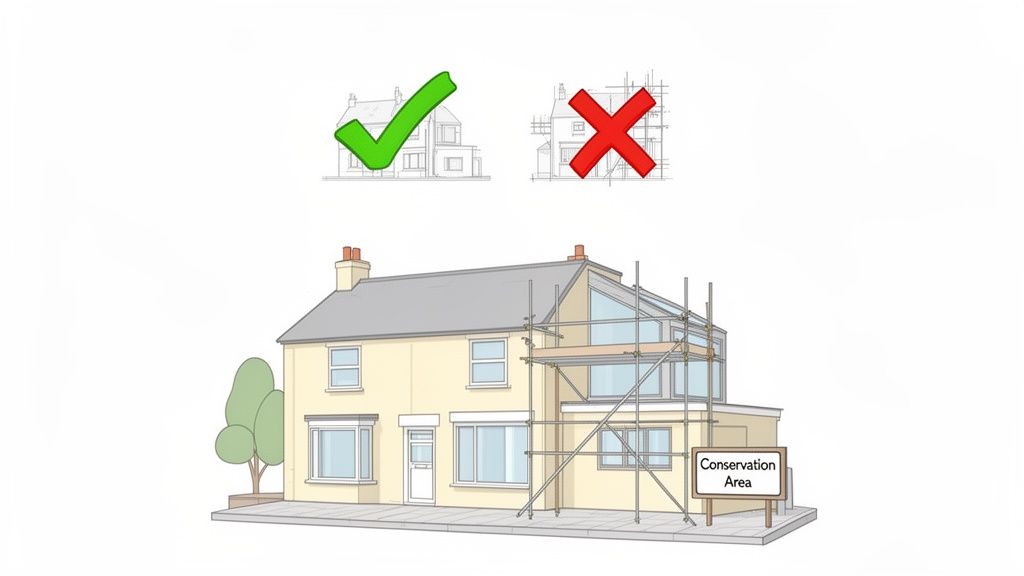
Many homeowners fear that living in a conservation area means giving up on improving their property. The thought of complex rules and instant refusals can be paralysing. But this is a common misunderstanding.
A conservation area designation is not a complete ban on development. Its purpose is to protect the special character of a neighbourhood. This just means your plans will face more checks. It does not remove all your rights.
Your Rights Are Restricted, Not Removed
The government gives most homeowners a set of pre approved building rights called Permitted Development Rights. These let you do common projects without a full planning application. In a conservation area, some of these rights are just scaled back. This gives the local council more control over changes.
This guide gives you clarity on what changes for you. Getting this right from the start helps you avoid two major problems:
Wasting money on rejected plans. A planning application refusal costs time and money. The standard fee in England is £258.
Getting an enforcement notice. If you build something that is not permitted, the council could force you to tear it down. This would be at your own expense.
Success depends on knowing the specific limits for your home before you commit to designs or builders. Some projects will be simple. Others will need a more careful approach.
By understanding how permitted development rights in a conservation area work, you can set realistic goals. This knowledge helps you adapt your plans to fit the rules. Or it helps you prepare a stronger case if you do need to apply for full planning permission. We will explain how to find out where you stand.
What Are Permitted Development Rights?
Before planning any home improvements, you need to understand your building rights. Getting this wrong can be an expensive mistake. Nobody wants to pay a £258 refusal fee. Even worse is being told to tear down work you have already completed.
Think of Permitted Development Rights (PDR) as a national green light from the government. They cover common and simple home improvements. They are a pre approved list of works. They save homeowners and councils the time and cost of a full planning application.
A Simple Analogy
Imagine a restaurant.
Permitted Development is like the set menu. It offers popular, simple options with clear rules on size, placement, and materials.
Full Planning Permission is the à la carte menu. Everything is up for discussion. It needs the council's specific approval. The final decision is up to them.
This system works well for most standard projects. But the rules change if you live in a designated area. Your permitted development rights in a conservation area are often greatly reduced or removed.
A common mistake is assuming the national PDR rules apply everywhere. In a conservation area, local rules to protect the neighbourhood always come first.
Permitted Development vs Full Planning Permission
Let's look at the key differences. The main factors are the project's size, its complexity, and how it gets approved.
Aspect | Permitted Development (PDR) | Full Planning Permission |
|---|---|---|
Approval | Pre approved by national rules | Needs specific council approval |
Speed | Faster process, often no wait | 8 to 13 week decision timeline |
Cost | Often no application fee needed | Standard application fee of £258 |
Scope | Limited to specific common projects | Covers complex or large scale work |
Flexibility | Strict size and location limits | More design freedom is possible |
As you can see, PDR offers a simpler path for many homeowners. Local restrictions do not mean PDR is off the table. It is still a useful tool. Nationally, PDR rules created 10,303 new homes in 2021/22. This shows how flexible it can be. You can find more information on the Historic England website.
PDR is not a universal pass. But it is a useful shortcut for the right project. For more details on what is usually covered, see our guide explaining permitted development rights in more detail.
Now let's see how living in a conservation area changes things.
How a Conservation Area Changes the Rules
Living in a conservation area means your local council must protect its special character. This directly affects your permitted development rights (PDR). Understanding how is vital to avoid a costly planning mistake.
It is a myth that all your rights disappear in a conservation area. That is not correct. Instead, the rules get tighter. This gives the council more control over changes that affect the area's look, especially anything seen from the street.
Where Your Rights Are Most Affected
The restrictions on permitted development rights in a conservation area are not random. They focus on work that has the biggest visual impact on a property and the street.
Three common areas where your rights are almost always reduced include:
Side Extensions: Any extension to the side of your house will almost certainly need full planning permission.
Roof Alterations: Adding dormer windows on the front or side of your roof is not typically allowed under PDR.
External Cladding: You cannot apply stone, render, or timber cladding to your home under permitted development.
These jobs are restricted because they can change a building's appearance. They can disrupt the character the conservation area is meant to protect.
The Impact of an Article 4 Direction
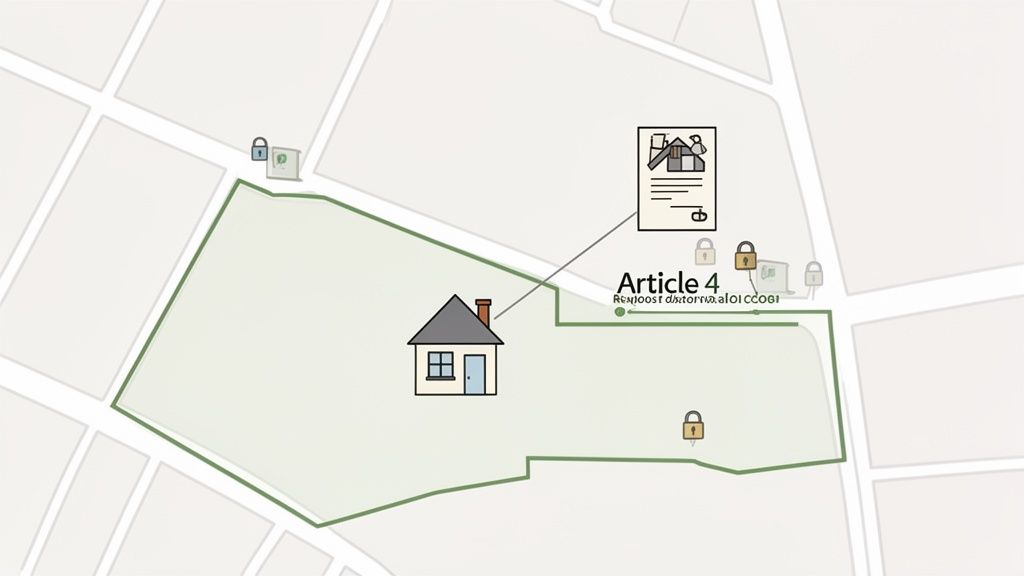
Things can get more complicated here. Your local council can use a special power called an Article 4 Direction. This removes specific permitted development rights in a certain area. It is an extra layer of protection on top of the standard conservation area rules.
An Article 4 Direction does not remove all your PDR. It is very specific. For example, a council might use one to control minor changes that could slowly damage the neighbourhood’s character over time.
An Article 4 Direction means the council needs to look at your plans more closely. It turns what would normally be a simple job into one needing a full planning application.
Common things targeted by these directions include replacing windows and doors, painting brickwork, or altering front garden walls. Knowing if one applies to your home is essential before you plan any work. You can learn more in our detailed guide to Article 4 Directions.
Even with these extra controls, many rights often remain. For example, you can usually still demolish walls under one metre high. But assuming these rights still apply without checking for an Article 4 Direction is a risk.
Common Projects: What Is and Is Not Allowed
Let's look at how these rules affect common home improvements. This will show you what is realistic for your property. It will also show you what is likely to fail before you spend money. Avoiding a rejection is much better than trying to fix one.
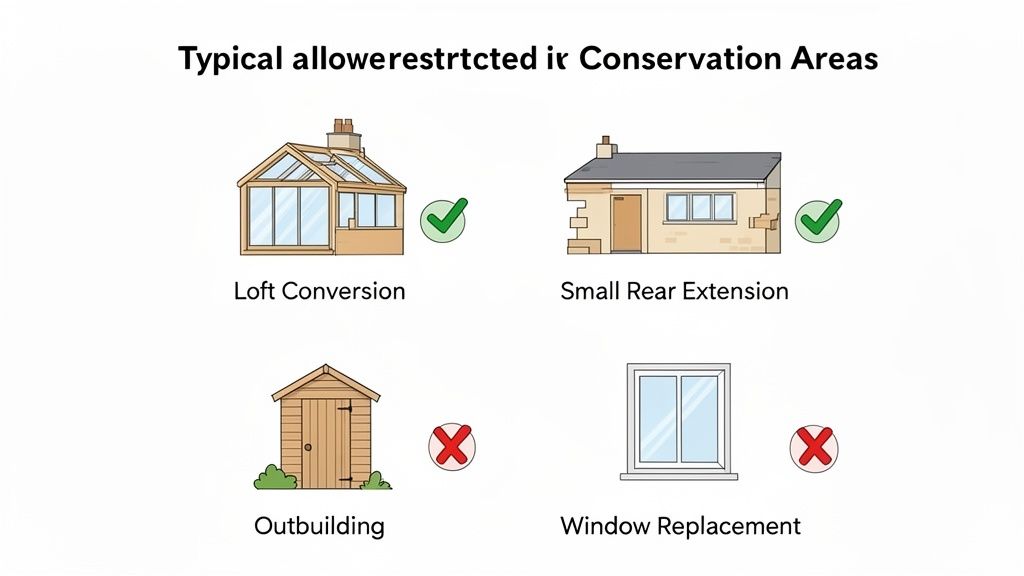
General permitted development rights can be generous. But the restrictions in a conservation area are about protecting the neighbourhood's character. Any change visible from the street will face the most checks. Here is how that affects popular projects.
Rear Extensions
Outside a conservation area, you can often build a single storey rear extension up to eight metres deep for a detached house. Inside one, this right is cut down a lot.
General Rule: A single storey rear extension can project up to six metres for a semi detached or terraced house. It can be eight metres for a detached house.
Conservation Area Rule: This is cut to just three metres for semi detached or terraced houses. It is four metres for detached properties. Anything larger needs full planning permission.
The council's main concern is how the extension affects the original building and its neighbours. Using materials that clash with the existing house is a common reason for refusal.
Loft Conversions
A loft conversion is often still possible under permitted development. But the limits are much tighter. The key is making sure the changes are not obvious from the front of your property.
General Rule: You can add up to 50 cubic metres of extra roof space.
Conservation Area Rule: This is reduced to 40 cubic metres. You cannot build any dormer windows on a roof slope that faces a road. Side facing dormers are also not allowed.
Any proposal that greatly alters the roofline visible from the road will almost certainly need a full planning application. The council's goal is to keep the original street scene as it is.
Outbuildings and Garden Rooms
Adding an outbuilding like a garden office is often still allowed. The key factor that changes inside a conservation area is the location.
General Rule: You can place an outbuilding anywhere in your rear or side garden if it meets height and size limits.
Conservation Area Rule: You cannot build any outbuilding or shed between the side of your house and the boundary wall. This is to stop visible gaps between properties from being filled.
Windows and Doors
Replacing windows is one of the most common projects that causes problems. Original windows are often seen as a key part of a building's historic character.
You might think swapping old windows for new uPVC ones is a simple improvement. But it is often forbidden under permitted development rights in a conservation area. Many councils use Article 4 Directions to control window and door replacements. This forces you to apply for planning permission to ensure new designs are suitable. Proposing plastic frames in a historic brick property is a classic mistake.
How to Find the Specific Rules for Your Home
General advice will only get you so far. The rules that truly matter are the local ones for your address. Finding them is the only way to avoid a costly planning mistake. It gives you the evidence you need to move forward.
You can find this information yourself. The key is knowing where to look and what to look for. Your first stop should be your local council’s website. It is the official source.
Start with Your Local Council Website
Every local council sets its own planning policies. Its website has the official documents that define the rules for your home. You are looking for two specific things.
Conservation Area Maps: Go to the planning section of your council's website. Search for "conservation areas". You should find a map that shows the boundaries. This confirms if your property is officially inside the zone. If you’re in south-west London, see planning permission in Richmond upon Thames.
Article 4 Directions: Next, search for "Article 4 Directions". The council must publish a list and maps of any active directions. Check these carefully. See if your property is included and which specific permitted development rights have been removed.
This first check is vital. It gives you the basic restrictions you are working with before you think about designs.
Finding an Article 4 Direction that removes your right to replace windows is not a dead end. It is valuable information. It saves you from ordering the wrong materials and facing enforcement action.
Find Real Examples on Planning Portals
Knowing the official rules is one thing. Seeing how the council actually uses them is another. You can get this insight by looking at the planning history of properties on your street. Use your council’s online planning portal or the national Planning Portal.
This is what the national Planning Portal's homepage looks like.
From here, you can go to local planning portals. Search for past applications by postcode or street name. Look for applications similar to your project on neighbouring properties. This research shows you real examples of what has been approved. More importantly, it shows what has been refused and why. A pattern of refusals for extensions like yours is a major warning sign.
This research can feel complicated if you are not used to planning documents. If you just want clarity quickly, a SurePlan report simplifies this process for you. For £49, it does the research for you. It analyses local decisions and highlights specific risks for your property. Learn how our planning permission checker can give you a clear score in under 24 hours.
Your Next Steps With the Right Information
Knowing the specific rules for your property is the most important step. You can now move forward with a clear plan based on evidence. You are no longer guessing and hoping. This knowledge protects you from expensive mistakes and wasted time.
So, what is next? That depends on what your research has found.
If it looks like your project is within your permitted development rights, your path is much simpler. But before you hire builders, it is smart to get official confirmation.
Get Certainty With a Lawful Development Certificate
You can apply to your council for a Lawful Development Certificate (LDC). This is not planning permission. It is a legal document from the council confirming your project is lawful. It proves your project does not need a full planning application.
An LDC is your project’s official seal of approval. It provides peace of mind. It also proves to future buyers that the work was done correctly. This is vital when you sell your home. It protects you from future disputes or changes in policy.
This decision tree gives you a visual guide for finding the rules for your home.
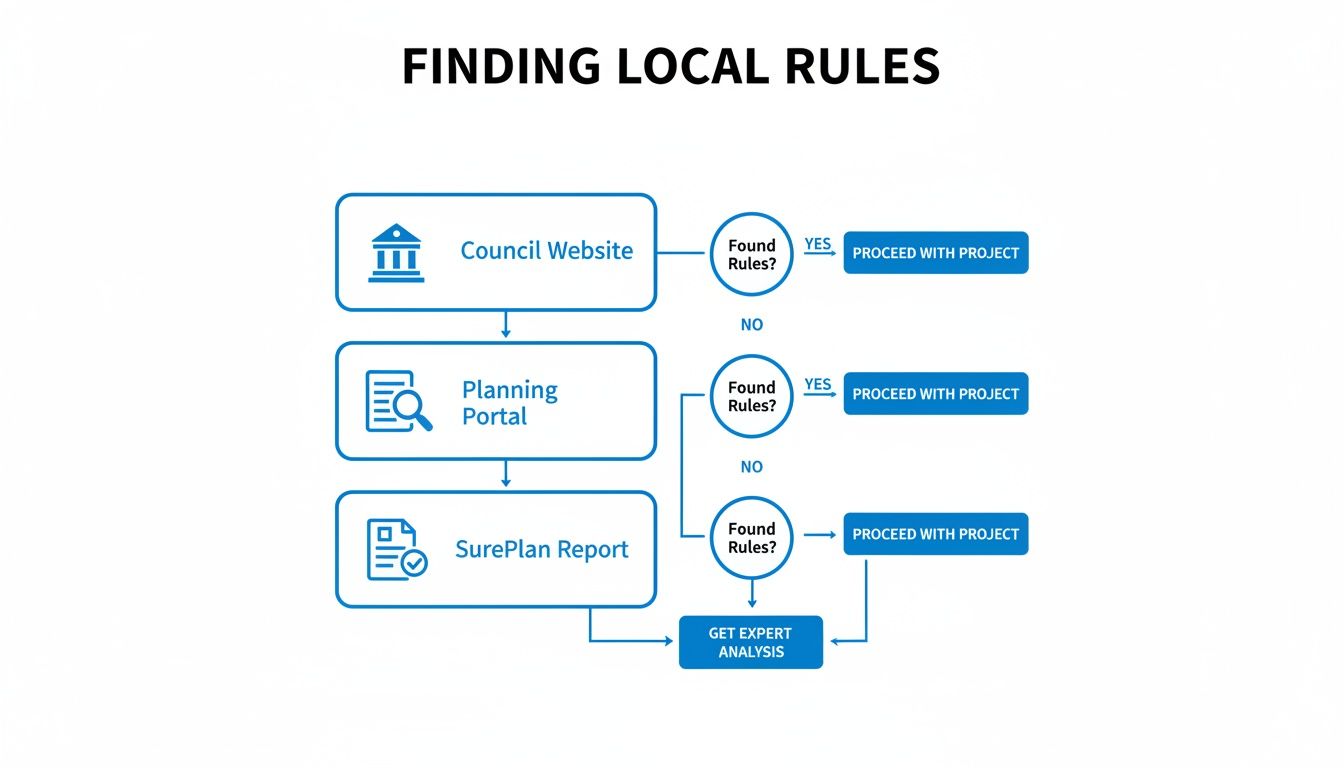
Starting with official sources like the council website and the Planning Portal gives you the raw data. A specialist report can interpret it for you.
Preparing for a Full Planning Application
If it is clear you need full planning permission, your research is still very useful. You now understand the council’s specific concerns about the conservation area. This insight allows you to prepare a much stronger application from the start.
When you speak to a designer, you can give them a clear brief. Explain the specific restrictions you have found, like rules on materials or design limits. This helps them create a proposal that respects the local character. This greatly improves your chances of getting approval.
Frequently Asked Questions
It is normal to have questions when dealing with a property in a conservation area. Here are straight answers to the things homeowners ask us most.
Can You Use Permitted Development in a Conservation Area?
Yes, but with some big conditions. Many of your standard permitted development rights are reduced. You can often still do things like small rear extensions and some loft conversions.
However, the rights for side extensions, roof alterations visible from the street, and adding external cladding are almost always removed. The rules are there to protect the look of the street. Anything that changes the front or side of your house gets more checks.
Do I Need Planning Permission to Paint My House?
Usually, you do not need planning permission just to repaint your house if you use a similar colour. It is considered general maintenance.
But if your local council has an Article 4 Direction in place, this right might be removed. Painting over unpainted brickwork is a different matter. That almost always needs full planning permission because it permanently changes the building's character.
How Do I Know if My Project Is Allowed?
The only way to be certain is to check your local council's website. You are looking for two key pieces of information. First, the conservation area map to confirm your property is inside it. Second, a list of any Article 4 Directions that apply.
These documents will tell you exactly which permitted development rights have been removed. They will also tell you what you need to apply for permission to do.
A conservation area designation does not mean no development is ever allowed. Research from Historic England found that new build sales made up 5.1% of all sales inside conservation areas. This shows that sensitive development still happens. You can learn more about development in conservation areas on Planning Geek.
Getting it wrong with your permitted development rights in a conservation area can lead to costly enforcement action. Starting with the right information is the best way to avoid a rejected application or being told to tear your work down.
Before you spend a fortune on architectural drawings or application fees, get the real data you need. SurePlan digs into your council's recent planning decisions. We give you a clear, honest picture of your project's chances. Get your personalised Planning Confidence Report in under 24 hours.