
Feb 28, 2026
A 'yes' for your project shouldn't feel like a lottery. You deserve to know if your plans are likely to be approved before you sink thousands into architect fees, and this guide will show you how to find out.
What Are My Real Chances of Getting Planning Permission?
Thinking about a home project often starts with one big question: "Will I actually get planning permission?"
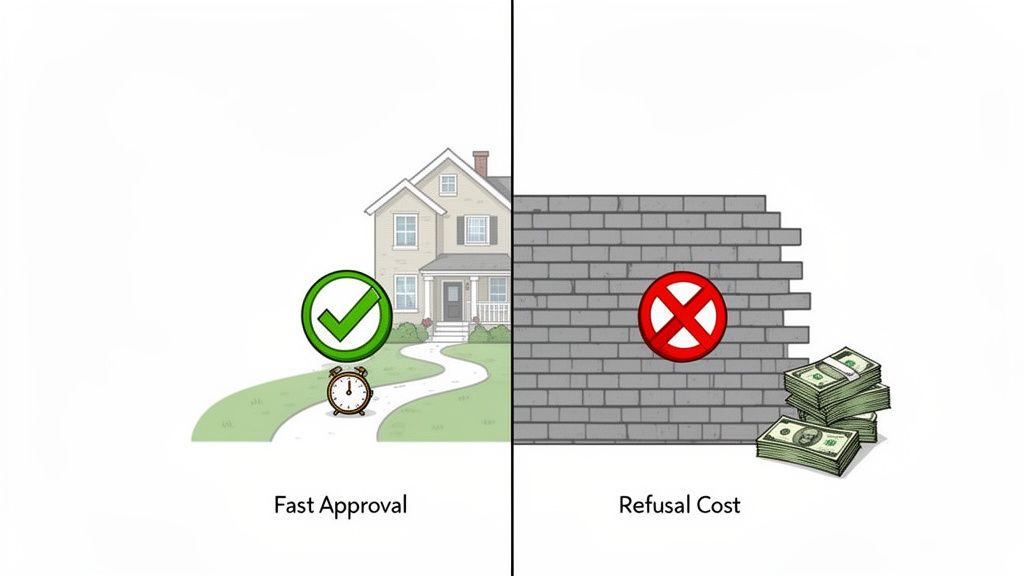
It’s a fair question. The fear of spending money on an architect only to face rejection can stop a great idea. A refusal is not just a disappointment. It means you lose your application fee, which can be over £258. It also means the thousands spent on drawings are wasted.
But the national picture is surprisingly positive. Across England, local authorities approved 87% of all applications in the year ending June 2025. For "householder" applications, the category covering extensions and loft conversions, approval rates are often even higher. This shows that well prepared projects have a very strong chance.
Planning Permission vs. Permitted Development: What's the Difference?
Your first step is to learn if you need a full planning application at all. Many common projects are covered by something called Permitted Development rights. This could save you time, money, and stress.
Permitted Development rights are a government grant of permission. They let you do certain building works without a full planning application. These rights have strict rules and limits.
Think of it as a pre approved list of works for your home. If your project fits these rules, you can skip the 8 week wait and uncertainty of an application. This is why a neighbour might build an extension without needing permission, while a similar project down the road does.
This table shows the key differences. It helps you see which path your project might follow.
Planning Permission vs Permitted Development At A Glance
Factor | Planning Permission | Permitted Development |
|---|---|---|
What is it? | A formal request to your local council for approval. | A national grant of permission for certain works without an application. |
When is it needed? | For larger projects that do not meet the strict rules. This includes two storey extensions, work on flats, or projects in protected areas. | For straightforward projects that fit the criteria. This includes smaller extensions, loft conversions, and garden buildings. |
Process | Submit detailed plans. Then there is an 8 week decision period with public consultation. | Check your project against the rules. Some larger extensions need you to notify neighbours first. |
Timeline | A decision usually takes 8 to 13 weeks. | Can be instant if no neighbour notice is needed. Up to 42 days if neighbour consultation is required. |
Cost | Application fee (from £258) plus professional design fees. | No application fee. A Lawful Development Certificate is optional but costs money. |
Certainty | Approval is not guaranteed. It depends on local rules and the planner's assessment. | If your project meets the criteria, it is lawful. A certificate provides legal proof of this. |
Understanding this difference is the most important first step. It determines your timeline, costs, and how closely your project will be examined.
Before you spend money on drawings, you can use an online planning refusal risk checker. It gives you a quick idea of potential issues in your specific area. This initial check helps you know what to investigate next.
Why Your Postcode Matters More Than Your Plans
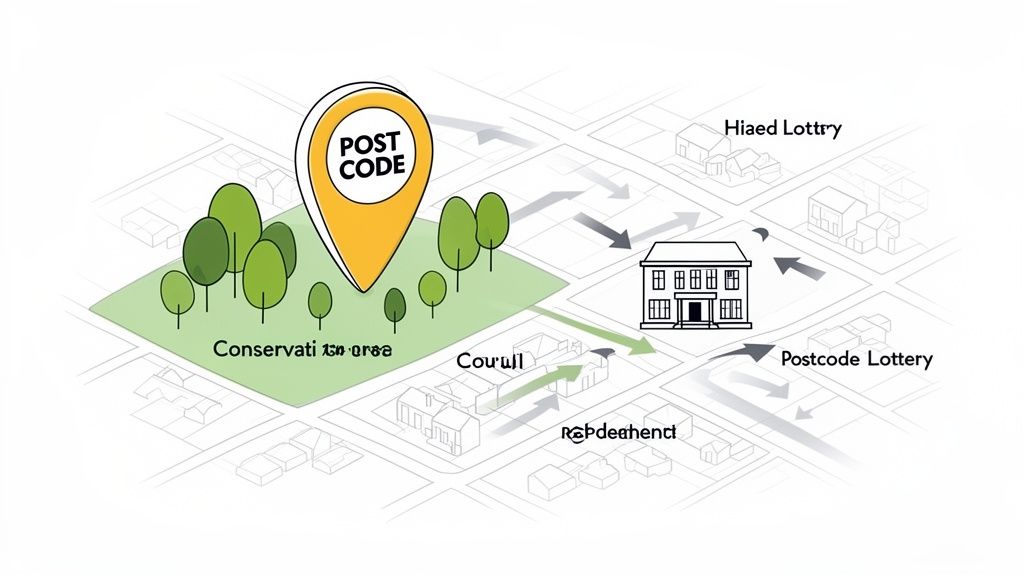
Here is a hard truth about UK planning. Where you live often matters more than what you want to build. An extension that is easily approved in one area could be rejected just a few streets away. Understanding these local rules is the best way to avoid a costly and frustrating refusal.
This is what people mean by the ‘postcode lottery’. Every local council has its own planning policies and priorities. Your chances of getting permission depend entirely on how they apply the rules.
Do not be fooled by national approval statistics. While the overall rate for England looks high at 87%, this hides huge local differences. For example, some councils like Knowsley approve 97% of applications. Others like Woking approve just 29%. You can find more detail on these local variations at Landlister.co.uk.
The Importance of Local Precedent
What your council has approved or refused for nearby properties is the strongest clue you will get. A neighbour’s successful application is a good sign. But it is not a guarantee of your own success.
Planning policies change. An approval from five years ago might be irrelevant today. This is because councils update their Local Plan, which is their main rulebook.
This is why digging into recent decisions for similar projects is so important. It gives you real world insight into what planners in your area accept right now. We explain how you can investigate these past decisions in our dedicated article.
Spotting Local Red Flags
Your property might also have special rules that add extra hurdles. These can often remove your normal Permitted Development rights. Finding these issues early can save you from designing a project that is impossible to get approved.
Key red flags to watch for include:
Conservation Areas: These areas have much stricter controls to protect their special character. Even small changes might need permission.
Article 4 Directions: A council can use this to remove specific Permitted Development rights in an area. This is common where many small changes threaten a neighbourhood's character.
Listed Buildings: If your home is listed, you will need Listed Building Consent for almost any change, inside or out. This is in addition to any planning permission.
These are not minor details. They are fundamental rules that dictate what is possible for your property. Knowing these risks upfront allows you to design a project that works with your council’s policies, not against them. This improves your odds and helps you avoid wasting thousands on an application that was never going to be approved.
What Planners Really Look For
To understand the planning process, you need to know one thing. Council officers do not make decisions based on personal taste. Their decisions are guided by a rulebook called the Local Plan. This document sets out what can be built where. Knowing these rules before you start designing is how you avoid expensive mistakes.
If you are asking "can I get planning permission?", you need to start thinking like a planner. For almost every home project, their decision will come down to three key questions. Answering them helps you see your project from their professional point of view.
Will It Harm the Look of the Street?
This is all about visual impact. Planners must protect the character of a neighbourhood. They will look at your plans and ask if your extension fits with the style, materials, and scale of the houses around you.
A modern glass box on a row of Victorian terraces is a classic example of what is likely to be refused. In the same way, using bright yellow bricks when all your neighbours have red ones could be seen as harmful to the street. The key is to design something that looks like it belongs.
Does It Intrude on a Neighbour’s Privacy?
The next big hurdle is overlooking. No one wants a new window staring directly into their bedroom or garden. Planners take this very seriously to protect people’s right to a private home.
For instance, a first floor side extension with a large window facing a neighbour’s property will raise a red flag. The solution is often simple.
Use obscure glazing: Frosted glass is a common condition of approval for windows that might cause overlooking.
Position windows carefully: A high level window that you cannot see out of is much more likely to be approved.
Consider rooflights: Velux style windows in a roof often avoid direct overlooking issues.
These small design tweaks can be the difference between a swift approval and a frustrating refusal. A minor change that costs very little can save you a world of hassle.
A planner's job is to balance your desire to improve your home with your neighbours' "amenity". Amenity is their right to enjoy their own property without unreasonable disturbance.
Will It Block a Neighbour’s Light?
Finally, councils assess the loss of light. Your project cannot cast a neighbour’s home or garden into shadow to an unreasonable degree. This is a very common reason for refusal, especially where houses are close together.
Planners often use a technical guide called the "45 degree rule" to check this. Imagine a line drawn at a 45 degree angle from the centre of your neighbour’s nearest window. If your new extension crosses that line, it is likely to be considered too overbearing. Even a single storey extension that is too long can fail this test, leading to a refused application that costs you time and money.
How to Check Your Chances Before Spending Thousands
Before you pay an architect over £1,000 for drawings, you need to know if your project is realistic. A failed application is not just disappointing. It means lost time and a non refundable fee that can be over £258.
The good news is you can do your own detective work. You can find the risks before you spend a penny. This involves digging for evidence in your local council's own records.
Every council has an online planning portal. This is where they keep records of all planning applications. It is a goldmine of useful information.
Become a Local Planning Detective
Start by searching for applications on your street and in the immediate area. You can usually search by postcode or use a map. Your goal is to find projects similar to yours, like single storey extensions or loft conversions.
Once you find a few good examples, look for these key documents:
The Decision Notice: This is the most important one. It states clearly if the application was “Approved” or “Refused”.
The Officer's Report: This is where the magic happens. It explains why the decision was made. If a project was refused, this report lists the specific policies it broke. This is crucial for avoiding the same mistakes.
The Plans: Look at the approved drawings. What did they get right? If you find a refusal, compare the plans to the officer’s report to see the exact design feature that caused the problem.
This process gives you a powerful, evidence based view of what your council is likely to accept. It moves you from nervously asking "can I get planning permission?" to confidently understanding how to get it.
The flowchart below shows the key things a council officer will look at.
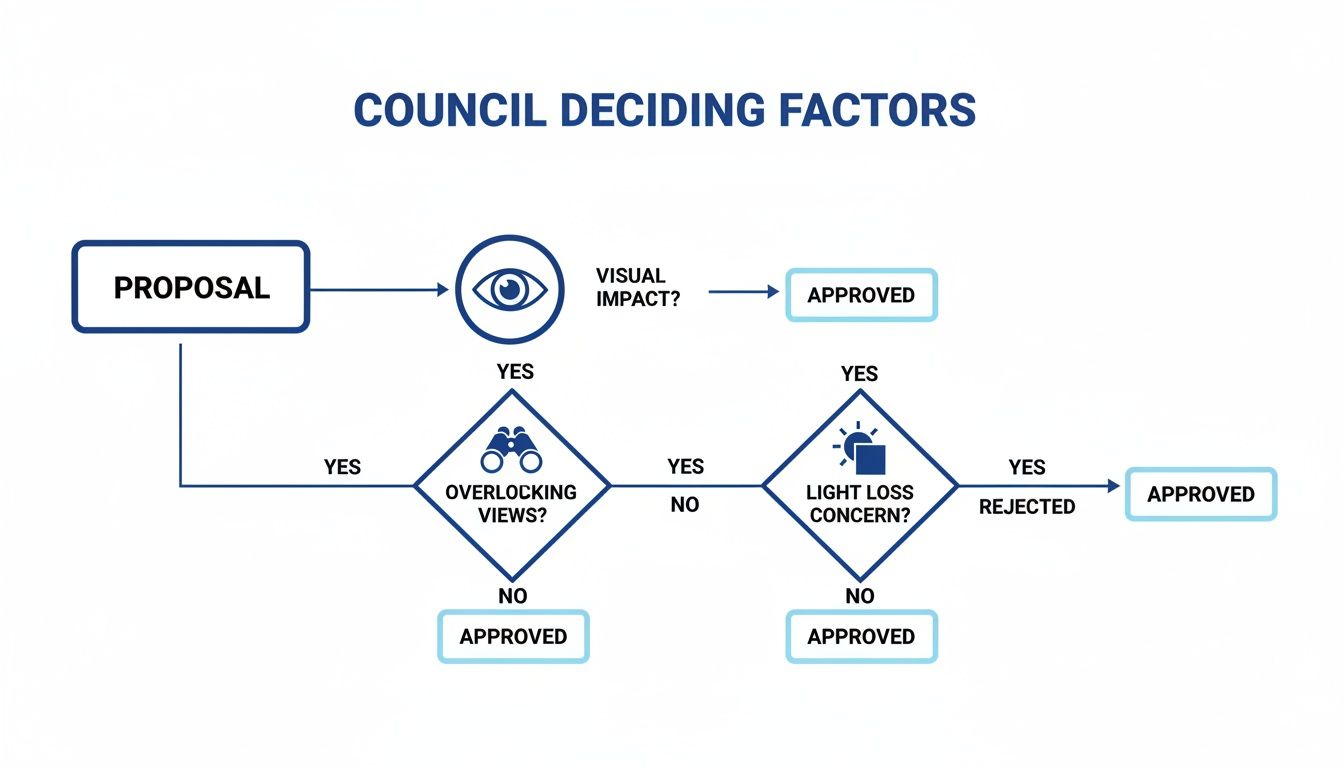
As you can see, your proposal is judged on a few core principles, not someone's personal taste.
A Quicker, Clearer Way to Get Evidence
Doing this research yourself is powerful. But it is also time consuming. Planning portals can be difficult to use. Officer reports are often filled with jargon that is hard to understand. It can take hours to piece together a clear picture.
This is where a targeted check can save you a huge amount of effort. Instead of you wading through council documents, a specialised service can do the heavy lifting for you.
For example, a Planning Confidence Report from SurePlan does this exact work for you. For £49, it analyses recent decisions for similar projects in your area. It flags common local refusal reasons in plain English. It then gives you an evidence based score on your chances.
This gives you clarity in just 24 hours. You get a simple PDF report that tells you if your idea is a safe bet, a risk, or a likely non starter. This is all based on real local data. It lets you either move forward with confidence or change your design early, avoiding a much more expensive mistake later.
Improving Your Odds or Finding a Better Path
So, what if your initial checks suggest your project is a long shot? A high risk score or seeing similar local projects get refused does not have to be the end of your plans. Think of it as a signal to be smarter with your next steps. This way you will not waste money on an application that is likely to fail.
The goal here is to move forward with evidence, not just hope. This is your chance to improve your chances or find a less risky way to get what you want.
Getting Feedback Before You Apply
Instead of submitting a full application and crossing your fingers, you can use a process called pre-application advice. This is a formal service where you pay the council for a planner’s written opinion on your proposal. You do this before you commit to the full cost of an application.
It is not a guarantee of approval. But it offers valuable insight directly from the source. The planner might flag a policy issue you had not considered. Or they might suggest a design change that would make your project acceptable.
Costs vary a lot between councils. For a typical home project, you can expect to pay anywhere from £150 to over £500. You will usually get a written response in a few weeks. That initial cost can easily save you thousands by helping you avoid a refusal.
Adjusting Your Plans Based on Evidence
Sometimes the answer is not to push ahead with your original idea, but to change it. The evidence you have gathered from research should directly shape your design. If two storey extensions are consistently refused in your area, applying for one is just a recipe for wasted time and money.
Instead, ask yourself a few key questions:
Can it be smaller? A slightly shorter rear extension might fall under your Permitted Development rights. This would let you bypass the main planning system altogether.
Can the design change? If planners dislike flat roofs in your area, could a pitched roof work instead? If a new window creates an overlooking issue, could you move it or use a rooflight?
Is there another way? Could a different type of conversion achieve your goal with far less risk?
Making these small, strategic adjustments based on local evidence is the smartest way to get what you want. A big part of knowing how to prepare a strong planning application is understanding when to adapt your plans for a smoother journey.
Your Planning Permission Questions, Answered
When you first start dreaming about improving your home, the questions come quickly. The planning system can feel complex. But getting clear answers to common queries gives you the confidence to get started. Let’s tackle some of the things homeowners like you ask most often.
How Long Does Planning Permission Take to Get?
Knowing the timeline is crucial. It helps you schedule everything else, from builders to budgets. For most straightforward householder applications, your local council should make a decision within 8 weeks. This is a target they try hard to meet.
However, if your project is more complex or is in a sensitive area, the process can take longer. It might stretch to 13 weeks or more if there are problems that need more information.
It is a classic mistake to think the 8 week clock starts when you submit your application. The timeline only begins once the council has 'validated' it. This means they have confirmed all the right documents and fees are present. This step alone can take a week or two.
What Happens if I Build Without Planning Permission?
Building without the right permissions is a serious mistake. It is known as a planning breach. It can create problems far more expensive and stressful than getting permission in the first place.
If the council finds out, they can issue an enforcement notice. This is a legal order demanding you either change the building to make it acceptable or demolish it entirely at your own expense. It also creates a massive headache when you try to sell, as buyers will not touch a home with an unresolved planning issue.
Can I Apply for Permission on a House I Don't Own?
Yes, absolutely. You do not need to own a property to apply for planning permission on it. This is a common tactic for potential buyers. They want to know if their extension ideas are possible before they commit to buying the house.
There is just one crucial rule you must follow. You are legally required to notify the current owner that you are submitting an application. This is usually done by serving a formal notice. It simply ensures the owner is aware of the application.
Do I Need an Architect to Apply for Planning Permission?
You are not legally required to use an architect, but it is a very good idea. A planning application depends on a set of detailed, accurate drawings. They have to meet specific technical standards. A professional has the software and expertise to produce these correctly.
More importantly, a good designer understands local and national planning rules. They can shape a project that is more likely to be approved. They help you sidestep potential problems like overlooking before they become reasons for refusal. Investing in professional advice hugely increases your chances of success.
Before you commit thousands to professional fees, get the evidence you need to move forward with confidence. SurePlan provides a clear, evidence-based Planning Confidence Report for just £49. We analyse real local data to show you the risks and opportunities for your project. We do not offer guarantees, we provide evidence. Find out your chances at https://www.getsureplan.co.uk.